
Long-nosed Dasyure
Murexia naso
Red List assessment
Least Concernon the IUCN Red List
- EXExtinct
- EWExtinct in the Wild
- CRCritically Endangered
- ENEndangered
- VUVulnerable
- NTNear Threatened
- LCLeast Concern
The Long-nosed Dasyure is recorded in 2 countries across Asia and Oceania. The IUCN Red List assesses the Long-nosed Dasyure as Least Concern. No reliable global population estimate exists.
- Family
- Dasyuridae
- Order
- Dasyuromorphia
- Genus
- Murexia
- Countries recorded
- 2
- Continents
- Asia and Oceania
- Red List category
- Least Concern
- Data updated
- August 9, 2026
What is the Long-nosed Dasyure?
Murexia naso is a small, shrew-like carnivorous marsupial belonging to the family Dasyuridae, endemic to the island of New Guinea. It is distinguished by its notably elongated, pointed snout, which gives the species both its common and scientific names. Like other members of its genus, it inhabits tropical rainforests and relies primarily on invertebrates for food. It is one of the lesser-studied small marsupials of the Australo-Papuan region, and much of its natural history remains incompletely documented.
Where does the Long-nosed Dasyure live?
Island of New Guinea: Papua New Guinea and the Indonesian provinces of Papua and West Papua
Endemic to the island of New Guinea. Its range spans both the eastern portion (Papua New Guinea, including mainland highlands and some lowland regions) and the western portion (Indonesian Papua, including the Bird's Head Peninsula area and the central ranges). It is not found outside of New Guinea.
Altitude and depth
Recorded from sea level up to approximately 2,000–2,500 m elevation, with the species seemingly more prevalent in mid-elevation montane forests between 500 and 1,800 m.
Seasonal movements
No significant seasonal migrations are known. Activity patterns and reproductive timing may show subtle variation correlated with seasonal rainfall cycles in New Guinea, but detailed longitudinal data are lacking.
Habitat of the Long-nosed Dasyure
Primary tropical rainforest, including lowland and lower montane forest. The species is generally associated with dense, humid forest with abundant leaf litter and fallen logs, which provide microhabitats rich in invertebrate prey. It may also occur in secondary forest near undisturbed primary forest edges.
Adaptations to its environment
The elongated, highly mobile snout is richly supplied with sensory whiskers (vibrissae) and olfactory receptors, enabling precise detection of invertebrates beneath leaf litter and soil. Its slender, agile body allows it to navigate through root tangles and dense undergrowth. As a marsupial, extremely short gestation minimizes maternal energetic investment before pouch transfer.
Conservation status and numbers
Least Concern (LC) on the IUCN Red List. The species is considered to have a sufficiently broad distribution across New Guinea and no evidence of rapid population decline to warrant a higher threat category. However, baseline population data remain sparse, and the classification partly reflects limited survey effort rather than confirmed stability.
Estimated population
No reliable global population estimate exists. The population is assumed to be relatively stable given LC status, but trend data are insufficient. Overall trend is considered stable to unknown.
What threatens the Long-nosed Dasyure?
Deforestation driven by agricultural expansion (oil palm, logging, subsistence farming) represents the primary long-term threat, particularly in lowland areas of both Papua New Guinea and Indonesian Papua. Habitat fragmentation can isolate populations. Introduced predators such as dogs and cats, as well as rodents competing for food resources, may exert local pressure.
Diseases and parasites
No specific disease or parasite studies are known for this species. Like other small New Guinean marsupials, it is likely host to ectoparasites (mites, fleas, ticks) and intestinal helminths, but detailed parasitological surveys have not been published.
What is being done to protect it?
The species benefits indirectly from protected areas such as Lorentz National Park (UNESCO World Heritage Site) in Indonesian Papua and various wildlife management areas in Papua New Guinea. No species-specific conservation program is known to be in place.
Recommended actions
Targeted field surveys to clarify population size and precise distribution; long-term monitoring programs in representative forest types; expansion and effective management of protected areas in New Guinea lowlands and mid-montane zones; research into the impacts of introduced predators and logging on local dasyurid populations.
What the Long-nosed Dasyure looks like
The dorsal fur is typically dark brown to grayish-brown, often with a slightly paler underside ranging from cream to pale grey. The coat is relatively short and dense. The muzzle is strikingly elongated and tapered, the ears are moderate-sized and rounded, and the eyes are small but relatively prominent. The tail is slender and lightly furred.
Size
Head-body length approximately 10–17 cm; tail length approximately 9–15 cm. Total length roughly 20–30 cm. A small, mouse-to-small-rat-sized marsupial.
Weight
Estimated body mass approximately 30–80 g; males may be slightly larger than females, though precise sex-specific weight data are scarce.
Distinctive features
The prominently elongated, shrew-like snout is the most visually diagnostic feature, clearly distinguishing M. naso from the co-occurring Murexia longicaudata, which has a shorter rostrum and longer tail relative to body length. The lack of bold dorsal striping separates it from Murexia rothschildi.
Differences between males and females
Sexual dimorphism is modest. Males tend to be slightly larger and heavier than females on average, as is typical in dasyurids. Females possess a pouch (marsupium) used during lactation; males lack a pouch.
Behaviour and diet of the Long-nosed Dasyure
Presumed to be largely solitary outside of the breeding season, consistent with most small dasyurids. Individuals likely maintain individual home ranges with some degree of overlap. No complex social hierarchy is known.
When it is active
Primarily nocturnal and possibly crepuscular. The species likely rests in concealed refuges such as hollow logs, root cavities, or dense ground vegetation during daylight hours and forages actively through the night.
Diet
Carnivorous and insectivorous. The diet consists mainly of invertebrates including insects (beetles, cockroaches, orthopterans), earthworms, spiders, and small myriapods. Small vertebrates such as lizards or frogs may occasionally be taken, consistent with the opportunistic foraging behavior typical of dasyurids.
How it feeds and hunts
Likely employs olfactory and tactile searching through leaf litter, soil, and bark using its sensitive elongated snout and facial vibrissae. Prey is detected by scent and movement, then captured with a rapid bite from the sharp, pointed teeth adapted for holding and crushing invertebrates.
Communication
Communication likely involves high-frequency vocalizations (squeaks, churrs) used in agonistic or mating contexts, as well as scent marking via urine, feces, and possibly secretions from facial or sternal glands. Tactile contact plays a role during mating and mother–young interactions.
Interactions with other species
Natural predators likely include owls (particularly Tyto and Ninox species), snakes (pythons and other arboreal or terrestrial species), and larger carnivorous mammals. The species likely competes with other small insectivorous mammals (other dasyurids, rodents) for invertebrate prey and shelter sites.
Role in its ecosystem
Functions as a secondary consumer in the forest floor food web, regulating populations of soil and litter invertebrates. As prey for owls and snakes, it contributes to energy flow up the trophic chain. Seed dispersal is not a primary ecological role given its predominantly invertivorous diet.
Reproduction and lifecycle
Breeding biology is poorly documented. Like other small dasyurids, gestation is extremely short (estimated around 12–16 days). Females likely give birth to small litters of 3–8 tiny young, which attach to teats and complete development over several weeks in or near the maternal pouch. There may be one to two reproductive events per year.
Raising the young
Maternal care predominates. After the young detach from the pouch teats, the mother continues to provision and shelter them in a nest until they are weaned and capable of independent foraging. Paternal care is not documented, as is typical for dasyurids.
Maturity and lifespan
Age of sexual maturity is estimated at approximately 6–10 months, consistent with similarly sized dasyurids. Lifespan in the wild is likely 2–4 years; captive longevity data are not available for this species.
Taxonomy and naming of the Long-nosed Dasyure
Classification
Mammalia > Dasyuromorphia > Dasyuridae > Murexia > Murexia naso
Scientific synonyms
Phascogale naso Peters & Doria, 1876; Antechinus naso; Phascolosorex naso. The species has been shuffled between several genera as the taxonomy of New Guinean dasyurids has been progressively revised.
What research says
Recent studies
The taxonomic history of the genus Murexia has been the subject of periodic revision; molecular studies of Australo-Papuan dasyurids have helped clarify intergeneric relationships. However, species-specific ecological or genetic studies focused solely on M. naso remain scarce as of the early 2020s.
Genome and DNA
Specific karyotype data for Murexia naso are not confirmed in the literature. Related dasyurids typically have diploid chromosome numbers in the range of 2n = 14–24. The species has been included in broader molecular phylogenetic studies of Dasyuridae confirming its placement within the New Guinean radiation of the family.
Compared with similar species
Murexia naso is most closely related to Murexia longicaudata (Long-tailed Dasyure or Short-furred Dasyure), which shares its New Guinea range but tends to have a proportionally longer tail and less elongated snout. Both differ from the African shrews they superficially resemble by being marsupials with a fundamentally different reproductive strategy and evolutionary origin.
The Long-nosed Dasyure and people
Despite resembling a shrew in body plan, the Long-nosed Dasyure is entirely unrelated to true shrews (Soricidae) — a striking example of convergent evolution across two independent mammalian lineages. Like many small dasyurids, it possesses remarkably sharp, needle-like teeth capable of piercing the exoskeleton of large beetles with ease. New Guinea hosts an extraordinary diversity of dasyurid species found nowhere else on Earth, making it the global hotspot for these small carnivorous marsupials.
Where and how to see it
Best observed at night in undisturbed montane rainforest in Papua New Guinea, particularly in areas such as the highlands around Mount Hagen or Tari, or within the boundaries of managed forest reserves. Using a headlamp while slowly walking forest trails and scanning the leaf litter layer offers the best chance of detecting eye-shine or movement. Camera traps set at ground level along forest edges near fallen logs also increase detection probability.
Risks to humans
No notable risk to humans. It may bite if handled, but is far too small to cause significant injury. It is not venomous and is not a known vector of diseases transmissible to humans.
Myths and legends
No specific myths or legends associated with Murexia naso have been documented in the ethnographic literature. Small forest marsupials in New Guinea are sometimes generically considered spirits or omens by local communities, but no specific cultural symbolism attributable to this species is recorded.
Countries where the Long-nosed Dasyure is recorded
The 2 countries named in the range description of its IUCN Red List assessment.
Questions about the Long-nosed Dasyure
Where does the Long-nosed Dasyure live?
The Long-nosed Dasyure is recorded in Indonesia and Papua New Guinea across Asia and Oceania. These countries come from the range description of its IUCN Red List assessment, and they are what place the species on the interactive map.
Is the Long-nosed Dasyure endangered?
The IUCN Red List assesses the Long-nosed Dasyure as Least Concern. The species is widespread and abundant enough not to qualify for any threatened category. It does not mean the species is safe forever, only that nothing in the current data raises an alarm.
How many are left in the wild?
No reliable global population estimate exists. This figure comes from the species assessment on the IUCN Red List; population estimates for wild mammals are ranges, not counts, and are revised at each assessment.
What habitat does the Long-nosed Dasyure live in?
Primary tropical rainforest, including lowland and lower montane forest.
What is the scientific name of the Long-nosed Dasyure?
The Long-nosed Dasyure is Murexia naso, in the family Dasyuridae, order Dasyuromorphia.
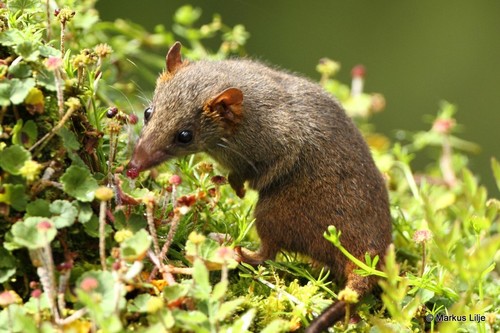
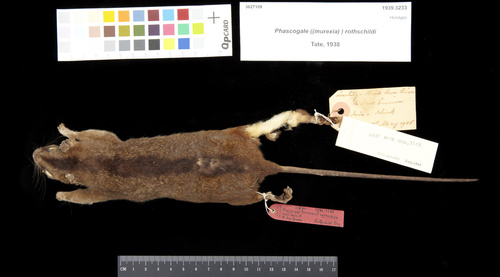
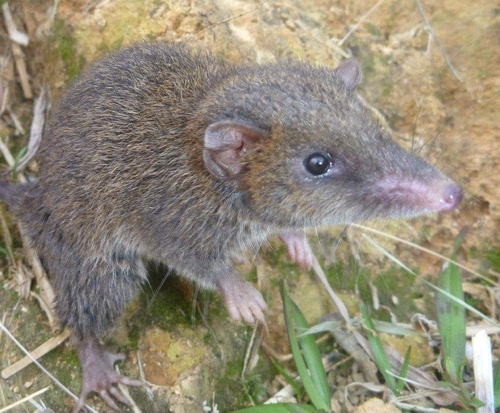
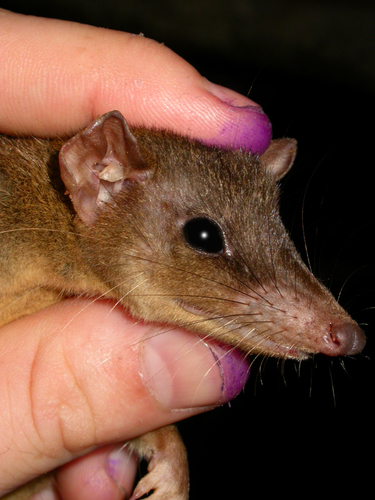
Other species in the genus Murexia
Other species in the family Dasyuridae

Species that share its range
Sources
Conservation status, range description and population estimate come from the IUCN Red List assessment for Murexia naso. Countries are derived from that range description, not from a mapped country list. Last refreshed on .
The distribution map is drawn from the IUCN Red List spatial data compiled in 2008. IUCN (International Union for Conservation of Nature)