
Jamaican Fig-eating Bat
Ariteus flavescens
Red List assessment
Least Concernon the IUCN Red List
- EXExtinct
- EWExtinct in the Wild
- CRCritically Endangered
- ENEndangered
- VUVulnerable
- NTNear Threatened
- LCLeast Concern
The Jamaican Fig-eating Bat is recorded in one country, Jamaica across North America. The IUCN Red List assesses the Jamaican Fig-eating Bat as Least Concern. No precise global population estimate exists.
- Family
- Phyllostomidae
- Order
- Chiroptera
- Genus
- Ariteus
- Countries recorded
- 1
- Continents
- North America
- Red List category
- Least Concern
- Data updated
- August 9, 2026
What is the Jamaican Fig-eating Bat?
The Jamaican Fig-eating Bat is a small phyllostomid (leaf-nosed) bat endemic to the island of Jamaica. It belongs to the subfamily Stenodermatinae, a group characterized by frugivorous diets and diverse cranial adaptations for processing hard fruits. Remarkably, Ariteus is the sole representative of its genus, making it a unique evolutionary lineage in the Caribbean. It plays a crucial ecological role as a seed disperser in Jamaican forest ecosystems, particularly for fig trees (Ficus spp.).
Where does the Jamaican Fig-eating Bat live?
Endemic to Jamaica, Caribbean
Strictly endemic to Jamaica, Greater Antilles, Caribbean. Found across much of the island from the lowland coastal plains to the higher elevations of the Blue Mountains and John Crow Mountains. Its entire global range is confined within the island of Jamaica.
Altitude and depth
Recorded from near sea level up to approximately 1,500 m elevation, with highest densities thought to occur in mid-elevation moist forests between 200 and 900 m.
Seasonal movements
No long-distance migrations are known given the island-endemic nature of the species. Reproductive activity may follow a bimodal seasonal pattern tied to fruit availability peaks, common among tropical phyllostomid bats. Activity patterns likely shift slightly with seasonal changes in forest fruiting phenology.
Habitat of the Jamaican Fig-eating Bat
Primarily inhabits tropical and subtropical moist broadleaf forests across Jamaica, including both lowland coastal forests and montane rainforests. It is also found in forest edges, secondary growth, and areas with abundant fruiting fig trees. The species shows some tolerance for disturbed habitats where fruiting trees persist.
Adaptations to its environment
Possesses a well-developed noseleaf typical of phyllostomid bats, used to focus echolocation pulses for navigation in dense forest. Its robust skull and teeth are adapted for crushing the hard skin and seeds of figs. Short, broad wings (low aspect ratio) facilitate maneuvering flight in cluttered forest interiors. Loss of a functional tail membrane (uropatagium) is characteristic of stenodermatine fruit bats.
Conservation status and numbers
Least Concern (LC) on the IUCN Red List. Although its restricted island range makes it inherently vulnerable, the species is considered relatively widespread and locally common across suitable habitat in Jamaica. However, ongoing habitat loss and degradation remain concerns for its long-term stability.
Estimated population
No precise global population estimate exists. The species is considered locally common in intact forest habitats but population size is unknown. Population trend is suspected to be slowly declining in parallel with ongoing habitat loss across Jamaica.
What threatens the Jamaican Fig-eating Bat?
Deforestation and agricultural conversion remain the primary threats, as Jamaica has experienced significant loss of native forest cover. Urbanization, particularly around Kingston and other growing cities, reduces available forested habitat. Hurricanes periodically devastate forest cover across the island, temporarily reducing food availability. Introduced predators such as mongooses (Herpestes auropunctatus) and rats may pose localized threats.
Diseases and parasites
Specific diseases and parasites documented for Ariteus flavescens are poorly studied. Like other phyllostomid bats, it may harbor ectoparasites (mites, flies of family Streblidae) and internal parasites. Bats generally are known reservoirs of various viruses, but no specific pathogen data are published for this species.
What is being done to protect it?
Jamaica's Blue and John Crow Mountains National Park (a UNESCO World Heritage Site) protects significant montane forest habitat potentially used by this species. The National Environment and Planning Agency (NEPA) of Jamaica oversees wildlife protection. The species benefits from general bat conservation awareness initiatives in the Caribbean.
Recommended actions
Expansion and strengthening of Jamaica's protected area network to safeguard lowland forests. Dedicated population surveys to establish baseline abundance and distribution data. Restoration of degraded forest corridors to connect fragmented habitats. Inclusion of the species in national biodiversity monitoring programs.
What the Jamaican Fig-eating Bat looks like
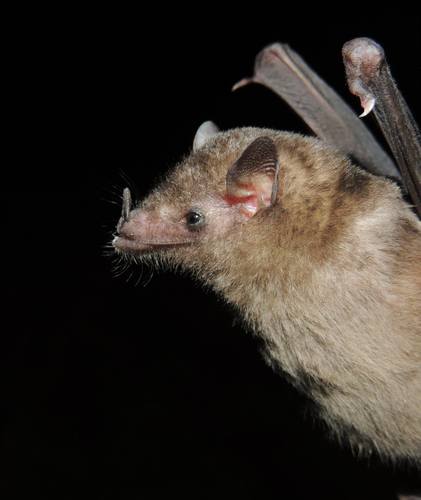
Fur on the dorsal surface is yellowish-brown to tawny-buff (reflected in the epithet 'flavescens,' meaning yellowish), while the ventral fur is paler, often creamy or grayish-white. The face bears a well-developed triangular noseleaf. Ears are medium-sized, rounded, and brownish. The wing membranes are thin and dark. The uropatagium is greatly reduced, typical of stenodermatine bats.
Size
Small bat; total body length approximately 55–68 mm; forearm length approximately 38–44 mm; wingspan estimated at 28–34 cm. No external tail visible.
Weight
Approximately 10–18 g; precise sex-specific weight data are limited.
Distinctive features
Distinguished from other Jamaican bats by its combination of yellowish-buff dorsal coloration, highly reduced tail membrane, prominent noseleaf, and robust frugivorous dentition. Its monotypic genus status and restricted Jamaican endemism make it taxonomically unique in the region.
Differences between males and females
Sexual dimorphism is not strongly pronounced, as is typical in stenodermatine fruit bats. Females may be marginally larger than males as is common in phyllostomids, but detailed morphometric comparisons for this species are limited.
Behaviour and diet of the Jamaican Fig-eating Bat
Likely roosts in small to medium-sized groups, as is typical for frugivorous phyllostomid bats. Specific details on colony size and social structure in Ariteus flavescens are poorly documented. Roost sites include tree hollows, rock crevices, and dense foliage.
When it is active
Strictly nocturnal. Foraging activity begins shortly after sunset and continues through the night, with peaks of activity corresponding to fruiting tree availability. Rests in roosts during daylight hours.
Diet
Primarily frugivorous, with a strong preference for figs (Ficus spp.) — the basis for its common name. Also consumes other soft tropical fruits and may occasionally take nectar or pollen as supplementary food sources. Like other stenodermatine bats, it likely carries fruits to a feeding perch away from the source tree.
How it feeds and hunts
Locates ripe fruit using a combination of olfaction, vision (adapted to low-light conditions), and echolocation. Uses low-intensity, high-frequency echolocation calls suited for short-range detection in dense forest environments. Plucks individual fruits and transports them to a preferred feeding roost for consumption.
Communication
Uses echolocation for spatial orientation and obstacle avoidance, emitting short constant-frequency or frequency-modulated ultrasonic pulses through the noseleaf. Social vocalizations are used within roosts for individual recognition and mother-pup bonding. Olfactory cues likely play a role in locating ripe fruit and in social interactions.
Interactions with other species
Predators include nocturnal raptors such as the Jamaican owl (Pseudoscops grammicus) and possibly arboreal snakes. Competes for fruiting resources with other frugivorous bats and birds. Acts as a mutualist with fig trees and other fruit-producing plants through seed dispersal, potentially dispersing seeds over considerable distances.
Role in its ecosystem
Plays a significant ecological role as a seed disperser for Ficus and other tropical fruit trees in Jamaican forests, contributing to forest regeneration and plant community structure. As an endemic frugivore, it represents a unique component of Jamaica's forest ecosystem dynamics.
Reproduction and lifecycle
Likely follows a bimodal polyestrous reproductive pattern common in tropical phyllostomids, with two birth pulses per year timed to periods of high fruit abundance. Gestation is estimated at approximately 3–4 months. Litter size is typically one pup per birth, as in most phyllostomid bats.
Raising the young
Maternal care is the primary mode of parental investment, as in virtually all phyllostomid bats. The mother nurses the single pup in the roost; the pup is weaned and becomes volant after several weeks. Pups are carried by the mother during early life before being left at the roost during foraging.
Maturity and lifespan
Age at sexual maturity is likely around 8–12 months, as is typical for small phyllostomid bats. Maximum lifespan in the wild is unknown but likely 5–10 years; no captive longevity data are available for this species.
Taxonomy and naming of the Jamaican Fig-eating Bat
Classification
Mammalia > Chiroptera > Phyllostomidae > Ariteus > Ariteus flavescens
Subspecies
No recognized subspecies. Ariteus is a monotypic genus containing only this single species.
Scientific synonyms
Phyllostoma flavescens Gray, 1831; historically placed in genera such as Artibeus and Stenoderma before being assigned to the monotypic genus Ariteus.
What research says
Recent studies
Molecular phylogenetic studies of Caribbean phyllostomid bats have helped clarify the placement of Ariteus within Stenodermatinae and its relationships to other island-endemic genera. Broader bat surveys in Jamaica have occasionally documented occurrence records but targeted ecological studies on Ariteus flavescens remain scarce.
Genome and DNA
No published chromosome count or genome assembly is currently available specifically for Ariteus flavescens. Phylogenomic studies of Phyllostomidae place Ariteus within the subfamily Stenodermatinae, closely related to genera such as Ardops and Phyllops.
Compared with similar species
Closely related to other Caribbean stenodermatine genera including Ardops (tree bats of the Lesser Antilles) and Phyllops (Cuban fig-eating bat), all sharing frugivorous diets and reduced uropatagium. Differs from Artibeus species (which are larger and more widespread) in its smaller size, distinct coloration, and restricted insular range. Among Caribbean endemic fruit bats, it represents one of the most range-restricted species.
The Jamaican Fig-eating Bat and people
Ariteus flavescens is one of only two bat species endemic to Jamaica (alongside Jamaican flower bat Phyllonycteris aphylla), making it a jewel of Caribbean biodiversity. The genus name 'Ariteus' is thought to derive from a Latin or Greek root evoking virtue or excellence, while 'flavescens' simply means 'becoming yellow,' referencing its distinctive warm-toned fur. As a fig specialist, this bat may visit dozens of fig trees in a single night, inadvertently planting seeds far from the parent tree and helping regenerate Jamaica's forests.
Where and how to see it
Best observed in intact or semi-intact tropical forest areas of Jamaica, particularly in the Blue and John Crow Mountains National Park. Nighttime surveys near fruiting fig trees (Ficus spp.) offer the best chance of encounters. Using a bat detector tuned to ultrasonic frequencies can help confirm presence. The species is most active in the first few hours after sunset.
Risks to humans
No notable risk to humans. Like all wild bats, direct handling should be avoided due to a general (though low) risk of rabies and other bat-associated pathogens. The species is not aggressive and poses no direct danger under normal observation conditions.
Human uses
No known commercial, agricultural, or traditional medicinal uses. The species has scientific value as a unique endemic lineage and ecological value as a seed disperser supporting forest regeneration across Jamaica.
Myths and legends
No specific myths or legends are known to be associated with Ariteus flavescens in Jamaican culture. Bats in general have mixed cultural associations in the Caribbean, sometimes linked to folklore about spirits or seen as omens, but no documented tradition specifically references this species.
Countries where the Jamaican Fig-eating Bat is recorded
The 1 countries named in the range description of its IUCN Red List assessment.
Questions about the Jamaican Fig-eating Bat
Where does the Jamaican Fig-eating Bat live?
The Jamaican Fig-eating Bat is recorded in Jamaica across North America. These countries come from the range description of its IUCN Red List assessment, and they are what place the species on the interactive map.
Is the Jamaican Fig-eating Bat endangered?
The IUCN Red List assesses the Jamaican Fig-eating Bat as Least Concern. The species is widespread and abundant enough not to qualify for any threatened category. It does not mean the species is safe forever, only that nothing in the current data raises an alarm.
How many are left in the wild?
No precise global population estimate exists. This figure comes from the species assessment on the IUCN Red List; population estimates for wild mammals are ranges, not counts, and are revised at each assessment.
What habitat does the Jamaican Fig-eating Bat live in?
Primarily inhabits tropical and subtropical moist broadleaf forests across Jamaica, including both lowland coastal forests and montane rainforests.
What is the scientific name of the Jamaican Fig-eating Bat?
The Jamaican Fig-eating Bat is Ariteus flavescens, in the family Phyllostomidae, order Chiroptera.
Other species in the family Phyllostomidae
Species that share its range
Sources
Conservation status, range description and population estimate come from the IUCN Red List assessment for Ariteus flavescens. Countries are derived from that range description, not from a mapped country list. Last refreshed on .
The distribution map is drawn from the IUCN Red List spatial data compiled in 2008. IUCN (International Union for Conservation of Nature)