
Indochinese Chiromyscus
Chiromyscus chiropus
Red List assessment
Least Concernon the IUCN Red List
- EXExtinct
- EWExtinct in the Wild
- CRCritically Endangered
- ENEndangered
- VUVulnerable
- NTNear Threatened
- LCLeast Concern
The Indochinese Chiromyscus is recorded in 3 countries across Asia. The IUCN Red List assesses the Indochinese Chiromyscus as Least Concern. No precise population estimates exist; the species is considered to have a stable but poorly monitored population
- Family
- Muridae
- Order
- Rodentia
- Genus
- Chiromyscus
- Countries recorded
- 3
- Continents
- Asia
- Red List category
- Least Concern
- Data updated
- August 9, 2026
What is the Indochinese Chiromyscus?
Chiromyscus chiropus, also known as Fea's Tree Rat, is a small arboreal rodent native to the forests of Indochina. It is notable for its long tail and specialized limb structure adapted for climbing. This species is relatively understudied compared to other murid rodents, with much of its ecology inferred from limited field observations. It plays a role in forest ecosystems as both a seed disperser and prey item for various predators.
Where does the Indochinese Chiromyscus live?
Indochina, primarily Vietnam, Laos, and Cambodia
Found in Vietnam, Laos, and Cambodia within the Indochinese biogeographic region. Its distribution is patchy and tied closely to remaining forest cover in these countries.
Altitude and depth
Typically found at low to mid elevations, roughly 100-1000 meters above sea level
Habitat of the Indochinese Chiromyscus
Primarily found in tropical and subtropical moist broadleaf forests, including both primary and secondary growth forests. It is often associated with dense forest canopy and undergrowth that provide climbing structures and shelter.
Adaptations to its environment
Possesses long limbs and a prehensile-like tail adapted for arboreal locomotion through forest canopy. Its nocturnal habits help avoid diurnal predators and extreme daytime heat in tropical forests.
Conservation status and numbers
Listed as Least Concern (LC) by IUCN, though this assessment is based on limited data. The species is thought to have a relatively stable population within its range, but ongoing habitat loss could change this status.
Estimated population
No precise population estimates exist; the species is considered to have a stable but poorly monitored population
What threatens the Indochinese Chiromyscus?
Primary threats include deforestation due to logging, agricultural expansion, and infrastructure development in Southeast Asia. Habitat fragmentation may isolate populations and reduce genetic diversity over time.
What is being done to protect it?
Limited species-specific conservation efforts exist, though it may benefit indirectly from forest protection programs and protected areas within Vietnam, Laos, and Cambodia.
Recommended actions
Increased field surveys to better understand population size and distribution, along with continued forest habitat protection in Indochina, are recommended priorities.
What the Indochinese Chiromyscus looks like
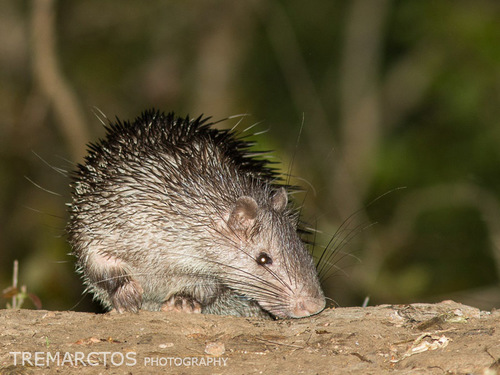
Fea's Tree Rat has soft, dense fur that is typically grayish-brown to reddish-brown on the dorsal side with paler underparts. It has large eyes suited for nocturnal activity and a long tail that aids in balance while climbing.
Size
Body length approximately 10-13 cm, with a tail length often exceeding body length at 13-17 cm
Weight
Estimated weight range of 30-50 grams, though comprehensive data is limited
Distinctive features
Distinguished by its long tail-to-body ratio and specialized foot morphology adapted for arboreal life, differentiating it from more terrestrial murid rodents in the region.
Behaviour and diet of the Indochinese Chiromyscus
Believed to be largely solitary, with limited data suggesting minimal social interaction outside of breeding periods, consistent with many arboreal rodent species.
When it is active
Nocturnal, being most active during nighttime hours when it forages and moves through the forest canopy under cover of darkness.
Diet
Omnivorous diet likely consisting of fruits, seeds, and possibly insects, based on general dietary patterns observed in related tree rat species.
Communication
Likely relies on vocalizations, scent marking, and tactile communication typical of nocturnal rodents, though detailed studies on this specific species are limited.
Interactions with other species
Serves as prey for forest predators such as snakes, owls, and small carnivorous mammals. May compete with other arboreal rodents for food resources and nesting sites.
Role in its ecosystem
Functions as a seed disperser within its forest habitat, contributing to forest regeneration, and serves as a prey species supporting the food web of Indochinese forest ecosystems.
Reproduction and lifecycle
Specific reproductive data for this species is scarce, but related murid rodents typically have short gestation periods of about 20-25 days and produce litters of 2-6 offspring.
Raising the young
Presumed maternal care similar to related rodent species, where females nurse and protect young until weaning, though specific behavioral studies are lacking for this species.
Maturity and lifespan
Specific data unavailable, but related rodent species typically reach sexual maturity within 2-3 months and may live 1-3 years in the wild
Taxonomy and naming of the Indochinese Chiromyscus
Classification
Class Mammalia > Order Rodentia > Family Muridae > Genus Chiromyscus > Species Chiromyscus chiropus
Scientific synonyms
Chiropodomys chiropus, Niviventer chiropus (formerly classified under different genera before taxonomic revision)
What research says
Compared with similar species
Similar to other arboreal murids like Chiropodomys species, but distinguished by specific morphological features of the feet and tail proportions unique to the Chiromyscus genus.
The Indochinese Chiromyscus and people
This species was historically difficult to classify and has been shuffled between several genera before settling into its own genus Chiromyscus. Its name 'chiropus' references its distinctive hand-like foot structure adapted for climbing.
Where and how to see it
Best observed at night in undisturbed forest areas of Vietnam, Laos, or Cambodia, though sightings are rare due to its elusive and understudied nature. Patience and knowledge of local forest trails are essential for observation attempts.
Risks to humans
No notable risk to humans
Countries where the Indochinese Chiromyscus is recorded
The 3 countries named in the range description of its IUCN Red List assessment.
Questions about the Indochinese Chiromyscus
Where does the Indochinese Chiromyscus live?
The Indochinese Chiromyscus is recorded in Cambodia, Laos and Vietnam across Asia. These countries come from the range description of its IUCN Red List assessment, and they are what place the species on the interactive map.
Is the Indochinese Chiromyscus endangered?
The IUCN Red List assesses the Indochinese Chiromyscus as Least Concern. The species is widespread and abundant enough not to qualify for any threatened category. It does not mean the species is safe forever, only that nothing in the current data raises an alarm.
How many are left in the wild?
No precise population estimates exist; the species is considered to have a stable but poorly monitored population This figure comes from the species assessment on the IUCN Red List; population estimates for wild mammals are ranges, not counts, and are revised at each assessment.
What habitat does the Indochinese Chiromyscus live in?
Primarily found in tropical and subtropical moist broadleaf forests, including both primary and secondary growth forests.
What is the scientific name of the Indochinese Chiromyscus?
The Indochinese Chiromyscus is Chiromyscus chiropus, in the family Muridae, order Rodentia.
Other species in the family Muridae
Species that share its range
Sources
Conservation status, range description and population estimate come from the IUCN Red List assessment for Chiromyscus chiropus. Countries are derived from that range description, not from a mapped country list. Last refreshed on .
The distribution map is drawn from the IUCN Red List spatial data compiled in 2008. IUCN (International Union for Conservation of Nature)