
Heaviside's Dolphin
Cephalorhynchus heavisidii
Red List assessment
Near Threatenedon the IUCN Red List
- EXExtinct
- EWExtinct in the Wild
- CRCritically Endangered
- ENEndangered
- VUVulnerable
- NTNear Threatened
- LCLeast Concern
The Heaviside's Dolphin is recorded in 2 countries across Africa. The IUCN Red List assesses the Heaviside's Dolphin as Near Threatened. Estimated global population is thought to be in the low tens of thousands, though precise figures are uncertain; the trend is suspected to be declining or stable with localized concerns.
- Family
- Delphinidae
- Order
- Cetartiodactyla
- Genus
- Cephalorhynchus
- Countries recorded
- 2
- Continents
- Africa
- Red List category
- Near Threatened
- Data updated
- August 9, 2026
What is the Heaviside's Dolphin?
Heaviside's Dolphin is a small, robust dolphin endemic to the cold, nutrient-rich waters of the Benguela Current along the southwestern African coast. It is one of only four species in the genus Cephalorhynchus, all restricted to the Southern Hemisphere. Named after Captain Haviside who collected the first specimen, it is notable for its distinctive tricolor pattern and blunt, rounded head lacking a pronounced beak. It is a relatively poorly studied species due to its remote and often rough coastal habitat.
Where does the Heaviside's Dolphin live?
Southwestern coast of Africa, primarily Namibia and South Africa
Endemic to the southwestern coast of Africa, ranging from northern Namibia (around the Kunene River) southward through the Namibian and South African coastlines to the Cape Peninsula and occasionally as far as Cape Agulhas.
Altitude and depth
Primarily found in shallow coastal waters from the surface to about 100-150 meters depth, though some individuals may forage slightly deeper offshore.
Seasonal movements
Some evidence suggests seasonal inshore-offshore movements linked to prey availability and reproductive activity, though the species does not undertake long-distance migrations.
Habitat of the Heaviside's Dolphin
Cool temperate coastal and shelf waters, typically found close to shore over sandy or rocky substrates within the Benguela upwelling ecosystem. Often observed in bays, near river mouths, and over the continental shelf.
Adaptations to its environment
Its compact body and thick blubber layer provide insulation against the cold Benguela Current waters. High-frequency echolocation clicks allow effective navigation and prey detection in often turbid coastal waters.
Conservation status and numbers
Classified as Near Threatened by the IUCN due to its restricted range, small population size, and susceptibility to bycatch in fishing gear, though population trends are not fully quantified.
Estimated population
Estimated global population is thought to be in the low tens of thousands, though precise figures are uncertain; the trend is suspected to be declining or stable with localized concerns.
What threatens the Heaviside's Dolphin?
Bycatch in gillnets and other fishing gear is the primary threat, alongside habitat degradation from coastal development, pollution, and potential competition with fisheries for prey resources.
Diseases and parasites
Limited data exists, but like other small cetaceans it may be susceptible to parasitic infections and pathogens affecting skin and internal organs.
What is being done to protect it?
Protected under South African and Namibian marine wildlife legislation, with some populations occurring within marine protected areas; ongoing research programs monitor bycatch and population trends.
Recommended actions
Priority actions include reducing gillnet bycatch through modified fishing gear, expanding marine protected areas along the Benguela coast, and conducting more comprehensive population surveys.
What the Heaviside's Dolphin looks like
The dolphin has a striking tricolor pattern: dark grey to black dorsal coloring, pale grey sides, and a white belly with distinctive dark markings extending onto the flanks. It has a rounded, blunt head without a pronounced beak and a small, triangular dorsal fin.
Size
Adults typically measure 1.2 to 1.7 meters in length.
Weight
Adults generally weigh between 40 and 75 kilograms.
Distinctive features
Distinguished from other Cephalorhynchus species by its unique color pattern, particularly the dark patches on the flanks and the shape of its dorsal fin, as well as its restricted range along the African coast.
Differences between males and females
Sexual dimorphism is minimal, though males may be slightly larger than females on average.
Behaviour and diet of the Heaviside's Dolphin
Typically found in small groups of 2 to 10 individuals, though larger aggregations of up to 20 or more can occur, especially when feeding or socializing.
When it is active
Primarily diurnal, with peak activity during daylight hours, though some foraging may occur at dusk or night depending on prey movement.
Diet
Carnivorous, feeding mainly on small fish and cephalopods, particularly hake, horse mackerel, and squid found in the Benguela ecosystem.
How it feeds and hunts
Uses echolocation to detect prey in the water column and near the seafloor, often foraging cooperatively in small groups close to shore.
Communication
Communicates through high-frequency echolocation clicks and possibly other acoustic signals for social interaction, though vocal repertoire is not as well studied as other dolphins.
Interactions with other species
Occasionally interacts with other cetacean species such as dusky dolphins within the Benguela ecosystem; natural predators may include large sharks, though direct predation events are rarely documented.
Role in its ecosystem
As a mid-level predator, it plays a role in regulating small fish and cephalopod populations within the productive Benguela upwelling ecosystem.
Reproduction and lifecycle
Breeding season appears to peak in spring and summer months; gestation lasts approximately 10 to 11 months, typically resulting in a single calf.
Raising the young
Calves are cared for primarily by the mother, nursing for an extended period of at least one year, with close mother-calf bonds observed during this time.
Maturity and lifespan
Sexual maturity is reached at approximately 5 to 9 years; lifespan in the wild is estimated to be around 15 to 25 years.
Taxonomy and naming of the Heaviside's Dolphin
Classification
Class Mammalia > Order Cetartiodactyla (Cetacea) > Family Delphinidae > Genus Cephalorhynchus > Species Cephalorhynchus heavisidii
Scientific synonyms
Electra heavisidii (original combination); Delphinus heavisidii
What research says
Recent studies
Recent studies have used satellite tagging and photo-identification to better understand habitat use, movement patterns, and bycatch risk along the Namibian and South African coasts.
Compared with similar species
Compared to its close relative Commerson's dolphin, Heaviside's Dolphin has a more subdued color pattern and lacks the extensive white coloring seen in that species; it is also smaller than the more widely distributed dusky dolphin found in the same region.
The Heaviside's Dolphin and people
Heaviside's Dolphin was originally misclassified due to a mix-up in specimen labeling with a whale captain's name; it is one of the smallest and least known dolphin species, and its unique coloring makes it easily distinguishable even from a boat.
Where and how to see it
Best observed via boat tours along the Namibian coast near Walvis Bay or the West Coast of South Africa, particularly in early morning when the sea is calm and dolphins are more active near shore.
Risks to humans
No notable risk to humans; the species is not aggressive and poses no direct threat.
Human uses
Primarily valued for ecotourism, with boat-based dolphin watching contributing to local economies in Namibia and South Africa; no significant historical use in trade or medicine is documented.
Countries where the Heaviside's Dolphin is recorded
The 2 countries named in the range description of its IUCN Red List assessment.
Questions about the Heaviside's Dolphin
Where does the Heaviside's Dolphin live?
The Heaviside's Dolphin is recorded in Namibia and South Africa across Africa. These countries come from the range description of its IUCN Red List assessment, and they are what place the species on the interactive map.
Is the Heaviside's Dolphin endangered?
The IUCN Red List assesses the Heaviside's Dolphin as Near Threatened. The species does not qualify as threatened today, but it is close to the thresholds and likely to cross them soon. It is the category that most often changes at the next assessment.
How many are left in the wild?
Estimated global population is thought to be in the low tens of thousands, though precise figures are uncertain; the trend is suspected to be declining or stable with localized concerns. This figure comes from the species assessment on the IUCN Red List; population estimates for wild mammals are ranges, not counts, and are revised at each assessment.
What habitat does the Heaviside's Dolphin live in?
Cool temperate coastal and shelf waters, typically found close to shore over sandy or rocky substrates within the Benguela upwelling ecosystem.
What is the scientific name of the Heaviside's Dolphin?
The Heaviside's Dolphin is Cephalorhynchus heavisidii, in the family Delphinidae, order Cetartiodactyla.
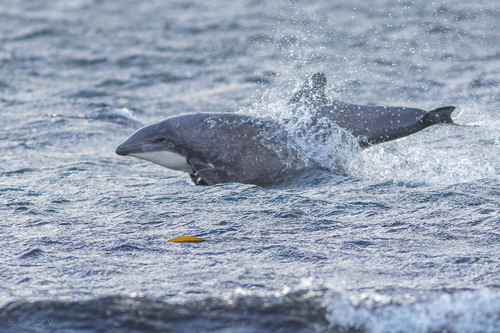
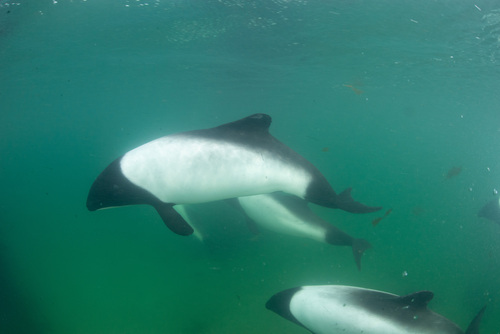
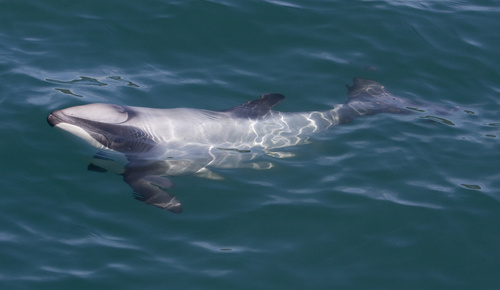
Other species in the genus Cephalorhynchus
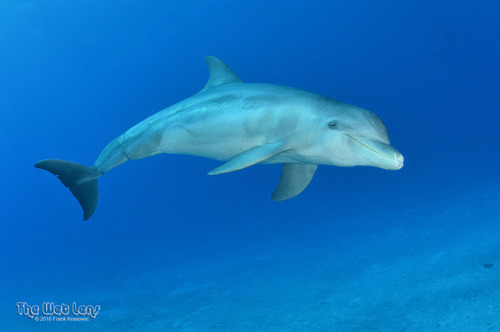
Other species in the family Delphinidae
Species that share its range
Sources
Conservation status, range description and population estimate come from the IUCN Red List assessment for Cephalorhynchus heavisidii. Countries are derived from that range description, not from a mapped country list. Last refreshed on .
The distribution map is drawn from the IUCN Red List spatial data compiled in 2013. IUCN (International Union for Conservation of Nature)