
Spinner Dolphin
Stenella longirostris
Red List assessment
Least Concernon the IUCN Red List
- EXExtinct
- EWExtinct in the Wild
- CRCritically Endangered
- ENEndangered
- VUVulnerable
- NTNear Threatened
- LCLeast Concern
The Spinner Dolphin is recorded in 3 countries across Asia and North America. The IUCN Red List assesses the Spinner Dolphin as Least Concern. Global population estimated in the hundreds of thousands, with regional estimates such as roughly 1-2 million in the Eastern Tropical Pacific prior to major declines; overall trend considered stable to slowly recovering in some regions.
- Family
- Delphinidae
- Order
- Cetartiodactyla
- Genus
- Stenella
- Countries recorded
- 3
- Continents
- Asia and North America
- Red List category
- Least Concern
- Data updated
- August 9, 2026
What is the Spinner Dolphin?
The spinner dolphin is a small, slender oceanic dolphin renowned for its spectacular acrobatic leaps and spins, sometimes rotating up to seven times in a single jump. It inhabits warm tropical and subtropical waters around the globe, often forming large, highly social pods. Its long, thin rostrum and distinctive tripartite color pattern make it easily recognizable. It is one of the most studied cetaceans due to its predictable resting behavior in shallow bays.
Where does the Spinner Dolphin live?
Tropical and subtropical waters worldwide, including Hawaii, the Eastern Tropical Pacific, the Indian Ocean, Southeast Asia, and the Red Sea
Circumtropical distribution spanning the Pacific, Atlantic, and Indian Oceans; notable populations occur in Hawaii, the Eastern Tropical Pacific, the Red Sea, the Gulf of Mexico, the Caribbean, and coastal Southeast Asia including Indonesia and the Philippines.
Altitude and depth
Typically dives to depths of 200-300 meters while foraging at night, though daytime resting occurs in shallow waters of less than 20 meters.
Seasonal movements
No strong migratory pattern globally, though some populations show localized seasonal movements linked to prey availability and oceanographic conditions such as upwelling.
Habitat of the Spinner Dolphin
Primarily pelagic, found in deep offshore waters during nighttime foraging but frequently resting in shallow, calm coastal bays and lagoons near coral reefs during the day. Prefers warm tropical and subtropical waters typically above 25°C.
Adaptations to its environment
Streamlined body and long rostrum enable fast swimming and efficient prey capture in the deep scattering layer at night. Echolocation allows navigation and hunting in dark, deep waters, while daytime resting in shallow bays conserves energy and reduces predation risk.
Conservation status and numbers
Listed as Least Concern globally by IUCN, though some regional subpopulations, particularly the Eastern spinner dolphin, have been significantly depleted by historic tuna purse-seine fishing and remain classified with more concern.
Estimated population
Global population estimated in the hundreds of thousands, with regional estimates such as roughly 1-2 million in the Eastern Tropical Pacific prior to major declines; overall trend considered stable to slowly recovering in some regions.
What threatens the Spinner Dolphin?
Bycatch in tuna purse-seine fisheries (historically severe in the Eastern Tropical Pacific), habitat disturbance from tourism in resting bays, pollution, and prey depletion due to overfishing.
Diseases and parasites
Known to host various parasites including nematodes, cestodes, and skin conditions such as tattoo skin disease, along with occasional morbillivirus infections.
What is being done to protect it?
Protected under the US Marine Mammal Protection Act, regulated by the International Dolphin Conservation Program in the Eastern Tropical Pacific, and subject to tourism management guidelines in Hawaii to limit disturbance during resting periods.
Recommended actions
Strengthen enforcement of bycatch reduction measures in tuna fisheries, regulate swim-with-dolphin tourism near resting bays, and expand long-term population monitoring in under-studied regions such as Southeast Asia.
What the Spinner Dolphin looks like
Slender body with a long, thin beak and a distinctive tripartite color pattern: dark gray cape on the back, lighter gray sides, and white or pale gray underside. Some populations show a subtle post-anal keel and a rounded dorsal fin.
Size
Body length typically ranges from 1.29 to 2.35 meters, with males slightly longer than females in some populations.
Weight
Adults typically weigh between 23 and 79 kilograms, varying by subspecies and region.
Distinctive features
Distinguished from other Stenella species by its notably long, slender rostrum, characteristic upright spinning leaps, and often more pronounced tripartite coloration pattern.
Differences between males and females
Males often develop a more pronounced post-anal hump and slightly larger dorsal fin than females, along with subtle differences in body proportions in some subspecies.
Behaviour and diet of the Spinner Dolphin
Highly social, forming groups ranging from a few dozen to several thousand individuals, often mixing with other species such as pantropical spotted dolphins. Social bonds appear fluid, with frequent group fission-fusion dynamics.
When it is active
Primarily nocturnal foragers, diving deep at night to feed in the deep scattering layer, while resting and socializing in shallow bays during the day.
Diet
Feeds mainly on small mesopelagic fish, squid, and shrimp found in the deep scattering layer, which migrates vertically at night into shallower depths.
How it feeds and hunts
Uses echolocation to locate prey in deep, dark waters and often forages cooperatively in groups, taking advantage of the nightly vertical migration of prey species.
Communication
Communicates through a variety of clicks, whistles, and burst-pulse sounds used for echolocation and social interaction, along with body language such as leaping, spinning, and tail slaps.
Interactions with other species
Often associates with pantropical spotted dolphins and sometimes yellowfin tuna schools, historically leading to high bycatch mortality in tuna fisheries; predators include large sharks and occasionally killer whales.
Role in its ecosystem
Plays a role as a mid-level predator in pelagic food webs, helping regulate populations of small fish and squid in the deep scattering layer community.
Reproduction and lifecycle
Breeding can occur year-round in many populations, though some regions show seasonal peaks. Gestation lasts approximately 10-11 months, typically resulting in a single calf.
Raising the young
Calves are cared for primarily by the mother, nursing for about 1-2 years, with strong mother-calf bonds and potential alloparental care from other pod members.
Maturity and lifespan
Reaches sexual maturity between 4 and 7 years of age; lifespan in the wild is estimated at around 20-25 years, though some individuals may live longer.
Taxonomy and naming of the Spinner Dolphin
Classification
Mammalia > Cetartiodactyla > Delphinidae > Stenella > Stenella longirostris
Subspecies
S. l. longirostris (Gray's spinner dolphin, widespread), S. l. orientalis (Eastern spinner dolphin, Eastern Tropical Pacific), S. l. centroamericana (Central American spinner dolphin), S. l. roseiventris (dwarf spinner dolphin, Southeast Asia)
Scientific synonyms
Delphinus longirostris, Stenella microps
What research says
Recent studies
Recent research has focused on the function and mechanics of the species' spinning behavior, revealing it may serve communication, parasite removal, and energy-efficient signaling purposes based on hydrodynamic studies.
Genome and DNA
Diploid chromosome number of 44, consistent with other delphinid species; genetic studies have been used to distinguish subspecies and regional populations.
Compared with similar species
Similar to the pantropical spotted dolphin but distinguished by its longer, thinner beak, lack of extensive spotting, and more frequent spinning leaps; also resembles the common dolphin but with a more slender build and distinct color pattern.
The Spinner Dolphin and people
Spinner dolphins can complete up to seven full rotations in a single leap, one of the most acrobatic displays among cetaceans. They are known to rest in the same shallow bays daily, forming predictable patterns studied extensively by researchers in Hawaii.
Where and how to see it
Best observed early morning in resting bays such as those in Hawaii (e.g., Kealakekua Bay) or via boat tours in the Red Sea, when pods return from nighttime foraging and engage in social spinning displays.
Risks to humans
No notable risk to humans under normal circumstances; however, close human interaction during resting periods can cause stress and behavioral disruption to the dolphins.
Human uses
Primarily valued for ecotourism, particularly swim-with-dolphin tours in Hawaii and the Red Sea, generating significant local economic benefits through responsible wildlife tourism.
Myths and legends
In some Pacific Island cultures, dolphins including spinner dolphins are considered spiritual guides or protectors of sailors, often featured in local folklore as benevolent sea spirits.
Countries where the Spinner Dolphin is recorded
The 3 countries named in the range description of its IUCN Red List assessment.
Questions about the Spinner Dolphin
Where does the Spinner Dolphin live?
The Spinner Dolphin is recorded in Indonesia, Mexico and Philippines across Asia and North America. These countries come from the range description of its IUCN Red List assessment, and they are what place the species on the interactive map.
Is the Spinner Dolphin endangered?
The IUCN Red List assesses the Spinner Dolphin as Least Concern. The species is widespread and abundant enough not to qualify for any threatened category. It does not mean the species is safe forever, only that nothing in the current data raises an alarm.
How many are left in the wild?
Global population estimated in the hundreds of thousands, with regional estimates such as roughly 1-2 million in the Eastern Tropical Pacific prior to major declines; overall trend considered stable to slowly recovering in some regions. This figure comes from the species assessment on the IUCN Red List; population estimates for wild mammals are ranges, not counts, and are revised at each assessment.
What habitat does the Spinner Dolphin live in?
Primarily pelagic, found in deep offshore waters during nighttime foraging but frequently resting in shallow, calm coastal bays and lagoons near coral reefs during the day.
What is the scientific name of the Spinner Dolphin?
The Spinner Dolphin is Stenella longirostris, in the family Delphinidae, order Cetartiodactyla.
Other species in the genus Stenella
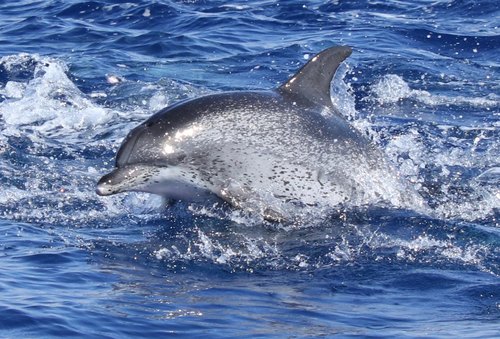
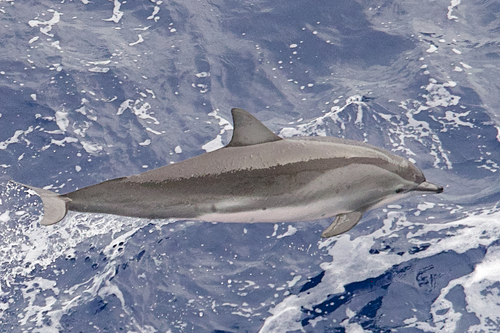
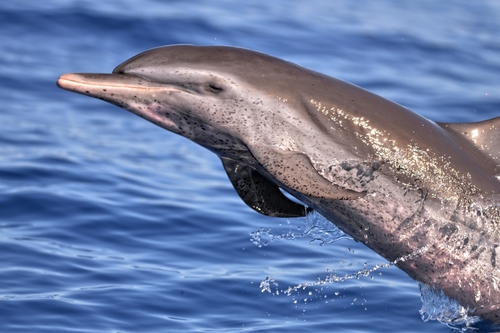
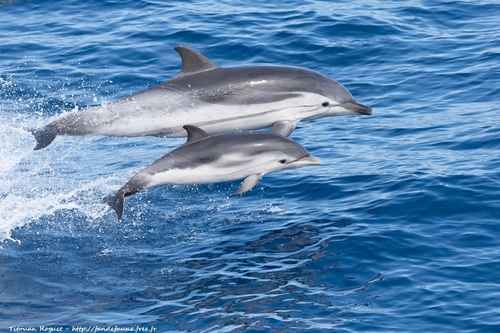
Other species in the family Delphinidae
Species that share its range
Sources
Conservation status, range description and population estimate come from the IUCN Red List assessment for Stenella longirostris. Countries are derived from that range description, not from a mapped country list. Last refreshed on .
The distribution map is drawn from the IUCN Red List spatial data compiled in 2012. IUCN (International Union for Conservation of Nature)