
Common Bottlenose Dolphin
Tursiops truncatus
Red List assessment
Least Concernon the IUCN Red List
- EXExtinct
- EWExtinct in the Wild
- CRCritically Endangered
- ENEndangered
- VUVulnerable
- NTNear Threatened
- LCLeast Concern
The IUCN Red List assesses the Common Bottlenose Dolphin as Least Concern. Global population estimated at several hundred thousand individuals; trends vary by region, with some populations stable and others declining due to local pressures.
- Family
- Delphinidae
- Order
- Cetartiodactyla
- Genus
- Tursiops
- Red List category
- Least Concern
- Data updated
- August 9, 2026
What is the Common Bottlenose Dolphin?
The common bottlenose dolphin is one of the most widely recognized and studied cetaceans, found in coastal and offshore waters across the globe. It is highly intelligent, socially complex, and adaptable to a variety of marine habitats. Its friendly appearance and frequent interactions with humans have made it a flagship species for marine conservation and public education. The species exhibits remarkable behavioral plasticity, with distinct ecotypes adapted to coastal versus pelagic environments.
Where does the Common Bottlenose Dolphin live?
Worldwide in temperate and tropical waters, including coastal and offshore regions of the Atlantic, Pacific, Indian Oceans, Mediterranean and Black Seas
Found nearly worldwide in temperate and tropical waters between roughly 45°N and 45°S, including the Atlantic and Pacific coasts of the Americas, European and African coastlines, the Mediterranean and Black Seas, the Indian Ocean, and Australian waters.
Altitude and depth
Typically dives to 0-300m, though offshore populations can dive deeper, occasionally exceeding 500m in pursuit of prey.
Seasonal movements
Some populations undertake seasonal movements tracking prey availability and water temperature, though many coastal populations are largely resident year-round.
Habitat of the Common Bottlenose Dolphin
Coastal bays, estuaries, lagoons, harbors, and continental shelf waters, as well as deeper offshore pelagic zones. Highly adaptable, tolerating a wide range of temperatures and salinities from temperate to tropical seas.
Adaptations to its environment
Possesses echolocation for navigation and hunting in murky or dark waters, a streamlined fusiform body for efficient swimming, and thick blubber for thermoregulation. Its flexible diet and social learning abilities allow it to exploit diverse habitats from shallow estuaries to open ocean.
Conservation status and numbers
Listed as Least Concern by the IUCN due to its wide distribution and large overall population, though some regional populations face significant declines from human activities.
Estimated population
Global population estimated at several hundred thousand individuals; trends vary by region, with some populations stable and others declining due to local pressures.
What threatens the Common Bottlenose Dolphin?
Bycatch in fishing gear, habitat degradation, pollution (including plastic and chemical contaminants), boat strikes, noise pollution, and historic hunting in some regions.
Diseases and parasites
Susceptible to morbillivirus outbreaks, skin lesions from pollution-related stress, and various internal parasites including nematodes and trematodes.
What is being done to protect it?
Protected under various national laws (e.g., US Marine Mammal Protection Act), international agreements like CITES Appendix II, and regional conservation programs including marine protected areas and bycatch reduction initiatives.
Recommended actions
Reduce bycatch through modified fishing gear, mitigate coastal pollution and habitat loss, regulate boat traffic in critical habitats, and continue long-term population monitoring programs.
What the Common Bottlenose Dolphin looks like
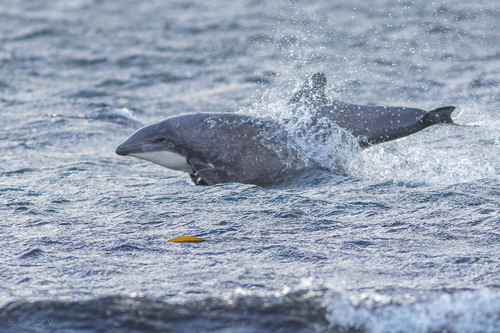
Sleek, robust grey body, darker dorsally and lighter ventrally, with a short, well-defined rostrum (beak) and a curved dorsal fin. Skin is smooth and rubbery, aiding hydrodynamic movement.
Size
Body length typically ranges from 2 to 4 meters, with offshore ecotypes generally larger than coastal ecotypes.
Weight
Adults typically weigh between 150 and 650 kg, with males generally slightly larger and heavier than females.
Distinctive features
Distinguished from other dolphin species by its relatively short, thick beak, robust body shape, and the sharp demarcation between beak and melon (forehead).
Differences between males and females
Males are generally slightly larger and more robust than females, though external differences are subtle and not easily distinguished in the field.
Behaviour and diet of the Common Bottlenose Dolphin
Highly social, living in fluid groups called pods that can range from a few individuals to over 100, with fission-fusion dynamics where group composition changes frequently.
When it is active
Primarily diurnal but can be active at night as well; activity patterns often align with prey availability rather than strict day-night cycles.
Diet
Carnivorous, feeding mainly on a variety of fish, squid, and crustaceans, with diet composition varying by region and habitat type.
How it feeds and hunts
Uses echolocation to locate prey, cooperative hunting strategies such as herding fish into tight balls, strand feeding in shallow waters, and sometimes uses tools like sponges to protect their rostrum while foraging on the seafloor.
Communication
Communicates through a complex repertoire of whistles, clicks, and body language such as breaching, tail-slapping, and signature whistles that function like individual names.
Interactions with other species
Occasionally interacts with other dolphin species and seabirds during cooperative feeding; predators include large sharks and occasionally orcas, while humans pose the greatest threat through fisheries interactions.
Role in its ecosystem
Acts as an upper-level predator in marine food webs, helping regulate fish and squid populations, and serves as an indicator species for the health of coastal marine ecosystems.
Reproduction and lifecycle
Breeding can occur year-round in many populations but often peaks seasonally; gestation lasts about 12 months, typically resulting in a single calf.
Raising the young
Calves are cared for primarily by their mothers for 3-6 years, during which they learn foraging and social skills; alloparental care by other females ("aunts") is also observed.
Maturity and lifespan
Sexual maturity is reached around 5-13 years; lifespan in the wild averages 40-50 years, with some individuals in captivity living slightly longer under managed care.
Taxonomy and naming of the Common Bottlenose Dolphin
Classification
Class Mammalia > Order Cetartiodactyla (Cetacea) > Family Delphinidae > Genus Tursiops > Species Tursiops truncatus
Subspecies
Tursiops truncatus truncatus (worldwide, common form) and Tursiops truncatus ponticus (Black Sea bottlenose dolphin, smaller-bodied)
Scientific synonyms
Delphinus truncatus, Tursiops nuuanu, Tursiops gillii (historically considered synonyms or now sometimes separate)
What research says
Recent studies
Recent research has focused on tool use (sponge foraging), individual signature whistles functioning as names, and the impacts of anthropogenic noise on communication and foraging behavior.
Genome and DNA
Diploid chromosome number is 44; genomic studies have been used to distinguish coastal and offshore ecotypes and assess population structure.
Compared with similar species
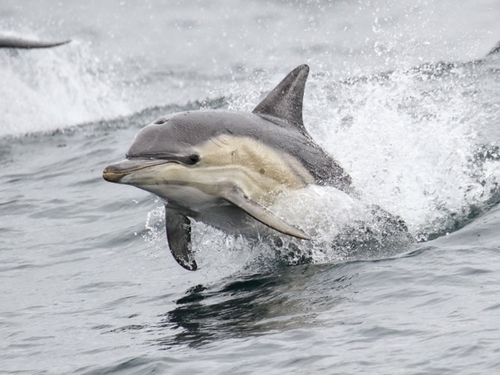
Compared to the more slender common dolphin (Delphinus delphis), the bottlenose dolphin has a stockier body and shorter beak; it is also distinguished from the Indo-Pacific bottlenose dolphin (Tursiops aduncus) by subtle differences in size and coloration.
The Common Bottlenose Dolphin and people
Bottlenose dolphins can recognize themselves in mirrors, indicating advanced self-awareness; some individuals use marine sponges as tools to protect their snouts while foraging; they have signature whistles that function much like personal names.
Where and how to see it
Best observed via boat tours or coastal watching in known hotspots such as Sarasota Bay (Florida), the Moray Firth (Scotland), or the Bahamas, ideally during calm morning hours when dolphins are most active near the surface.
Risks to humans
Generally low risk to humans, though wild dolphins can occasionally bite or behave aggressively if harassed or fed improperly.
Human uses
Used in ecotourism, scientific research, and historically in marine parks and therapy programs, though captivity practices remain ethically debated.
Myths and legends
Dolphins have long been symbols of intelligence, friendship, and guidance in many cultures, often depicted in Greek mythology as helpers of sailors and companions to gods like Poseidon.
Questions about the Common Bottlenose Dolphin
Is the Common Bottlenose Dolphin endangered?
The IUCN Red List assesses the Common Bottlenose Dolphin as Least Concern. The species is widespread and abundant enough not to qualify for any threatened category. It does not mean the species is safe forever, only that nothing in the current data raises an alarm.
How many are left in the wild?
Global population estimated at several hundred thousand individuals; trends vary by region, with some populations stable and others declining due to local pressures. This figure comes from the species assessment on the IUCN Red List; population estimates for wild mammals are ranges, not counts, and are revised at each assessment.
What habitat does the Common Bottlenose Dolphin live in?
Coastal bays, estuaries, lagoons, harbors, and continental shelf waters, as well as deeper offshore pelagic zones.
What is the scientific name of the Common Bottlenose Dolphin?
The Common Bottlenose Dolphin is Tursiops truncatus, in the family Delphinidae, order Cetartiodactyla.
Other species in the genus Tursiops

Other species in the family Delphinidae
Sources
Conservation status, range description and population estimate come from the IUCN Red List assessment for Tursiops truncatus. Countries are derived from that range description, not from a mapped country list. Last refreshed on .
The distribution map is drawn from the IUCN Red List spatial data compiled in 2019. IUCN (International Union for Conservation of Nature)