
Golden Snub-nosed Monkey
Rhinopithecus roxellana
Red List assessment
Endangeredon the IUCN Red List
- EXExtinct
- EWExtinct in the Wild
- CRCritically Endangered
- ENEndangered
- VUVulnerable
- NTNear Threatened
- LCLeast Concern
The Golden Snub-nosed Monkey is recorded in one country, China across Asia. The IUCN Red List assesses the Golden Snub-nosed Monkey as Endangered. Approximately 15,000-20,000 individuals remaining in the wild, with populations considered fragmented and generally declining or stable depending on region.
- Family
- Cercopithecidae
- Order
- Primates
- Genus
- Rhinopithecus
- Countries recorded
- 1
- Continents
- Asia
- Red List category
- Endangered
- Data updated
- August 9, 2026
What is the Golden Snub-nosed Monkey?
The Golden Snub-nosed Monkey is one of the most visually striking primates, famous for its vivid orange-gold fur and distinctive upturned nose. It inhabits high-altitude temperate forests in central China, enduring some of the coldest climates of any non-human primate. This species is remarkable for its complex multi-level social structure and its status as a flagship species for Chinese wildlife conservation.
Where does the Golden Snub-nosed Monkey live?
Central and Southwest China, primarily in mountainous forest regions
Endemic to China, found in fragmented populations across the Qinling Mountains (Shaanxi), Sichuan, Gansu, and the Shennongjia region of Hubei province.
Altitude and depth
1500-3400 meters, with seasonal vertical migration between lower winter ranges and higher summer ranges.
Seasonal movements
Exhibits seasonal altitudinal migration, moving to lower elevations in winter to escape extreme cold and deep snow, then returning to higher forests in summer.
Habitat of the Golden Snub-nosed Monkey
Temperate and subalpine coniferous and mixed deciduous forests, often with dense bamboo understory. They favor old-growth forests with a mix of conifers (fir, spruce) and broadleaf trees at higher elevations.
Adaptations to its environment
Thick, dense fur provides insulation against sub-zero winter temperatures. Their unique nasal structure may help warm inhaled cold air, and their varied diet allows them to survive on bark and lichen when fruit is scarce in winter.
Conservation status and numbers
Endangered (EN) according to IUCN, due to significant habitat loss and fragmentation combined with historical hunting pressure, resulting in population decline exceeding 20% over the past three generations.
Estimated population
Approximately 15,000-20,000 individuals remaining in the wild, with populations considered fragmented and generally declining or stable depending on region.
What threatens the Golden Snub-nosed Monkey?
Habitat loss from logging and agricultural expansion, forest fragmentation isolating populations, poaching for fur and traditional medicine, and human disturbance from tourism and infrastructure development.
Diseases and parasites
Susceptible to various gastrointestinal parasites and respiratory infections; disease transmission risk increases with habitat fragmentation and closer proximity to human populations.
What is being done to protect it?
Protected under Chinese law as a Class I protected species; several nature reserves have been established including Shennongjia National Nature Reserve and Foping Nature Reserve; captive breeding programs exist in Chinese zoos.
Recommended actions
Expand and connect protected habitat corridors between fragmented populations, strengthen anti-poaching enforcement, engage local communities in conservation-based ecotourism, and continue genetic monitoring of isolated subpopulations.
What the Golden Snub-nosed Monkey looks like
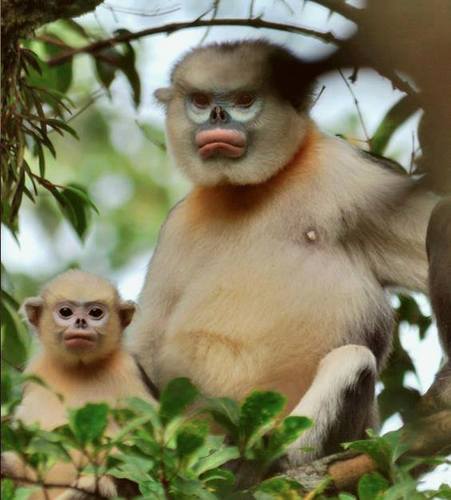
Striking golden-orange to reddish fur covers the back and shoulders, contrasting with a pale blue-gray face and a distinctive upturned, nearly nostril-less nose. The fur is notably long and dense, especially in males, giving a shaggy cape-like appearance around the shoulders.
Size
Body length 51-83 cm, with a tail of similar or slightly longer length (52-72 cm); males are notably larger than females.
Weight
Males typically weigh 15-16 kg, while females weigh significantly less, around 6.5-10 kg.
Distinctive features
The vivid golden mantle of fur combined with the flat, upturned nose lacking a bridge is unique among primates and distinguishes it clearly from other snub-nosed monkey species, which tend to have grayer or blacker coloration.
Differences between males and females
Pronounced sexual dimorphism exists: males are considerably larger and heavier than females, possess more vivid golden fur and longer cape-like hair, and display more prominent facial coloration.
Behaviour and diet of the Golden Snub-nosed Monkey
Lives in complex multi-level societies composed of small one-male, multi-female breeding units that aggregate into larger bands of up to several hundred individuals, particularly in winter.
When it is active
Diurnal, with peak activity during daylight hours spent foraging, socializing, and traveling through the forest canopy and ground.
Diet
Primarily folivorous and frugivorous, feeding on leaves, lichens, bark, buds, seeds, and fruits; diet shifts seasonally, with increased reliance on bark and lichen during harsh winters when other food is scarce.
Communication
Communicates through a range of vocalizations including screams, chirps, and grunts, as well as facial expressions, body postures, and physical grooming to maintain social bonds.
Interactions with other species
Natural predators include leopards, yellow-throated martens, and golden eagles; competes with other herbivorous mammals for food resources but generally occupies a fairly specialized ecological niche.
Role in its ecosystem
Plays a role in forest ecology as a seed disperser and through its foraging activity which can influence forest structure and plant community dynamics in its temperate forest habitat.
Reproduction and lifecycle
Breeding season typically occurs in autumn (August-October), with a gestation period of about 6-7 months, usually resulting in a single offspring born in spring.
Raising the young
Mothers provide primary care, nursing and carrying infants for the first year; allomothering (care by other females in the unit) is common, and juveniles remain closely associated with their natal group for several years.
Maturity and lifespan
Females reach sexual maturity around 4-5 years, males slightly later; lifespan in the wild is estimated at 15-20 years, while captive individuals may live up to 23 years.
Taxonomy and naming of the Golden Snub-nosed Monkey
Classification
Mammalia > Primates > Cercopithecidae > Rhinopithecus > R. roxellana
Subspecies
Three recognized subspecies: R. r. roxellana (Qinling Mountains, Shaanxi), R. r. qinlingensis (sometimes considered synonymous with roxellana), and R. r. hubeiensis (Shennongjia, Hubei), with a fourth population in Sichuan/Gansu sometimes classified separately.
Scientific synonyms
Presbytis roxellana (original classification), Rhinopithecus roxellanae (orthographic variant)
What research says
Recent studies
Recent genomic research has identified specific genetic adaptations for cold and high-altitude survival, and long-term field studies continue to reveal the complexity of their multi-level social organization comparable to that of humans and some other primates.
Genome and DNA
Diploid chromosome number is 2n=44; genomic studies have revealed adaptations related to high-altitude living and cold tolerance, including genes associated with metabolism and hypoxia response.
Compared with similar species
Closely related to other snub-nosed monkeys such as the black snub-nosed monkey (R. bieti) and gray snub-nosed monkey (R. brelichi), but distinguished by its golden coloration; shares the multi-level society structure seen in hamadryas baboons and geladas, a rare trait among primates.
The Golden Snub-nosed Monkey and people
Their nasal structure is so distinctive that local legend claims heavy snowfall can enter their upturned nostrils, forcing them to sneeze; they are one of the few primates that can survive temperatures dropping below -20°C; males' elaborate fur capes are thought to play a role in female mate choice.
Where and how to see it
Best observed in Shennongjia National Nature Reserve (Hubei) or the Qinling Mountains during autumn and winter months when they gather in larger bands, though visits require respecting reserve regulations and often guided access.
Risks to humans
No notable risk to humans; they are generally shy and avoid human contact, though habituated populations near tourist areas may show reduced fear response.
Human uses
Historically hunted for fur and body parts used in traditional Chinese medicine, though this practice is now illegal; today the species serves primarily as a symbol for ecotourism and conservation awareness in China.
Myths and legends
In Chinese folklore, this species is sometimes associated with mythical figures due to its human-like face and vivid coloration, and it has inspired characters in traditional Chinese art and stories, though it is less prominently featured than the more famous panda.
Countries where the Golden Snub-nosed Monkey is recorded
The 1 countries named in the range description of its IUCN Red List assessment.
Questions about the Golden Snub-nosed Monkey
Where does the Golden Snub-nosed Monkey live?
The Golden Snub-nosed Monkey is recorded in China across Asia. These countries come from the range description of its IUCN Red List assessment, and they are what place the species on the interactive map.
Is the Golden Snub-nosed Monkey endangered?
Yes. The IUCN Red List assesses the Golden Snub-nosed Monkey as Endangered, one of the three threatened categories. The species faces a very high risk of extinction in the wild — a step below Critically Endangered, but still on a trajectory that ends badly without intervention.
How many are left in the wild?
Approximately 15,000-20,000 individuals remaining in the wild, with populations considered fragmented and generally declining or stable depending on region. This figure comes from the species assessment on the IUCN Red List; population estimates for wild mammals are ranges, not counts, and are revised at each assessment.
What habitat does the Golden Snub-nosed Monkey live in?
Temperate and subalpine coniferous and mixed deciduous forests, often with dense bamboo understory.
What is the scientific name of the Golden Snub-nosed Monkey?
The Golden Snub-nosed Monkey is Rhinopithecus roxellana, in the family Cercopithecidae, order Primates.
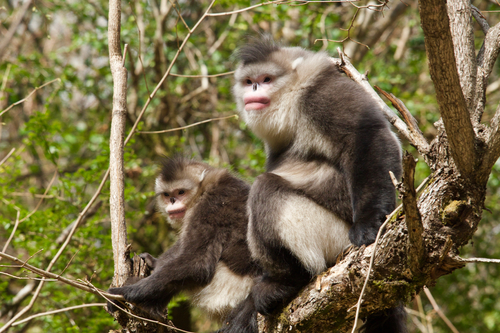
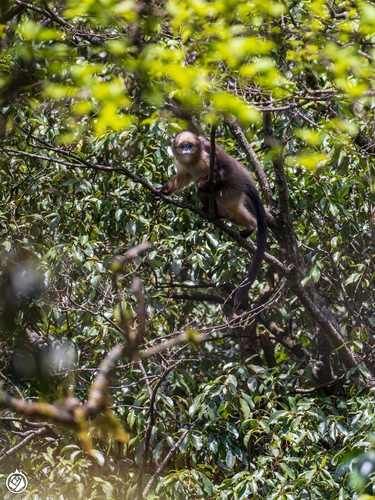
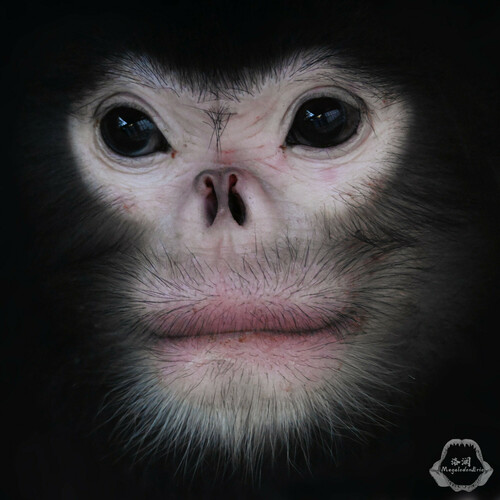
Other species in the genus Rhinopithecus
Other species in the family Cercopithecidae
Species that share its range
Sources
Conservation status, range description and population estimate come from the IUCN Red List assessment for Rhinopithecus roxellana. Countries are derived from that range description, not from a mapped country list. Last refreshed on .
The distribution map is drawn from the IUCN Red List spatial data compiled in 2021. IUCN (International Union for Conservation of Nature)