
Eurasian Beaver
Castor fiber
Red List assessment
Least Concernon the IUCN Red List
- EXExtinct
- EWExtinct in the Wild
- CRCritically Endangered
- ENEndangered
- VUVulnerable
- NTNear Threatened
- LCLeast Concern
The Eurasian Beaver is recorded in 9 countries across Asia and Europe. The IUCN Red List assesses the Eurasian Beaver as Least Concern. Current population estimated at over 1 million individuals across Europe and Asia, with numbers continuing to increase due to successful reintroduction programs and legal protections.
- Family
- Castoridae
- Order
- Rodentia
- Genus
- Castor
- Countries recorded
- 9
- Continents
- Asia and Europe
- Red List category
- Least Concern
- Data updated
- August 9, 2026
What is the Eurasian Beaver?
The Eurasian beaver is a large, semi-aquatic rodent renowned as a keystone ecosystem engineer, building dams and lodges that reshape wetland habitats. Once nearly driven to extinction by overhunting for fur and castoreum, it has made a remarkable recovery through reintroduction efforts across Europe and Asia. It inhabits rivers, lakes, and wetlands where it constructs elaborate dam systems. Its ability to modify landscapes makes it one of the most influential rodents in temperate ecosystems.
Where does the Eurasian Beaver live?
Widely distributed across Europe and parts of northern Asia, including Russia, Scandinavia, Germany, France, Poland, and Mongolia.
Found across much of Europe including Scandinavia, France, Germany, Poland, and the Baltic states, extending through Russia into Siberia, Mongolia, and parts of China. Reintroduction programs have restored populations in Britain, Belgium, the Netherlands, and other countries where it had been extirpated.
Altitude and depth
Typically found at low to moderate elevations, generally below 1,500m, though can occur at higher altitudes in mountainous river systems in parts of its range.
Seasonal movements
No true hibernation; beavers remain active year-round but reduce activity in winter, relying on stored food caches submerged near lodges. Reproduction is strictly seasonal, with mating occurring in winter (January-February).
Habitat of the Eurasian Beaver
Freshwater habitats including rivers, streams, lakes, ponds, and wetlands with deciduous woodland nearby, especially willow, aspen, and birch stands used for food and building material. Prefers slow-moving or still water bodies with adequate bank vegetation.
Adaptations to its environment
Possesses waterproof fur, webbed hind feet, a flat scaly tail for swimming and communication, and transparent nictitating membranes for underwater vision. Continuously growing incisors allow constant gnawing of wood, while valves in the nose and ears close underwater for diving up to 15 minutes.
Conservation status and numbers
Listed as Least Concern by IUCN following substantial population recovery from near-extinction in the early 20th century, thanks to extensive reintroduction and legal protection across its range. Populations have increased dramatically since the 1900s when only around 1,200 individuals remained in isolated pockets.
Estimated population
Current population estimated at over 1 million individuals across Europe and Asia, with numbers continuing to increase due to successful reintroduction programs and legal protections.
What threatens the Eurasian Beaver?
Historical near-extinction was due to overhunting for fur, meat, and castoreum used in perfumes and medicine. Current threats include habitat fragmentation, water pollution, human-wildlife conflict from flooding of agricultural land, and vehicle collisions.
Diseases and parasites
Susceptible to tularemia, giardiasis, and various internal parasites including flukes and nematodes; can also carry Giardia which affects water quality and poses zoonotic risk to humans drinking untreated water.
What is being done to protect it?
Extensive reintroduction programs have been conducted across Europe including UK, Netherlands, Belgium, and Scandinavia. The species is protected under the EU Habitats Directive and Bern Convention, with numerous river restoration projects incorporating beaver activity as a conservation tool.
Recommended actions
Continued habitat connectivity along river systems, mitigation of human-beaver conflicts through management techniques like flow devices, and public education about the ecological benefits of beaver engineering for biodiversity and flood control.
What the Eurasian Beaver looks like
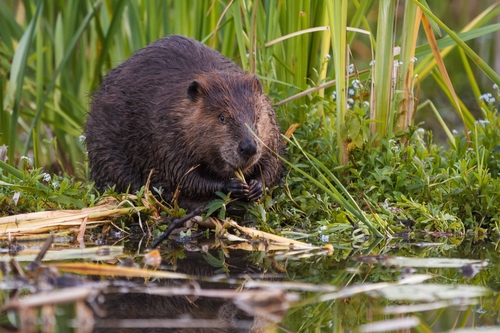
Dense brown fur ranging from light chestnut to nearly black, with a distinctive broad, flat, scaly tail and large orange incisors. The body is stocky and streamlined for swimming, with small eyes and ears relative to body size.
Size
Body length ranges from 80-100cm (excluding tail), with tail adding an additional 25-35cm; shoulder height approximately 30-35cm.
Weight
Adults typically weigh 15-30kg, with some large individuals reaching up to 35kg; males and females are similar in size with no significant sexual dimorphism.
Distinctive features
Distinguished from the North American beaver (Castor canadensis) by subtle skull and chromosome differences (48 vs 40 chromosomes) rather than obvious external features; the two species cannot interbreed successfully.
Behaviour and diet of the Eurasian Beaver
Lives in monogamous family units called colonies, typically consisting of a breeding pair and their offspring from the past two years, usually 4-8 individuals per colony. Family members cooperate in dam building, lodge maintenance, and territory defense.
When it is active
Primarily nocturnal and crepuscular, being most active during dusk, night, and dawn hours, though can be observed during daylight especially in undisturbed areas.
Diet
Strictly herbivorous, feeding on bark, twigs, leaves of deciduous trees (especially willow, aspen, poplar, and birch), as well as aquatic plants, grasses, and agricultural crops when available. Diet shifts seasonally with more woody material consumed in winter.
Communication
Communicates through scent marking with castoreum deposited on scent mounds to establish territory, as well as tail-slapping on water surface as an alarm signal. Vocalizations include whining, hissing, and grunting sounds, especially between family members.
Interactions with other species
Few natural predators exist for adults due to size, though wolves, lynx, and large birds of prey may take kits or vulnerable individuals. Beaver-created wetlands provide critical habitat for numerous other species including amphibians, fish, waterfowl, and invertebrates, making beavers important ecosystem facilitators.
Role in its ecosystem
Functions as a keystone species and ecosystem engineer, creating wetland habitats through dam construction that increase biodiversity, improve water quality, and enhance flood and drought resilience in landscapes. Beaver ponds trap sediment and nutrients while creating varied habitat structures beneficial to many other species.
Reproduction and lifecycle
Mating occurs in winter (January-February) with a gestation period of approximately 105-107 days, resulting in births in spring (April-May). Litters typically contain 1-6 kits (average 2-3), which are born fully furred and able to swim within days.
Raising the young
Both parents and older siblings from previous litters participate in caring for kits, a behavior known as cooperative breeding. Kits are weaned around 6-8 weeks but remain with the family group for up to two years before dispersing to establish their own territories.
Maturity and lifespan
Reaches sexual maturity at approximately 2-3 years of age. Lifespan in the wild averages 10-15 years, while captive individuals can live up to 20 years or more.
Taxonomy and naming of the Eurasian Beaver
Classification
Class Mammalia > Order Rodentia > Family Castoridae > Genus Castor > Species Castor fiber
Subspecies
Historically several subspecies were described (e.g., C. f. albicus, C. f. galliae, C. f. vistulanus), but many are now considered doubtful due to genetic homogenization from reintroduction programs; modern taxonomy often treats Eurasian beavers as a single polytypic species with regional genetic lineages.
Scientific synonyms
Castor europaeus (obsolete synonym used historically).
What research says
Recent studies
Recent research has focused on the role of beaver reintroductions in climate change mitigation through wetland carbon sequestration and their effectiveness in natural flood management, with several UK and European studies documenting significant reductions in downstream flooding.
Genome and DNA
Possesses 48 chromosomes, distinguishing it genetically from the North American beaver which has 40 chromosomes, making natural hybridization between the two species impossible.
Compared with similar species
Closely resembles the North American beaver (Castor canadensis) in size and behavior, but the two are genetically distinct species that cannot interbreed due to different chromosome numbers. The Eurasian beaver has a slightly narrower tail and different skull morphology compared to its American counterpart.
The Eurasian Beaver and people
Beaver dams can be massive engineering feats, with the largest recorded dam (built by North American beavers) visible from space; Eurasian beaver dams, while smaller, can still dramatically alter local hydrology. Beavers secrete castoreum from specialized glands, historically used in perfumes and even as a food flavoring additive (now largely discontinued).
Where and how to see it
Best observed at dawn or dusk near quiet rivers, streams, or ponds with visible dam or lodge structures; look for gnawed trees, dams, and V-shaped ripples on water surface. Reintroduction sites in Scotland, England, and various European nature reserves offer guided beaver-watching experiences.
Risks to humans
No notable risk to humans under normal circumstances; beavers are generally shy and avoid human contact, though they may defend themselves if cornered. Their dam-building can occasionally cause localized flooding affecting agricultural land or infrastructure.
Human uses
Historically hunted extensively for fur (used in hat-making) and castoreum (used in perfumery, traditional medicine, and formerly as a food flavoring). Today, beavers are increasingly valued for their ecosystem services in wetland restoration and natural flood management projects.
Myths and legends
In medieval European folklore, beavers were believed to bite off their own testicles when hunted to avoid capture, a myth linked to the value placed on castoreum. Some indigenous Siberian and Northern European cultures regarded the beaver as a symbol of industriousness and family cooperation.
Countries where the Eurasian Beaver is recorded
The 9 countries named in the range description of its IUCN Red List assessment.
Questions about the Eurasian Beaver
Where does the Eurasian Beaver live?
The Eurasian Beaver is recorded in Belgium, China, France, Germany and Mongolia, among 9 countries in total across Asia and Europe. These countries come from the range description of its IUCN Red List assessment, and they are what place the species on the interactive map.
Is the Eurasian Beaver endangered?
The IUCN Red List assesses the Eurasian Beaver as Least Concern. The species is widespread and abundant enough not to qualify for any threatened category. It does not mean the species is safe forever, only that nothing in the current data raises an alarm.
How many are left in the wild?
Current population estimated at over 1 million individuals across Europe and Asia, with numbers continuing to increase due to successful reintroduction programs and legal protections. This figure comes from the species assessment on the IUCN Red List; population estimates for wild mammals are ranges, not counts, and are revised at each assessment.
What habitat does the Eurasian Beaver live in?
Freshwater habitats including rivers, streams, lakes, ponds, and wetlands with deciduous woodland nearby, especially willow, aspen, and birch stands used for food and building material.
What is the scientific name of the Eurasian Beaver?
The Eurasian Beaver is Castor fiber, in the family Castoridae, order Rodentia.
Other species in the genus Castor
Species that share its range

Sources
Conservation status, range description and population estimate come from the IUCN Red List assessment for Castor fiber. Countries are derived from that range description, not from a mapped country list. Last refreshed on .
The distribution map is drawn from the IUCN Red List spatial data compiled in 2008. IUCN (International Union for Conservation of Nature)