
North American Beaver
Castor canadensis
Red List assessment
Least Concernon the IUCN Red List
- EXExtinct
- EWExtinct in the Wild
- CRCritically Endangered
- ENEndangered
- VUVulnerable
- NTNear Threatened
- LCLeast Concern
The North American Beaver is recorded in 5 countries across North America and South America. The IUCN Red List assesses the North American Beaver as Least Concern. Estimated at several million individuals across North America (commonly cited figures range from 10-15 million), with populations stable to increasing after historic lows in the early 20th century.
- Family
- Castoridae
- Order
- Rodentia
- Genus
- Castor
- Countries recorded
- 5
- Continents
- North America and South America
- Red List category
- Least Concern
- Data updated
- August 9, 2026
What is the North American Beaver?
The North American beaver is the largest rodent in North America, renowned for its dam- and lodge-building behavior that dramatically reshapes freshwater ecosystems. It inhabits rivers, streams, ponds, and wetlands across most of the continent. Highly adapted to a semi-aquatic lifestyle, it is considered a keystone species and 'ecosystem engineer' due to its impact on hydrology and biodiversity.
Where does the North American Beaver live?
United States and Canada, with introduced populations in South America (Tierra del Fuego)
Found throughout most of Canada and the United States, from the Arctic tundra edge to northern Mexico; absent from the extreme Arctic, peninsular Florida, and arid desert regions lacking permanent water; introduced to Tierra del Fuego in Argentina and Chile where it has become invasive.
Altitude and depth
Typically found from sea level up to about 3,000 meters in mountainous regions, wherever suitable freshwater habitat exists.
Seasonal movements
Beavers do not hibernate; they remain active year-round, but in winter they rely on stored food caches beneath ice-covered ponds and reduce activity, spending more time inside insulated lodges.
Habitat of the North American Beaver
Freshwater habitats including rivers, streams, lakes, ponds, and wetlands bordered by deciduous trees such as aspen, willow, birch, and maple, which provide both food and building material.
Adaptations to its environment
Beavers have webbed hind feet, a flat scaly tail for swimming and communication, waterproof fur coated with castoreum oil, and nictitating membranes and valved ears/nostrils for underwater activity; their continuously growing incisors allow efficient tree-felling for dam construction.
Conservation status and numbers
Listed as Least Concern by IUCN; populations have recovered strongly from near extirpation due to historical fur trapping, and are now widespread and stable or increasing across most of their range.
Estimated population
Estimated at several million individuals across North America (commonly cited figures range from 10-15 million), with populations stable to increasing after historic lows in the early 20th century.
What threatens the North American Beaver?
Localized threats include habitat loss, water pollution, conflicts with humans over flooding and property damage, and continued trapping in some regions; historically overharvested for the fur trade.
Diseases and parasites
Susceptible to Giardia lamblia (contributing to 'beaver fever' in humans via contaminated water), tularemia, and various external parasites such as beaver beetles and mites.
What is being done to protect it?
Protected under various state, provincial, and federal wildlife regulations; reintroduction programs in the 20th century successfully restored populations; some regions now manage beavers as a wetland restoration tool.
Recommended actions
Promote coexistence strategies such as flow devices and tree protection instead of lethal control, maintain riparian habitat corridors, and support beaver-based wetland restoration initiatives.
What the North American Beaver looks like
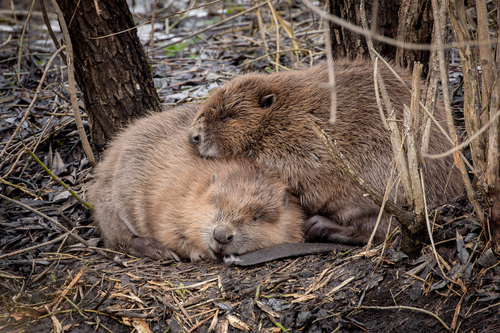
Stocky body covered in dense brown fur ranging from reddish-brown to almost black, with a broad flat, scaly, paddle-shaped tail and large orange incisors.
Size
Body length typically 74-90 cm including a tail of 20-35 cm.
Weight
Adults typically weigh 16-32 kg, with some individuals reaching over 40 kg; sexes are similar in size.
Distinctive features
Distinguished from the Eurasian beaver by skull shape, chromosome number, and slightly smaller size; the paddle-shaped tail and large webbed hind feet are diagnostic among North American mammals.
Behaviour and diet of the North American Beaver
Beavers live in family units called colonies, typically consisting of a monogamous breeding pair, kits, and yearlings; they are territorial, marking boundaries with scent mounds of castoreum.
When it is active
Primarily nocturnal and crepuscular, though they may be active during the day, especially in undisturbed areas.
Diet
Herbivorous, feeding on bark, cambium, leaves, and twigs of trees like aspen, willow, and birch, as well as aquatic plants, roots, and grasses in warmer months.
Communication
Beavers communicate through tail-slapping on water to signal danger, vocalizations such as whines and grunts, and scent marking with castoreum from specialized glands.
Interactions with other species
Predators include wolves, coyotes, bears, and large birds of prey targeting kits; beaver-created wetlands provide critical habitat for fish, amphibians, waterfowl, and other wildlife, making them important ecosystem facilitators.
Role in its ecosystem
As a keystone species and ecosystem engineer, beavers create wetlands through dam-building that increase biodiversity, improve water quality, recharge groundwater, and mitigate downstream flooding.
Reproduction and lifecycle
Mating occurs in winter (January-February), with a gestation period of about 105-107 days; females give birth to 1-6 kits in late spring, usually once per year.
Raising the young
Both parents and older siblings help care for kits, which are precocial but remain in the family lodge for up to two years before dispersing to establish their own territories.
Maturity and lifespan
Sexual maturity is reached around 2-3 years of age; lifespan in the wild is typically 10-12 years, while captive individuals can live up to 20 years.
Taxonomy and naming of the North American Beaver
Classification
Class Mammalia > Order Rodentia > Family Castoridae > Genus Castor > Species Castor canadensis
Subspecies
Several subspecies have been described (e.g., C. c. canadensis, C. c. acadicus, C. c. carolinensis, C. c. pacificus, C. c. missouriensis), differentiated mainly by geographic range across North America; taxonomic validity of many subspecies is debated.
Scientific synonyms
Castor americanus (historical synonym); sometimes still confused taxonomically with Castor fiber, the Eurasian beaver.
What research says
Recent studies
Recent studies focus on beavers' role in climate change mitigation through wetland carbon storage and their use in ecological restoration projects to combat drought and improve watershed resilience.
Genome and DNA
Castor canadensis has a diploid chromosome number of 40, which distinguishes it genetically from the Eurasian beaver (Castor fiber), which has 48 chromosomes; the two species cannot interbreed successfully.
Compared with similar species
Similar to the Eurasian beaver (Castor fiber) in appearance and ecology but genetically distinct with different chromosome numbers; generally larger than muskrats, which share aquatic habitats but lack the flat paddle tail and dam-building behavior.
The North American Beaver and people
Beavers can hold their breath underwater for up to 15 minutes; their dams can grow so large they are visible from space, including one in Alberta, Canada exceeding 850 meters in length.
Where and how to see it
Best observed at dawn or dusk near ponds, streams, or wetlands with visible dams or lodges; quiet observation from a distance in spring and summer increases chances of seeing active beavers.
Risks to humans
Generally low risk to humans, though beavers can carry Giardia which contaminates water sources; direct aggressive encounters are rare unless the animal is cornered or defending young.
Human uses
Historically trapped extensively for fur used in hats and clothing during the North American fur trade; today used in wildlife tourism and increasingly valued for ecosystem restoration and water management services.
Myths and legends
In many Indigenous North American cultures, the beaver is regarded as a symbol of hard work, industriousness, and community; it is also the national animal of Canada, symbolizing the historic fur trade that shaped the country's economy.
Countries where the North American Beaver is recorded
The 5 countries named in the range description of its IUCN Red List assessment.
Questions about the North American Beaver
Where does the North American Beaver live?
The North American Beaver is recorded in Argentina, Canada, Chile, Mexico and United States across North America and South America. These countries come from the range description of its IUCN Red List assessment, and they are what place the species on the interactive map.
Is the North American Beaver endangered?
The IUCN Red List assesses the North American Beaver as Least Concern. The species is widespread and abundant enough not to qualify for any threatened category. It does not mean the species is safe forever, only that nothing in the current data raises an alarm.
How many are left in the wild?
Estimated at several million individuals across North America (commonly cited figures range from 10-15 million), with populations stable to increasing after historic lows in the early 20th century. This figure comes from the species assessment on the IUCN Red List; population estimates for wild mammals are ranges, not counts, and are revised at each assessment.
What habitat does the North American Beaver live in?
Freshwater habitats including rivers, streams, lakes, ponds, and wetlands bordered by deciduous trees such as aspen, willow, birch, and maple, which provide both food and building material.
What is the scientific name of the North American Beaver?
The North American Beaver is Castor canadensis, in the family Castoridae, order Rodentia.
Other species in the genus Castor
Species that share its range
Sources
Conservation status, range description and population estimate come from the IUCN Red List assessment for Castor canadensis. Countries are derived from that range description, not from a mapped country list. Last refreshed on .
The distribution map is drawn from the IUCN Red List spatial data compiled in 2016. IUCN (International Union for Conservation of Nature)