
Cutch Rock-rat
Cremnomys cutchicus
Red List assessment
Least Concernon the IUCN Red List
- EXExtinct
- EWExtinct in the Wild
- CRCritically Endangered
- ENEndangered
- VUVulnerable
- NTNear Threatened
- LCLeast Concern
The Cutch Rock-rat is recorded in one country, India across Asia. The IUCN Red List assesses the Cutch Rock-rat as Least Concern. No precise global population estimate exists; considered locally common in suitable rocky habitat with a presumed stable trend.
- Family
- Muridae
- Order
- Rodentia
- Genus
- Cremnomys
- Countries recorded
- 1
- Continents
- Asia
- Red List category
- Least Concern
- Data updated
- August 9, 2026
What is the Cutch Rock-rat?
The Cutch Rock-rat is a small murid rodent native to rocky and hilly terrain of western and central India. It is named after the Kutch region of Gujarat where it was first described. This species is adapted to arid and semi-arid rocky habitats, using crevices for shelter, and remains relatively poorly studied compared to more common rodent species.
Where does the Cutch Rock-rat live?
India (Gujarat, Maharashtra, Madhya Pradesh, and other central/western states)
Endemic to India, primarily found in Gujarat (Kutch region), Maharashtra, Madhya Pradesh, and parts of the Deccan Plateau in central and western India.
Altitude and depth
Typically found at low to moderate elevations, roughly 0-900m above sea level, in rocky hill terrain.
Seasonal movements
No long-distance migration; activity may be reduced during extreme summer heat, with rodents retreating deeper into rock crevices for thermal protection.
Habitat of the Cutch Rock-rat
Rocky outcrops, hills, and stony/boulder-strewn terrain in dry deciduous forests and scrubland. Also found in association with human settlements near rocky areas, using crevices and boulder piles as shelter.
Adaptations to its environment
Possesses strong claws and agile climbing ability suited for navigating rocky crevices and boulder fields. Nocturnal habits and crevice-dwelling behavior help it avoid extreme daytime temperatures in arid habitats.
Conservation status and numbers
Listed as Least Concern (LC) by IUCN due to a relatively wide distribution across suitable rocky habitats in India and presumed stable population, though detailed population data is limited.
Estimated population
No precise global population estimate exists; considered locally common in suitable rocky habitat with a presumed stable trend.
What threatens the Cutch Rock-rat?
Habitat degradation from quarrying and mining of rocky outcrops, agricultural expansion, and human settlement encroachment into rocky habitats.
Diseases and parasites
No specific diseases or parasites well-documented for this species; likely susceptible to common rodent ectoparasites and endoparasites found in similar murids.
What is being done to protect it?
No species-specific conservation programs are known; benefits indirectly from protection of rocky habitats within some Indian wildlife sanctuaries and protected areas.
Recommended actions
Further ecological surveys to better understand population status and distribution, and protection of rocky habitat patches from quarrying activities.
What the Cutch Rock-rat looks like
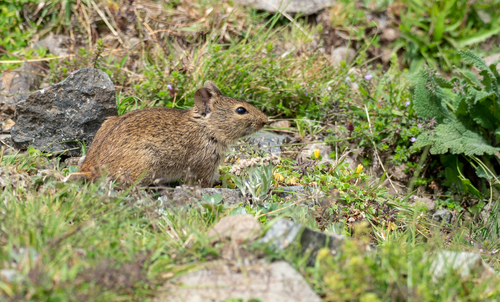
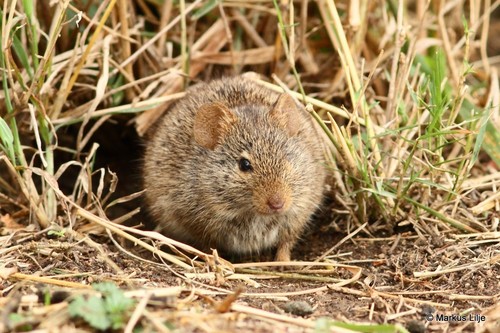
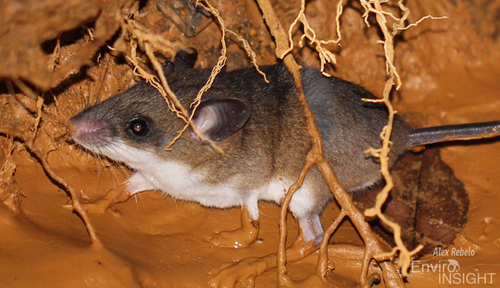
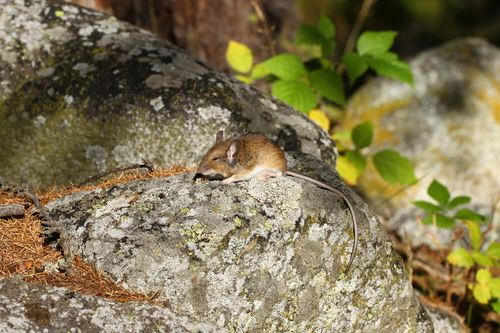
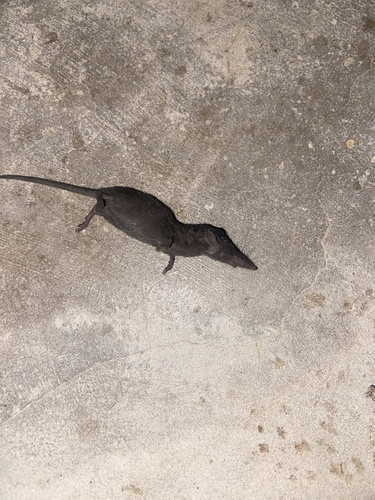
Grayish-brown to sandy-brown dorsal fur blending with rocky substrate, with paler underparts. Body is moderately robust with a long, mostly hairless or sparsely-haired tail.
Size
Head-body length approximately 12-15 cm, with tail length roughly equal to or slightly longer than the body.
Weight
Approximately 40-80 grams, similar to other Cremnomys species.
Distinctive features
Distinguished from related rat species by specific cranial and dental features, coloration matching rocky habitats, and habitat preference for rock crevices rather than burrows in soil.
Differences between males and females
Minimal sexual dimorphism; males and females are similar in size and coloration with no pronounced external differences.
Behaviour and diet of the Cutch Rock-rat
Generally solitary or found in small family groups, using rock crevices as individual or shared shelter sites.
When it is active
Primarily nocturnal, foraging at night and resting in rock crevices during the day to avoid heat and predators.
Diet
Omnivorous, feeding on seeds, grains, plant matter, and likely some insects, similar to other rock-dwelling murid rodents.
How it feeds and hunts
Forages opportunistically on the ground and among rocks for seeds, plant material, and small invertebrates; not an active hunter.
Communication
Likely relies on scent marking, ultrasonic vocalizations, and tactile communication typical of murid rodents, though specific studies on this species are scarce.
Interactions with other species
Predated upon by small carnivores, raptors, and snakes native to rocky habitats; may compete with other small rodents for food and shelter resources.
Role in its ecosystem
Plays a role in local ecosystems as a seed disperser and prey species for small predators, contributing to rocky habitat food webs.
Reproduction and lifecycle
Breeding likely occurs during favorable seasons with adequate food availability; litter sizes are presumed small to moderate (3-6 young) based on related species, though specific data is limited.
Raising the young
Presumed altricial young cared for primarily by the mother in a nest within rock crevices, similar to related murid rodents, though detailed behavioral studies are lacking.
Maturity and lifespan
Sexual maturity likely reached within a few months, consistent with small murid rodents; wild lifespan probably 1-2 years, though captive data is unavailable.
Taxonomy and naming of the Cutch Rock-rat
Classification
Class Mammalia > Order Rodentia > Family Muridae > Genus Cremnomys > Species Cremnomys cutchicus
Scientific synonyms
Rattus cutchicus, Golunda cutchica (older classifications placed this species in different genera before Cremnomys was established)
What research says
Recent studies
Limited recent taxonomic and ecological studies exist; most research is historical, focusing on initial species description and basic distribution records.
Compared with similar species
Similar to other Cremnomys species and related genera like Golunda, but distinguished by specific rocky habitat preference and cranial morphology; less arboreal than some related murids.
The Cutch Rock-rat and people
This species was first described from the Kutch (Cutch) region of Gujarat, giving it its common name. It is one of several poorly-studied rock-dwelling rodents endemic to India's rocky plateau regions.
Where and how to see it
Best observed at night using spotlighting techniques in rocky hill habitats of Gujarat or Maharashtra; patience is required as this species is elusive and not well-studied in the wild.
Risks to humans
No notable risk to humans; as with all rodents, may carry parasites but poses no significant direct threat.
Countries where the Cutch Rock-rat is recorded
The 1 countries named in the range description of its IUCN Red List assessment.
Questions about the Cutch Rock-rat
Where does the Cutch Rock-rat live?
The Cutch Rock-rat is recorded in India across Asia. These countries come from the range description of its IUCN Red List assessment, and they are what place the species on the interactive map.
Is the Cutch Rock-rat endangered?
The IUCN Red List assesses the Cutch Rock-rat as Least Concern. The species is widespread and abundant enough not to qualify for any threatened category. It does not mean the species is safe forever, only that nothing in the current data raises an alarm.
How many are left in the wild?
No precise global population estimate exists; considered locally common in suitable rocky habitat with a presumed stable trend. This figure comes from the species assessment on the IUCN Red List; population estimates for wild mammals are ranges, not counts, and are revised at each assessment.
What habitat does the Cutch Rock-rat live in?
Rocky outcrops, hills, and stony/boulder-strewn terrain in dry deciduous forests and scrubland.
What is the scientific name of the Cutch Rock-rat?
The Cutch Rock-rat is Cremnomys cutchicus, in the family Muridae, order Rodentia.
Other species in the genus Cremnomys
Other species in the family Muridae
Species that share its range
Sources
Conservation status, range description and population estimate come from the IUCN Red List assessment for Cremnomys cutchicus. Countries are derived from that range description, not from a mapped country list. Last refreshed on .
The distribution map is drawn from the IUCN Red List spatial data compiled in 2008. IUCN (International Union for Conservation of Nature)