
Burmese Short-tailed Shrew
Blarinella wardi
Red List assessment
Least Concernon the IUCN Red List
- EXExtinct
- EWExtinct in the Wild
- CRCritically Endangered
- ENEndangered
- VUVulnerable
- NTNear Threatened
- LCLeast Concern
The Burmese Short-tailed Shrew is recorded in 2 countries across Asia. The IUCN Red List assesses the Burmese Short-tailed Shrew as Least Concern. No precise population estimate exists; presumed stable based on current habitat availability within its limited range
- Family
- Soricidae
- Order
- Eulipotyphla
- Genus
- Blarinella
- Countries recorded
- 2
- Continents
- Asia
- Red List category
- Least Concern
- Data updated
- August 9, 2026
What is the Burmese Short-tailed Shrew?
Blarinella wardi, commonly known as Ward's short-tailed shrew, is a small insectivorous mammal native to the mountainous forests of northern Myanmar and adjacent Yunnan, China. It belongs to a poorly studied genus of short-tailed shrews restricted to montane Southeast Asia. Its remarkable adaptation to high-altitude, cool, humid forest floors and its relatively restricted range make it an interesting subject for biogeographic studies of the Himalayan-Indochinese transition zone.
Where does the Burmese Short-tailed Shrew live?
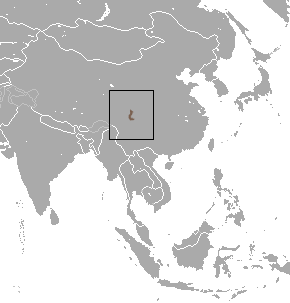
Northern Myanmar (Kachin State) and adjacent parts of southwestern China (Yunnan Province)
Restricted to northern Myanmar, particularly the Kachin State highlands, with a possible extension into southwestern Yunnan, China. The species occupies a narrow biogeographic corridor linking the Himalayas to the Indochinese peninsula.
Altitude and depth
Approximately 1500-3000 meters above sea level
Seasonal movements
No long-distance migration; likely reduces surface activity during colder winter months at higher elevations, though detailed seasonal behavior data is lacking
Habitat of the Burmese Short-tailed Shrew
Found in montane broadleaf and mixed coniferous-broadleaf forests, often with dense leaf litter and moist understory vegetation. It prefers cool, humid environments typical of subtropical to temperate highland forests.
Adaptations to its environment
Possesses a compact, muscular body and strong forelimbs suited for burrowing through leaf litter and loose soil to find invertebrate prey. Dense, water-resistant fur helps maintain body temperature in cool, humid montane climates.
Conservation status and numbers
Listed as Least Concern (LC) by the IUCN due to its relatively stable population and lack of evidence for significant range-wide decline, though its restricted distribution warrants monitoring.
Estimated population
No precise population estimate exists; presumed stable based on current habitat availability within its limited range
What threatens the Burmese Short-tailed Shrew?
Habitat loss from deforestation, agricultural expansion, and logging in its montane forest range; climate change may also alter suitable high-altitude habitat over time.
Diseases and parasites
Specific pathogens are undocumented, but like other shrews it likely hosts ectoparasites such as mites and fleas, and endoparasites like nematodes
What is being done to protect it?
No species-specific conservation programs are known; general forest protection measures in Myanmar and China's protected mountain areas may incidentally benefit this species
Recommended actions
Conduct further field surveys to clarify population size and distribution, protect remaining montane forest habitat, and monitor effects of deforestation and climate change on range shifts
What the Burmese Short-tailed Shrew looks like
Small shrew with dense, dark grayish-brown to blackish fur, a pointed snout, tiny eyes, and a notably short tail relative to body length, characteristic of the genus Blarinella.
Size
Body length approximately 60-75 mm, with a short tail of about 25-35 mm
Weight
Approximately 8-15 grams
Distinctive features
Distinguished from related Blarinella species by subtle differences in skull morphology, tooth structure, and tail length proportions, which require careful anatomical examination to differentiate reliably.
Differences between males and females
Minimal sexual dimorphism reported, with males and females similar in size and coloration
Behaviour and diet of the Burmese Short-tailed Shrew
Solitary and territorial, like most shrews, with limited social interaction outside of breeding encounters
When it is active
Primarily active both day and night in short bursts, reflecting the high metabolic demands typical of shrews requiring near-constant foraging
Diet
Insectivorous, feeding mainly on soil and leaf-litter invertebrates such as insects, earthworms, and other small arthropods
How it feeds and hunts
Forages by probing through leaf litter and soil with its sensitive snout, relying on smell and touch rather than vision to detect prey
Communication
Likely uses high-frequency vocalizations, scent marking via specialized skin glands, and tactile cues, consistent with other shrew species
Interactions with other species
Preyed upon by small carnivorous mammals, owls, and snakes; competes with other small insectivores for similar leaf-litter invertebrate prey
Role in its ecosystem
Plays a role in controlling invertebrate populations in forest leaf litter and contributes to nutrient cycling through its foraging and burrowing activities
Reproduction and lifecycle
Breeding biology is poorly documented, but likely follows the general shrew pattern with short gestation periods (around 20-25 days) and small litters of 3-6 young
Raising the young
Presumed maternal care typical of shrews, with the mother nursing and protecting the altricial young until weaning at a few weeks of age
Maturity and lifespan
Sexual maturity likely reached within a few months, with a typical wild lifespan of 1-2 years, consistent with the short-lived life history of shrews
Taxonomy and naming of the Burmese Short-tailed Shrew
Classification
Class Mammalia > Order Eulipotyphla > Family Soricidae > Genus Blarinella > Species Blarinella wardi
Scientific synonyms
Originally described as Blarinella quadraticauda wardi; sometimes treated as a subspecies of Blarinella quadraticauda before being elevated to full species status
What research says
Recent studies
Recent taxonomic revisions using morphological and molecular data have helped clarify species boundaries within the genus Blarinella, including the distinct status of B. wardi
Compared with similar species
Similar to other Blarinella species such as Blarinella quadraticauda and Blarinella griselda, but distinguished by subtle cranial and dental characteristics and a more restricted geographic range
The Burmese Short-tailed Shrew and people
Ward's short-tailed shrew belongs to one of the least-studied shrew genera in the world, and its extremely high metabolism requires it to eat several times its body weight in food daily to survive.
Where and how to see it
Best observed by biologists using live-trapping methods in montane forest leaf litter in Kachin State, Myanmar, during cooler months when activity may be more concentrated near the surface; direct wild sightings are extremely rare due to its secretive, subterranean lifestyle.
Risks to humans
No notable risk to humans
Countries where the Burmese Short-tailed Shrew is recorded
The 2 countries named in the range description of its IUCN Red List assessment.
Questions about the Burmese Short-tailed Shrew
Where does the Burmese Short-tailed Shrew live?
The Burmese Short-tailed Shrew is recorded in China and Myanmar across Asia. These countries come from the range description of its IUCN Red List assessment, and they are what place the species on the interactive map.
Is the Burmese Short-tailed Shrew endangered?
The IUCN Red List assesses the Burmese Short-tailed Shrew as Least Concern. The species is widespread and abundant enough not to qualify for any threatened category. It does not mean the species is safe forever, only that nothing in the current data raises an alarm.
How many are left in the wild?
No precise population estimate exists; presumed stable based on current habitat availability within its limited range This figure comes from the species assessment on the IUCN Red List; population estimates for wild mammals are ranges, not counts, and are revised at each assessment.
What habitat does the Burmese Short-tailed Shrew live in?
Found in montane broadleaf and mixed coniferous-broadleaf forests, often with dense leaf litter and moist understory vegetation.
What is the scientific name of the Burmese Short-tailed Shrew?
The Burmese Short-tailed Shrew is Blarinella wardi, in the family Soricidae, order Eulipotyphla.
Other species in the genus Blarinella

Other species in the family Soricidae



Species that share its range
Sources
Conservation status, range description and population estimate come from the IUCN Red List assessment for Blarinella wardi. Countries are derived from that range description, not from a mapped country list. Last refreshed on .
The distribution map is drawn from the IUCN Red List spatial data compiled in 2008. IUCN (International Union for Conservation of Nature)