
Blue Duiker
Philantomba monticola
Red List assessment
Least Concernon the IUCN Red List
- EXExtinct
- EWExtinct in the Wild
- CRCritically Endangered
- ENEndangered
- VUVulnerable
- NTNear Threatened
- LCLeast Concern
The Blue Duiker is recorded in 7 countries across Africa. The IUCN Red List assesses the Blue Duiker as Least Concern. Population size is not precisely quantified but estimated to be in the hundreds of thousands to low millions across its range; overall trend is considered stable to locally declining due to hunting pressure.
- Family
- Bovidae
- Order
- Artiodactyla
- Genus
- Philantomba
- Countries recorded
- 7
- Continents
- Africa
- Red List category
- Least Concern
- Data updated
- August 9, 2026
What is the Blue Duiker?
The Blue Duiker is the smallest African antelope species, inhabiting dense tropical and subtropical forests across Central and West Africa. Despite its name, its coat is not truly blue but a dark grayish-brown with a bluish sheen in certain light. It is remarkable for its shy, elusive nature and its critical ecological role as a seed disperser in forest ecosystems. This tiny ungulate has adapted well to forest life and remains one of the most abundant duiker species despite ongoing hunting pressure.
Where does the Blue Duiker live?
Central and West Africa, including Angola, Democratic Republic of Congo, Cameroon, Gabon, Republic of Congo, and parts of South Africa's coastal forests
Widely distributed across Central and West Africa, from Senegal through Nigeria, Cameroon, Gabon, Congo Basin countries, to Angola, and south to coastal KwaZulu-Natal in South Africa. Range follows the extent of forested habitats.
Altitude and depth
Sea level to approximately 2,500 meters, though most populations occur in lowland forests below 1,500 meters
Seasonal movements
No true migration; breeding can occur year-round though birth peaks may correlate with fruit availability seasons in some regions
Habitat of the Blue Duiker
Dense lowland tropical rainforest, montane forest, secondary forest, and forest edges with thick undergrowth. Also found in coastal forest patches in South Africa. Requires dense cover for concealment from predators.
Adaptations to its environment
Small compact body allows rapid movement through dense undergrowth; excellent camouflage coloration matches forest shadows; keen senses of hearing and smell compensate for limited visibility in thick vegetation; can freeze motionless to avoid detection.
Conservation status and numbers
Least Concern (LC) according to IUCN, reflecting its wide distribution and relatively large remaining population despite localized declines from hunting and habitat loss in parts of its range.
Estimated population
Population size is not precisely quantified but estimated to be in the hundreds of thousands to low millions across its range; overall trend is considered stable to locally declining due to hunting pressure.
What threatens the Blue Duiker?
Bushmeat hunting and snaring is the primary threat, particularly severe in West and Central Africa where it is a preferred hunting target; habitat loss from deforestation, logging, and agricultural expansion also reduces available range.
Diseases and parasites
Susceptible to various internal parasites including nematodes and external parasites like ticks; also documented as a host for certain trypanosome infections in some studies.
What is being done to protect it?
Protected within numerous national parks and forest reserves across its range including Dzanga-Sangha (CAR), Korup National Park (Cameroon), and various West African protected areas; regulated hunting exists in some regions.
Recommended actions
Strengthen anti-poaching enforcement in protected areas, promote sustainable bushmeat alternatives for local communities, maintain forest connectivity to prevent habitat fragmentation, and conduct more comprehensive population surveys.
What the Blue Duiker looks like
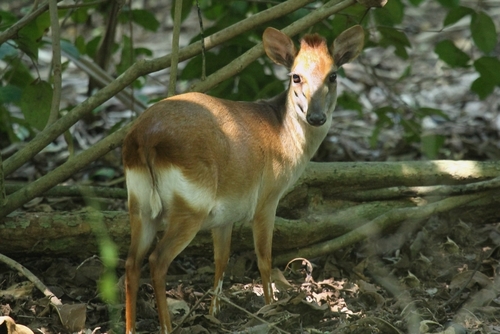
Small, compact antelope with short legs, rounded back, and a slate-gray to dark brown coat with a subtle bluish tinge, particularly visible on the flanks. Underparts are lighter, often white or cream colored. Both sexes have short, straight spike-like horns.
Size
Shoulder height 30-40 cm, body length 55-90 cm
Weight
3.5-9 kg, with females slightly larger than males on average
Distinctive features
Distinguished from other duiker species by its small size, distinctive bluish-gray sheen, and short horns present in both sexes; also has a small tuft of hair on the forehead.
Differences between males and females
Minimal sexual dimorphism; females are typically slightly larger and heavier than males, but both sexes possess horns of similar size
Behaviour and diet of the Blue Duiker
Generally monogamous, living in pairs or small family groups within defended territories; territories are marked and maintained by both partners.
When it is active
Primarily diurnal with peak activity in early morning and late afternoon, though some nocturnal activity has been observed, particularly in areas with high human disturbance.
Diet
Herbivorous, feeding mainly on fallen fruits, leaves, flowers, and fungi found on the forest floor; occasionally consumes insects and small invertebrates, making it partially omnivorous.
Communication
Uses vocalizations including whistles and bleats to communicate alarm or contact calls; scent marking via preorbital glands is used for territory demarcation; body postures signal alertness or submission.
Interactions with other species
Preyed upon by leopards, pythons, eagles, and various forest predators; also hunted extensively by humans; may share habitat with other duiker species with minimal direct competition due to differing microhabitat preferences.
Role in its ecosystem
Plays a significant role as a seed disperser for numerous forest plant species by consuming and excreting fruit seeds across the forest floor, contributing to forest regeneration and plant diversity.
Reproduction and lifecycle
Breeding occurs year-round with no strict seasonal pattern; gestation lasts approximately 4 months (120 days), typically resulting in a single offspring, rarely twins.
Raising the young
Mother provides primary care, nursing the calf for several months while it remains hidden in dense vegetation; the calf begins following the mother and eating solid food within weeks but maintains close association with parents for an extended period.
Maturity and lifespan
Sexual maturity reached around 12 months of age; lifespan in the wild is approximately 5-10 years, while captive individuals may live up to 15 years.
Taxonomy and naming of the Blue Duiker
Classification
Class Mammalia > Order Artiodactyla > Family Bovidae > Genus Philantomba > Species Philantomba monticola
Subspecies
Several subspecies recognized including P. m. monticola (South Africa), P. m. congicus (Congo Basin), P. m. aequatorialis (Central Africa), and P. m. lophoides (West Africa), though taxonomy remains debated.
Scientific synonyms
Cephalophus monticola (former genus classification before Philantomba was resurrected)
What research says
Recent studies
Recent camera trap and genetic studies have helped refine understanding of population densities and taxonomic status of various subspecies, revealing greater genetic diversity than previously recognized within different regional populations.
Genome and DNA
Diploid chromosome number reported as 2n=58; genetic studies have helped clarify subspecies boundaries and phylogenetic relationships within Philantomba.
Compared with similar species
Similar in appearance to other small forest duikers like the Maxwell's Duiker (Philantomba maxwellii) of West Africa, though the two species have largely non-overlapping ranges with the blue duiker occurring more in Central and East-Central Africa.
The Blue Duiker and people
The Blue Duiker is one of the smallest antelope species in the world, weighing less than a house cat. Despite its tiny size, it is one of the most heavily hunted mammals for bushmeat in West and Central Africa due to its abundance. It can leap remarkable distances relative to its body size when startled.
Where and how to see it
Best observed in protected reserves like Dzanga-Sangha (Central African Republic) or Korup National Park (Cameroon) during early morning hours; patience and quiet movement through forest trails increase chances of sighting this shy, elusive species.
Risks to humans
No notable risk to humans; the species is not aggressive and poses no direct threat.
Human uses
Widely hunted for bushmeat, representing one of the most commonly traded wild meat species in West and Central African markets; also occasionally kept in captivity for zoological display and research purposes.
Myths and legends
In some Central African cultures, duikers feature in folklore as clever, elusive characters symbolizing cunning and evasiveness, similar to trickster figures in oral storytelling traditions.
Countries where the Blue Duiker is recorded
The 7 countries named in the range description of its IUCN Red List assessment.
Questions about the Blue Duiker
Where does the Blue Duiker live?
The Blue Duiker is recorded in Angola, Cameroon, Democratic Republic of the Congo, Gabon and Nigeria, among 7 countries in total across Africa. These countries come from the range description of its IUCN Red List assessment, and they are what place the species on the interactive map.
Is the Blue Duiker endangered?
The IUCN Red List assesses the Blue Duiker as Least Concern. The species is widespread and abundant enough not to qualify for any threatened category. It does not mean the species is safe forever, only that nothing in the current data raises an alarm.
How many are left in the wild?
Population size is not precisely quantified but estimated to be in the hundreds of thousands to low millions across its range; overall trend is considered stable to locally declining due to hunting pressure. This figure comes from the species assessment on the IUCN Red List; population estimates for wild mammals are ranges, not counts, and are revised at each assessment.
What habitat does the Blue Duiker live in?
Dense lowland tropical rainforest, montane forest, secondary forest, and forest edges with thick undergrowth.
What is the scientific name of the Blue Duiker?
The Blue Duiker is Philantomba monticola, in the family Bovidae, order Artiodactyla.
Other species in the genus Philantomba
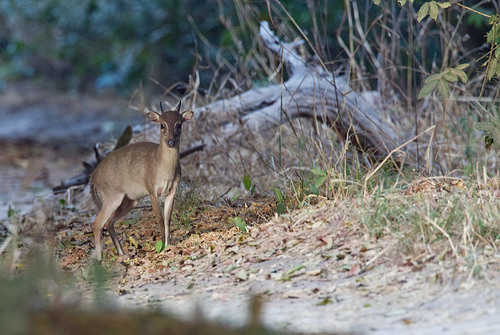
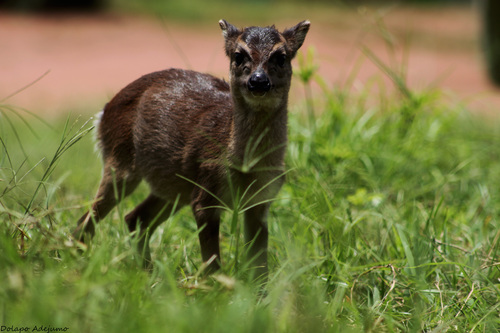
Other species in the family Bovidae
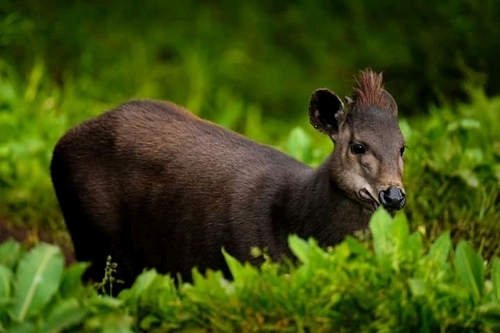
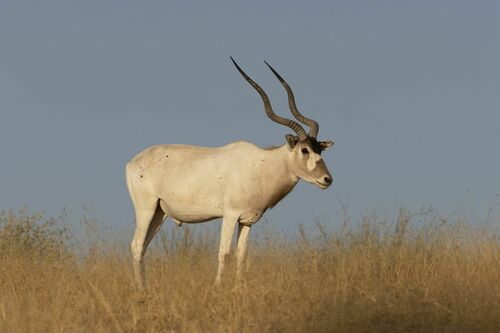
Species that share its range

Sources
Conservation status, range description and population estimate come from the IUCN Red List assessment for Philantomba monticola. Countries are derived from that range description, not from a mapped country list. Last refreshed on .
The distribution map is drawn from the IUCN Red List spatial data compiled in 2016. IUCN (International Union for Conservation of Nature)