
Maxwell's Duiker
Philantomba maxwellii
Red List assessment
Least Concernon the IUCN Red List
- EXExtinct
- EWExtinct in the Wild
- CRCritically Endangered
- ENEndangered
- VUVulnerable
- NTNear Threatened
- LCLeast Concern
The Maxwell's Duiker is recorded in 11 countries across Africa. The IUCN Red List assesses the Maxwell's Duiker as Least Concern. No precise global population estimate exists, but the species remains locally common in suitable habitat; overall trend is considered stable to slightly declining in heavily hunted areas.
- Family
- Bovidae
- Order
- Artiodactyla
- Genus
- Philantomba
- Countries recorded
- 11
- Continents
- Africa
- Red List category
- Least Concern
- Data updated
- August 9, 2026
What is the Maxwell's Duiker?
Maxwell's Duiker is a small, secretive forest antelope native to West Africa, one of the smallest duiker species. It inhabits dense tropical forests and thickets where its small size and cryptic coloration allow it to move stealthily through undergrowth. This species is notable for its wide distribution across coastal West Africa and its adaptability to secondary and degraded forest habitats. It plays an important ecological role as a seed disperser in forest ecosystems.
Where does the Maxwell's Duiker live?
West Africa, primarily coastal forests from Senegal and Gambia through Guinea, Sierra Leone, Liberia, Côte d'Ivoire, Ghana, Togo, Benin, and Nigeria
Found across coastal West Africa from Senegal and Gambia eastward through Guinea-Bissau, Guinea, Sierra Leone, Liberia, Côte d'Ivoire, Ghana, Togo, Benin, and into southwestern Nigeria, generally within the Upper Guinean forest belt.
Altitude and depth
Primarily lowland, from sea level up to approximately 1000 meters elevation
Seasonal movements
No true migration; breeding can occur year-round though some populations show slight birth peaks correlating with rainy seasons.
Habitat of the Maxwell's Duiker
Primary and secondary lowland tropical rainforest, gallery forests, dense thickets, and forest edges; also found in agricultural mosaics and degraded forest patches with sufficient cover.
Adaptations to its environment
Small compact body and low-slung build allow efficient movement through dense understory vegetation; excellent camouflage coloration blends with forest floor litter; keen senses of hearing and smell aid predator detection in low-visibility habitat.
Conservation status and numbers
Listed as Least Concern by IUCN due to its wide distribution and relatively large remaining population, though it faces localized declines from hunting and habitat loss in parts of its range.
Estimated population
No precise global population estimate exists, but the species remains locally common in suitable habitat; overall trend is considered stable to slightly declining in heavily hunted areas.
What threatens the Maxwell's Duiker?
Bushmeat hunting and snaring represent the primary threat, alongside habitat loss from deforestation, agricultural expansion, and logging across West Africa.
Diseases and parasites
Susceptible to various internal parasites including gastrointestinal nematodes and external parasites such as ticks; specific disease studies remain limited.
What is being done to protect it?
Protected within several West African national parks and reserves including Taï National Park (Côte d'Ivoire) and Gola Rainforest (Sierra Leone/Liberia); regulated under national wildlife laws, though enforcement varies.
Recommended actions
Strengthen anti-poaching enforcement, promote sustainable bushmeat alternatives for local communities, and expand protected forest corridors to maintain habitat connectivity.
What the Maxwell's Duiker looks like
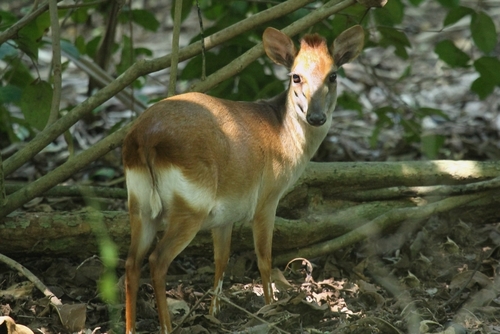
Small, compact antelope with reddish-brown to grayish-brown short fur, a dark dorsal stripe, pale underparts, and a distinctive dark facial blaze; short backward-curving horns present in both sexes.
Size
Head-body length approximately 70-90 cm; shoulder height around 30-40 cm
Weight
Typically 8-12 kg, with limited difference between males and females
Distinctive features
Distinguished from other duiker species by its smaller size, grayish tone, and the characteristic black tuft of hair between the horns; overall smaller and more grayish than the closely related blue duiker in some regions.
Differences between males and females
Minimal sexual dimorphism; both sexes bear short horns, though females' horns may be slightly shorter or thinner than males'.
Behaviour and diet of the Maxwell's Duiker
Generally solitary or found in monogamous pairs that maintain and defend a shared territory; occasional small family groups with recent offspring.
When it is active
Primarily crepuscular and nocturnal, though some diurnal activity occurs in undisturbed areas with low hunting pressure.
Diet
Herbivorous, feeding mainly on fallen fruits, leaves, seeds, flowers, and fungi found on the forest floor; occasionally consumes small invertebrates.
Communication
Communicates through scent marking via preorbital glands to mark territory, along with soft vocalizations and alarm whistles when startled or threatened.
Interactions with other species
Preyed upon by leopards, large forest eagles, pythons, and humans; competes for food resources with other small forest ungulates and rodents.
Role in its ecosystem
Functions as an important seed disperser for many forest plant species through consumption and passage of fruit seeds, contributing to forest regeneration.
Reproduction and lifecycle
Breeding occurs year-round with no strict seasonal pattern; gestation lasts approximately 4 months, typically resulting in a single offspring per birth.
Raising the young
Females provide primary care, nursing and protecting the calf which hides in dense vegetation for the first weeks of life; young become independent within several months.
Maturity and lifespan
Reaches sexual maturity around 9-12 months of age; lifespan in the wild is estimated at 8-10 years, with captive individuals sometimes living longer.
Taxonomy and naming of the Maxwell's Duiker
Classification
Class Mammalia > Order Artiodactyla > Family Bovidae > Genus Philantomba > Species P. maxwellii
Scientific synonyms
Cephalophus maxwellii; formerly classified within genus Cephalophus before Philantomba was recognized as distinct
What research says
Recent studies
Recent genetic and taxonomic studies have helped clarify the distinction between Philantomba maxwellii and the closely related Philantomba monticola (blue duiker), confirming them as separate species rather than subspecies.
Compared with similar species
Closely resembles the blue duiker (Philantomba monticola) but is generally larger and more grayish-brown rather than bluish-slate in coloration; ranges are largely allopatric with limited overlap.
The Maxwell's Duiker and people
Maxwell's Duiker can freeze motionless for extended periods to avoid detection by predators; its name honors a British collector, and despite being an antelope, it uses dense thickets much like a small forest recluse.
Where and how to see it
Best observed at dawn or dusk in protected forest reserves such as Taï National Park or Gola Rainforest, using quiet movement and patience near forest trails or water sources.
Risks to humans
No notable risk to humans; the species is shy and avoids human contact.
Human uses
Widely hunted as a source of bushmeat throughout its range, and its skin is sometimes used locally for leather or traditional crafts.
Myths and legends
In some West African cultures, duikers feature in folklore as clever, elusive tricksters symbolizing agility and cunning, similar to other small forest antelope in regional storytelling traditions.
Countries where the Maxwell's Duiker is recorded
The 11 countries named in the range description of its IUCN Red List assessment.
Questions about the Maxwell's Duiker
Where does the Maxwell's Duiker live?
The Maxwell's Duiker is recorded in Benin, Gambia, Ghana, Guinea and Guinea-Bissau, among 11 countries in total across Africa. These countries come from the range description of its IUCN Red List assessment, and they are what place the species on the interactive map.
Is the Maxwell's Duiker endangered?
The IUCN Red List assesses the Maxwell's Duiker as Least Concern. The species is widespread and abundant enough not to qualify for any threatened category. It does not mean the species is safe forever, only that nothing in the current data raises an alarm.
How many are left in the wild?
No precise global population estimate exists, but the species remains locally common in suitable habitat; overall trend is considered stable to slightly declining in heavily hunted areas. This figure comes from the species assessment on the IUCN Red List; population estimates for wild mammals are ranges, not counts, and are revised at each assessment.
What habitat does the Maxwell's Duiker live in?
Primary and secondary lowland tropical rainforest, gallery forests, dense thickets, and forest edges; also found in agricultural mosaics and degraded forest patches with sufficient cover.
What is the scientific name of the Maxwell's Duiker?
The Maxwell's Duiker is Philantomba maxwellii, in the family Bovidae, order Artiodactyla.
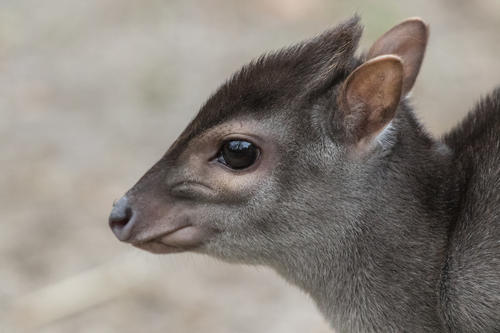
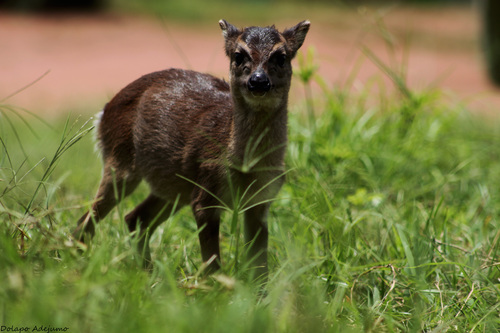
Other species in the genus Philantomba
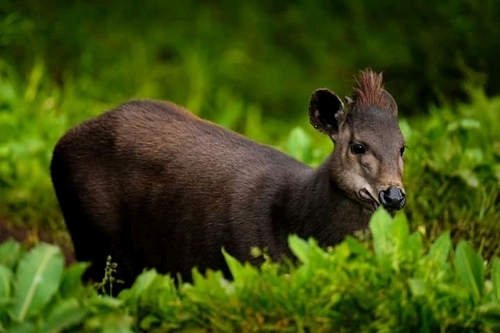
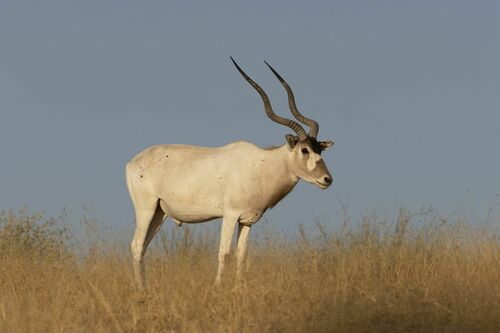
Other species in the family Bovidae
Species that share its range

Sources
Conservation status, range description and population estimate come from the IUCN Red List assessment for Philantomba maxwellii. Countries are derived from that range description, not from a mapped country list. Last refreshed on .
The distribution map is drawn from the IUCN Red List spatial data compiled in 2016. IUCN (International Union for Conservation of Nature)