
Mouflon
Ovis gmelini
Red List assessment
Near Threatenedon the IUCN Red List
- EXExtinct
- EWExtinct in the Wild
- CRCritically Endangered
- ENEndangered
- VUVulnerable
- NTNear Threatened
- LCLeast Concern
The Mouflon is recorded in 5 countries across Asia and Europe. The IUCN Red List assesses the Mouflon as Near Threatened. Global population estimated in the tens of thousands, with wild native populations in the Middle East declining while introduced European populations remain stable or increasing.
- Family
- Bovidae
- Order
- Artiodactyla
- Genus
- Ovis
- Countries recorded
- 5
- Continents
- Asia and Europe
- Red List category
- Near Threatened
- Data updated
- August 9, 2026
What is the Mouflon?
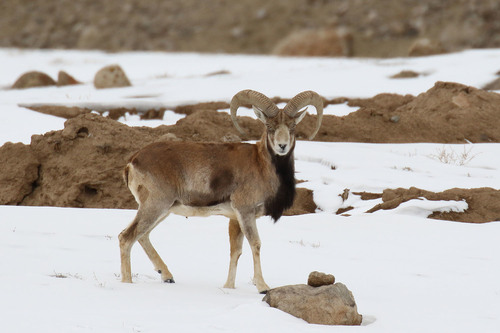
The mouflon is a wild sheep species native to the mountainous regions of the Near East, considered one of the ancestors of domestic sheep. It is characterized by its robust build, reddish-brown coat, and in males, large curling horns. Highly adapted to rugged terrain, it inhabits steep, rocky slopes and open woodlands. It is of major ecological and cultural importance as the wild progenitor of domestic sheep breeds.
Where does the Mouflon live?
Mainly found in Iran, Armenia, Azerbaijan, and Turkey, with introduced populations across Europe (Corsica, Sardinia, mainland Europe).
Native range spans the Zagros and Alborz mountains of Iran, parts of Armenia, Azerbaijan, and southeastern Turkey. Introduced and now feral populations exist widely across Europe, notably in Corsica, Sardinia, mainland France, Germany, and other parts of Central Europe.
Altitude and depth
Typically found between 200 and 3,500 meters elevation, depending on region and season.
Seasonal movements
Exhibits seasonal altitudinal migration, moving to higher elevations in summer and descending to lower slopes in winter to avoid heavy snow.
Habitat of the Mouflon
Mountainous terrain including rocky slopes, open woodlands, scrublands, and semi-arid steppe environments. Prefers areas with a mix of open grassland for grazing and rocky outcrops for refuge from predators.
Adaptations to its environment
Strong, agile legs and hooves adapted for climbing steep rocky terrain provide escape from predators. Thick coat changes seasonally, becoming denser in winter for insulation against cold mountain climates. Excellent eyesight helps detect predators across open landscapes.
Conservation status and numbers
Listed as Near Threatened (NT) by the IUCN due to population declines in native range from hunting and habitat loss, though numbers are stabilized in some introduced areas. Native populations face more pressure than the well-established feral European populations.
Estimated population
Global population estimated in the tens of thousands, with wild native populations in the Middle East declining while introduced European populations remain stable or increasing.
What threatens the Mouflon?
Illegal hunting and poaching, habitat degradation from livestock grazing competition, and habitat fragmentation due to human development. Predation and interbreeding with domestic sheep also pose genetic risks to wild populations.
Diseases and parasites
Susceptible to diseases such as sarcoptic mange, pestivirus, and various internal parasites including gastrointestinal nematodes, which can be exacerbated by contact with domestic sheep.
What is being done to protect it?
Protected within several national parks and reserves in Iran and Armenia. CITES Appendix I/II listings for some subspecies restrict trade; hunting regulations exist in various countries to control offtake.
Recommended actions
Strengthen anti-poaching enforcement in native range countries, reduce competition with domestic livestock, and maintain genetic diversity through managed breeding programs and protected corridors.
What the Mouflon looks like
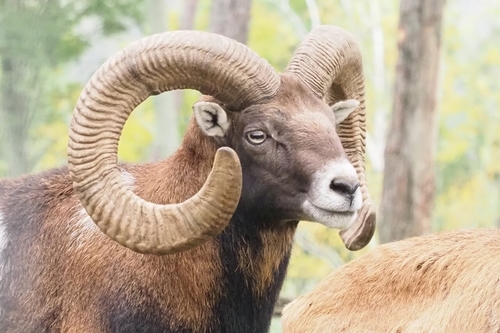
Coat is typically reddish-brown to grayish-brown with a dark dorsal stripe; underparts, muzzle, and rump patch are lighter, often white or cream colored. Males have large, curved horns that can form a full curl, while females have small or absent horns.
Size
Shoulder height ranges from 65 to 95 cm; body length typically 100-130 cm.
Weight
Males typically weigh 35-55 kg, while females are smaller, weighing around 25-35 kg.
Distinctive features
Distinguished from other wild sheep by its relatively smaller size, lighter build, and the male's characteristic saddle-shaped white patch on the back in some subspecies. Horn shape and coloration patterns can differ across subspecies.
Differences between males and females
Males are notably larger and heavier than females and possess large curved horns, whereas females typically have small or no horns at all.
Behaviour and diet of the Mouflon
Mouflons are social animals typically living in small herds; males and females often form separate groups outside of the breeding season. Herd size can range from a few individuals to over 20 depending on habitat and season.
When it is active
Primarily diurnal, with peak activity during early morning and late afternoon; they rest during the hottest parts of the day in shaded or sheltered areas.
Diet
Herbivorous, feeding on grasses, herbs, shrubs, and occasionally tree leaves and bark. Diet varies seasonally based on availability of vegetation at different elevations.
Communication
Communication includes vocalizations such as bleats, especially between mothers and lambs, along with body postures and scent marking to establish dominance and territory during the rut.
Interactions with other species
Natural predators include wolves, lynxes, and golden eagles (which may prey on lambs); mouflons often compete with domestic livestock for grazing resources. In some regions, they coexist with ibex and other wild ungulates sharing similar habitats.
Role in its ecosystem
As herbivores, mouflons play a role in shaping vegetation structure through grazing and act as prey for large carnivores, contributing to the food web balance in mountainous ecosystems.
Reproduction and lifecycle
Breeding season (the rut) generally occurs in autumn, with gestation lasting about 150-160 days. Females usually give birth to a single lamb, though twins can occasionally occur, typically in spring.
Raising the young
Lambs are cared for exclusively by the mother, who nurses and protects them until weaning at around 3-4 months of age. Young mouflons stay close to their mothers and the maternal herd for the first year of life.
Maturity and lifespan
Sexual maturity is reached at around 1.5 to 2 years of age. Lifespan in the wild is typically 10-12 years, while in captivity individuals may live up to 15-20 years.
Taxonomy and naming of the Mouflon
Classification
Class: Mammalia > Order: Artiodactyla > Family: Bovidae > Genus: Ovis > Species: Ovis gmelini
Subspecies
Several subspecies recognized including Ovis gmelini gmelini (Armenian mouflon), Ovis gmelini isphahanica (Isfahan mouflon), Ovis gmelini laristanica (Laristan mouflon), and Ovis gmelini musimon (European mouflon, introduced).
Scientific synonyms
Ovis orientalis (often used interchangeably), Ovis musimon (for the European feral population).
What research says
Recent studies
Recent genomic research has focused on using mouflon DNA to better understand the domestication history of Ovis aries and to identify genes related to coat color and horn development.
Genome and DNA
Diploid chromosome number is 2n=54; genetic studies have been used to trace domestication pathways linking mouflon to modern domestic sheep breeds.
Compared with similar species
Compared to the urial (Ovis vignei) and argali (Ovis ammon), the mouflon is smaller in body size with less massive horns, and generally inhabits lower elevation ranges than the argali.
The Mouflon and people
Mouflons are considered the wild ancestor of most modern domestic sheep breeds. The Corsican and Sardinian mouflon populations, though introduced by humans thousands of years ago, are now considered naturalized and iconic wildlife of those islands.
Where and how to see it
Best observed in early morning or late afternoon in protected mountainous areas of Iran's Zagros range or in Corsica's Restonica Valley and Sardinia's Gennargentu National Park, where populations are more visible and accustomed to human presence.
Risks to humans
No notable risk to humans; mouflons are shy and avoid human contact, posing no direct threat except potential vehicle collisions in areas where they cross roads.
Human uses
Historically important as the wild ancestor of domestic sheep, valued for meat, wool, and hide production. Also hunted as a game species in various regions under regulated hunting programs.
Myths and legends
In some Mediterranean cultures, the mouflon has been depicted in ancient art and considered a symbol of wilderness and mountain resilience, particularly in Corsican folklore where it represents the untamed spirit of the island's interior.
Countries where the Mouflon is recorded
The 5 countries named in the range description of its IUCN Red List assessment.
Questions about the Mouflon
Where does the Mouflon live?
The Mouflon is recorded in Armenia, Azerbaijan, France, Germany and Iran across Asia and Europe. These countries come from the range description of its IUCN Red List assessment, and they are what place the species on the interactive map.
Is the Mouflon endangered?
The IUCN Red List assesses the Mouflon as Near Threatened. The species does not qualify as threatened today, but it is close to the thresholds and likely to cross them soon. It is the category that most often changes at the next assessment.
How many are left in the wild?
Global population estimated in the tens of thousands, with wild native populations in the Middle East declining while introduced European populations remain stable or increasing. This figure comes from the species assessment on the IUCN Red List; population estimates for wild mammals are ranges, not counts, and are revised at each assessment.
What habitat does the Mouflon live in?
Mountainous terrain including rocky slopes, open woodlands, scrublands, and semi-arid steppe environments.
What is the scientific name of the Mouflon?
The Mouflon is Ovis gmelini, in the family Bovidae, order Artiodactyla.
Other species in the genus Ovis
Other species in the family Bovidae
Species that share its range
Sources
Conservation status, range description and population estimate come from the IUCN Red List assessment for Ovis gmelini. Countries are derived from that range description, not from a mapped country list. Last refreshed on .
The distribution map is drawn from the IUCN Red List spatial data compiled in 2020. IUCN (International Union for Conservation of Nature)