
Bighorn Sheep
Ovis canadensis
Red List assessment
Least Concernon the IUCN Red List
- EXExtinct
- EWExtinct in the Wild
- CRCritically Endangered
- ENEndangered
- VUVulnerable
- NTNear Threatened
- LCLeast Concern
The Bighorn Sheep is recorded in 3 countries across North America. The IUCN Red List assesses the Bighorn Sheep as Least Concern. Approximately 70,000-85,000 individuals across North America, with populations generally stable or increasing in managed areas but some isolated populations remain vulnerable or declining
- Family
- Bovidae
- Order
- Artiodactyla
- Genus
- Ovis
- Countries recorded
- 3
- Continents
- North America
- Red List category
- Least Concern
- Data updated
- August 9, 2026
What is the Bighorn Sheep?
The Bighorn Sheep is a large wild sheep native to the mountainous regions of western North America, renowned for the massive curled horns of the males used in dramatic head-butting contests. This species is highly adapted to steep, rocky terrain and is an iconic symbol of North American wilderness. Bighorn sheep are agile climbers, capable of navigating near-vertical cliffs to escape predators. They live in fragmented populations across the Rocky Mountains, desert ranges, and coastal mountains.
Where does the Bighorn Sheep live?
Western North America, primarily in the United States and Canada, with a small population extending into northern Mexico
Found throughout the western United States including the Rocky Mountains, Sierra Nevada, and desert Southwest, extending north into British Columbia and Alberta in Canada, and south into Baja California and Sonora in Mexico. Populations are now fragmented due to historical range contraction.
Altitude and depth
500-4000m, with populations occurring from low desert mountain ranges to high alpine zones depending on subspecies and season
Seasonal movements
Many populations undertake seasonal altitudinal migrations, moving to lower elevations in winter to escape deep snow and to higher elevations in summer for fresh forage. The rut (mating season) occurs in autumn, typically November to December.
Habitat of the Bighorn Sheep
Bighorn sheep inhabit alpine meadows, grassy mountain slopes, and rocky canyons, as well as arid desert mountains for desert subspecies. They prefer areas with steep, rugged terrain that provides escape routes from predators, combined with nearby grasslands or shrublands for foraging.
Adaptations to its environment
Specialized cloven hooves with soft, concave centers and hard outer edges provide exceptional grip on rocky, steep terrain. Their eyes are positioned to provide wide peripheral vision to detect predators, and they have excellent depth perception for navigating cliffs. Desert subspecies can survive extended periods without water and tolerate extreme heat.
Conservation status and numbers
Least Concern (LC) according to IUCN, though this masks significant regional variation; some subspecies like the Sierra Nevada bighorn are federally endangered in the US. Overall populations have recovered substantially from historic lows due to conservation efforts, though the species remains far below historical numbers.
Estimated population
Approximately 70,000-85,000 individuals across North America, with populations generally stable or increasing in managed areas but some isolated populations remain vulnerable or declining
What threatens the Bighorn Sheep?
Disease transmission from domestic sheep and goats (particularly pneumonia-causing pathogens), habitat loss and fragmentation from human development, competition with livestock for forage, and predation by mountain lions in some areas.
Diseases and parasites
Pneumonia caused by Mycoplasma ovipneumoniae and other respiratory pathogens transmitted from domestic sheep is the most significant disease threat, often causing catastrophic die-offs; also susceptible to internal parasites like lungworms and external parasites such as ticks.
What is being done to protect it?
Extensive reintroduction and translocation programs have been conducted since the mid-20th century, along with habitat protection in national parks and wilderness areas. Disease management protocols aim to separate wild bighorn from domestic sheep grazing allotments, and several subspecies have dedicated recovery plans under the US Endangered Species Act.
Recommended actions
Continue separating wild bighorn populations from domestic sheep and goats to prevent disease transmission, maintain habitat connectivity between fragmented populations, monitor and manage disease outbreaks, and protect critical winter range from development.
What the Bighorn Sheep looks like
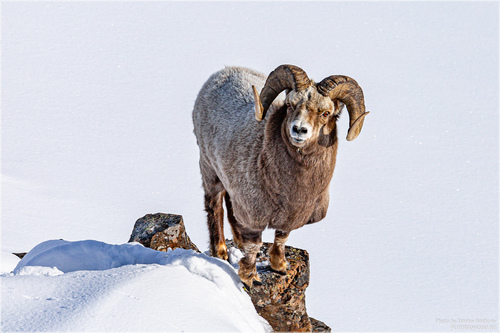
Bighorn sheep have a stocky, muscular build with brown to grayish-brown fur, a white rump patch, and a white muzzle. Males possess massive, tightly curled horns that can weigh up to 14 kg, while females have shorter, more slender, slightly curved horns.
Size
Body length 1.3-1.8m; shoulder height 75-105cm, with males (rams) generally larger than females (ewes)
Weight
Rams: 58-143 kg; Ewes: 34-91 kg, with desert bighorn subspecies typically smaller than Rocky Mountain subspecies
Distinctive features
The massive curled horns of mature rams, which can make a full curl of 360 degrees, distinguish this species from other wild sheep; these horns are used in dramatic clashing contests during the rut that can be heard from over a kilometer away.
Differences between males and females
Pronounced sexual dimorphism exists: rams are significantly larger and heavier than ewes and possess much larger, more massively curled horns, while ewes have shorter, spike-like horns that curve only slightly.
Behaviour and diet of the Bighorn Sheep
Bighorn sheep are highly social, living in separate bands of rams and ewes with lambs for most of the year, typically numbering 5-15 individuals though larger aggregations occur at mineral licks or during migrations. Rams establish dominance hierarchies through horn size and fighting ability, which determines mating access during the rut.
When it is active
Primarily diurnal (crepuscular peaks), with most feeding activity occurring in early morning and late afternoon, while resting and ruminating during midday and night in secure bedding areas.
Diet
Herbivorous, feeding on a variety of grasses, sedges, forbs, and shrubs; diet composition shifts seasonally with grasses dominant in summer and browse/shrubs more important in winter when snow covers ground vegetation.
Communication
Bighorn sheep communicate through visual displays (horn size, body posture), the loud clashing sound of horns during ram battles which can be heard for long distances, and various vocalizations including bleats between ewes and lambs, and low grunts during aggressive encounters.
Interactions with other species
Natural predators include mountain lions, wolves, coyotes (primarily on lambs), and golden eagles (on lambs); bighorn also compete with domestic livestock and mule deer for forage in some habitats, and are vulnerable to disease transmission from domestic sheep and goats.
Role in its ecosystem
As herbivorous grazers and browsers, bighorn sheep play a role in shaping alpine and montane plant communities through their feeding activities, and serve as an important prey species supporting populations of large predators like mountain lions.
Reproduction and lifecycle
The rut occurs primarily in November-December, with dominant rams competing through horn-clashing battles for access to estrous ewes. Gestation lasts approximately 174-180 days, with a single lamb (rarely twins) born in spring (April-June), and lambs are weaned by 4-6 months of age.
Raising the young
Ewes provide sole parental care, nursing and protecting lambs in secluded, rocky areas immediately after birth to avoid predators. Lambs begin following their mothers and grazing within days, and ewe-lamb bonds typically persist through the first year.
Maturity and lifespan
Sexual maturity reached at 2-3 years for ewes and 3-4 years for rams (though full breeding success often delayed until 7-8 years due to social hierarchy); lifespan averages 10-15 years in the wild, with some individuals reaching 20 years, and slightly longer in captivity.
Taxonomy and naming of the Bighorn Sheep
Classification
Mammalia > Artiodactyla > Bovidae > Ovis > Ovis canadensis
Subspecies
Several recognized subspecies including Ovis canadensis canadensis (Rocky Mountain bighorn), Ovis canadensis nelsoni (desert bighorn), Ovis canadensis mexicana (Mexican bighorn), and Ovis canadensis sierrae (Sierra Nevada bighorn, sometimes classified separately). The California bighorn (Ovis canadensis californiana) is also often recognized.
Scientific synonyms
Ovis montana (historical synonym)
What research says
Recent studies
Recent research has focused on genomic approaches to understand disease resistance to pneumonia-causing pathogens, with studies identifying genetic markers associated with susceptibility that may inform selective breeding or management strategies for vulnerable populations.
Genome and DNA
Diploid chromosome number is 2n=54; genetic studies have been used to identify distinct subspecies and management units, and to trace disease resistance and population connectivity for conservation planning.
Compared with similar species
Bighorn sheep are closely related to Dall sheep (Ovis dalli) of Alaska and northwestern Canada, which have white fur and more slender horns; they are also related to Eurasian wild sheep species like the argali and urial, though bighorn are generally stockier with more massive horns relative to body size.
The Bighorn Sheep and people
Male bighorn sheep can run head-first into each other at speeds up to 32 km/h during horn-clashing contests, with impacts absorbed by a thick skull and specialized honeycomb bone structure that prevents brain injury. Their horns alone can weigh as much as all the bones in their body combined.
Where and how to see it
Best observed in national parks such as Yellowstone, Glacier, Zion, and Rocky Mountain National Park, particularly during the autumn rut (November) when rams engage in dramatic head-butting displays; early morning and late afternoon offer the best viewing opportunities as sheep are most active feeding during these times.
Risks to humans
No notable risk to humans; bighorn sheep are generally wary of humans and avoid confrontation, though visitors should maintain distance during the rut when rams may be more aggressive and unpredictable.
Human uses
Historically hunted by Indigenous peoples for meat, hides, and horns which were fashioned into tools and ceremonial objects; today, bighorn sheep are a highly prized game species managed through regulated hunting programs that generate significant conservation funding, and are popular subjects for wildlife photography and ecotourism.
Myths and legends
Bighorn sheep hold deep cultural significance for many Indigenous peoples of North America, appearing in petroglyphs and rock art across the western United States dating back thousands of years, often symbolizing strength, agility, and connection to mountain spirits.
Countries where the Bighorn Sheep is recorded
The 3 countries named in the range description of its IUCN Red List assessment.
Questions about the Bighorn Sheep
Where does the Bighorn Sheep live?
The Bighorn Sheep is recorded in Canada, Mexico and United States across North America. These countries come from the range description of its IUCN Red List assessment, and they are what place the species on the interactive map.
Is the Bighorn Sheep endangered?
The IUCN Red List assesses the Bighorn Sheep as Least Concern. The species is widespread and abundant enough not to qualify for any threatened category. It does not mean the species is safe forever, only that nothing in the current data raises an alarm.
How many are left in the wild?
Approximately 70,000-85,000 individuals across North America, with populations generally stable or increasing in managed areas but some isolated populations remain vulnerable or declining This figure comes from the species assessment on the IUCN Red List; population estimates for wild mammals are ranges, not counts, and are revised at each assessment.
What habitat does the Bighorn Sheep live in?
Bighorn sheep inhabit alpine meadows, grassy mountain slopes, and rocky canyons, as well as arid desert mountains for desert subspecies.
What is the scientific name of the Bighorn Sheep?
The Bighorn Sheep is Ovis canadensis, in the family Bovidae, order Artiodactyla.
Other species in the genus Ovis
Other species in the family Bovidae
Species that share its range
Sources
Conservation status, range description and population estimate come from the IUCN Red List assessment for Ovis canadensis. Countries are derived from that range description, not from a mapped country list. Last refreshed on .
The distribution map is drawn from the IUCN Red List spatial data compiled in 2008. IUCN (International Union for Conservation of Nature)