
Wild Camel
Camelus ferus
Red List assessment
Endangeredon the IUCN Red List
- EXExtinct
- EWExtinct in the Wild
- CRCritically Endangered
- ENEndangered
- VUVulnerable
- NTNear Threatened
- LCLeast Concern
The Wild Camel is recorded in 2 countries across Asia. The IUCN Red List assesses the Wild Camel as Endangered. Fewer than 1,000 individuals remain in the wild, with continuing declining trend, split between Mongolia (around 350) and China (around 600).
- Family
- Camelidae
- Order
- Artiodactyla
- Genus
- Camelus
- Countries recorded
- 2
- Continents
- Asia
- Red List category
- Endangered
- Data updated
- August 9, 2026
What is the Wild Camel?
The Wild Camel is the last surviving wild population of two-humped camel, genetically distinct from the domestic Bactrian camel. It inhabits some of the most extreme desert environments on Earth in the Gobi Desert of Mongolia and China. Remarkably adapted to hyper-arid conditions, it can survive on saline or brackish water unsuitable for other mammals. Its critically small and fragmented population makes it one of the rarest large mammals in the world.
Where does the Wild Camel live?
Mongolia and China (Gobi Desert region)
Restricted to three isolated populations: the Lop Nur Nature Sanctuary in Xinjiang, China; the Taklamakan Desert; and the Great Gobi Strictly Protected Area in southwestern Mongolia. Historical range was much broader across Central Asia but has contracted dramatically due to human encroachment.
Altitude and depth
900-1500m
Seasonal movements
Undertakes seasonal movements in search of water and forage, moving between summer and winter ranges within their desert territories. Behavior shifts with extreme seasonal temperature swings from scorching summers to freezing winters.
Habitat of the Wild Camel
Hyper-arid desert habitats including rocky desert, sand dunes, and sparse desert steppe with minimal vegetation. Found in remote areas with access to sparse water sources, including saline springs. Occupies some of the harshest, most inhospitable terrain among large mammals.
Adaptations to its environment
Can drink saline/brackish water that would be toxic to domestic camels and other mammals, an adaptation unique among camelids. Thick fur insulates against extreme temperature swings (-40°C to +40°C), and broad padded feet prevent sinking into sand. Humps store fat reserves allowing survival through long periods without food.
Conservation status and numbers
Critically Endangered under IUCN Red List, with population continuing to decline due to habitat loss, hybridization with domestic camels, and hunting. Listed as one of the most endangered large mammals on Earth.
Estimated population
Fewer than 1,000 individuals remain in the wild, with continuing declining trend, split between Mongolia (around 350) and China (around 600).
What threatens the Wild Camel?
Habitat loss from mining and industrial development, hybridization with domestic Bactrian camels which threatens genetic purity, illegal hunting, competition with livestock for scarce water and forage, and nuclear testing legacy in Lop Nur affecting habitat.
Diseases and parasites
Susceptible to various camelid diseases and internal/external parasites, though specific wild population disease data is limited due to remoteness of habitat.
What is being done to protect it?
Protected within the Great Gobi Strictly Protected Area (Mongolia) and Lop Nur Nature Sanctuary (China). The Wild Camel Protection Foundation runs breeding and conservation programs, including a captive breeding center in Mongolia to safeguard genetic diversity.
Recommended actions
Expand protected areas and enforce anti-poaching laws, prevent hybridization with domestic camels through genetic management, secure water sources from industrial exploitation, and increase captive breeding and reintroduction efforts.
What the Wild Camel looks like
Covered in short, sandy-brown to grayish-brown fur that is shorter and less shaggy than domestic Bactrian camels, with smaller, more conical humps. Long legs and a long neck support a large head with heavy eyelashes protecting against sandstorms.
Size
Body length approximately 225-350 cm, shoulder height 180-230 cm.
Weight
300-690 kg depending on sex and condition.
Distinctive features
Smaller, more pointed humps compared to domestic Bactrian camels, and a more slender build overall. Genetic studies confirm it diverged from domestic camels roughly 1 million years ago, making it a distinct species rather than a feral population.
Differences between males and females
Males are generally larger and more robust than females, with more pronounced neck musculature, especially during the rutting season.
Behaviour and diet of the Wild Camel
Lives in small family groups typically consisting of one male, several females, and their offspring, though solitary males are also common. Group sizes rarely exceed 6-8 individuals.
When it is active
Primarily diurnal, active during cooler parts of the day and resting during the hottest midday hours in summer.
Diet
Herbivorous, feeding on sparse desert vegetation including saltwort, tamarisk, wild rhubarb, and other salt-tolerant desert plants. Can subsist on very low-quality forage due to efficient digestive adaptations.
Communication
Communicates through vocalizations such as grunts, groans, and bellows, along with body postures and scent marking. Visual cues like neck posturing are used in social and mating interactions.
Interactions with other species
Few natural predators remain due to remote habitat, though wolves may prey on young or weak individuals. Competes with domestic livestock for scarce water and grazing resources, and hybridizes with domestic Bactrian camels where ranges overlap.
Role in its ecosystem
As a large herbivore in a fragile desert ecosystem, it plays a role in seed dispersal of desert plants and shapes vegetation patterns through grazing. Its survival is an indicator of the health of the Gobi desert ecosystem.
Reproduction and lifecycle
Breeding season occurs in winter (roughly November to December), with gestation lasting about 13 months. Typically one calf is born per litter, which can walk within hours of birth.
Raising the young
Calves are cared for primarily by the mother and are weaned after about 1-1.5 years, though they may remain with the maternal group for up to 3 years. Males play little direct role in parental care.
Maturity and lifespan
Sexual maturity reached around 4-5 years of age. Lifespan in the wild is approximately 40 years, similar in captivity with proper care.
Taxonomy and naming of the Wild Camel
Classification
Mammalia > Artiodactyla > Camelidae > Camelus > Camelus ferus
Scientific synonyms
Camelus bactrianus ferus (formerly considered a subspecies of the domestic Bactrian camel)
What research says
Recent studies
Recent genomic research has focused on identifying genes related to salt tolerance and desert survival, as well as tracking hybridization rates with domestic camels to inform conservation genetics management.
Genome and DNA
Genetic studies have confirmed 2n=74 chromosomes, matching domestic Bactrian camels, but mitochondrial DNA analysis shows significant divergence supporting classification as a separate species with unique genetic lineage.
Compared with similar species
Distinguished from the domestic Bactrian camel (Camelus bactrianus) by smaller humps, slimmer build, shorter coat, and significant genetic divergence estimated at around 1 million years. Unlike domestic camels, wild camels can drink saline water without ill effects.
The Wild Camel and people
Wild camels are one of only two truly wild camel species remaining, alongside no direct wild ancestor for dromedaries. They can drink salty water that would kill most other mammals, and some populations survived near nuclear test sites in Lop Nur, China.
Where and how to see it
Best observed with specialized guided expeditions into the Great Gobi Strictly Protected Area in Mongolia, particularly in cooler months (spring or autumn) when camels are more active and easier to spot. Sightings require significant travel into remote desert terrain and permits.
Risks to humans
No notable risk to humans; wild camels are shy and avoid human contact, retreating quickly when encountered.
Human uses
Not used directly by humans due to rarity and protected status, though its genetic material is of interest for conservation breeding programs and potential crossbreeding studies with domestic camels for desert-adapted livestock.
Myths and legends
In Mongolian culture, camels are revered as symbols of endurance and survival in harsh environments, though specific legends about the wild camel are less documented compared to domestic camels' cultural significance.
Countries where the Wild Camel is recorded
The 2 countries named in the range description of its IUCN Red List assessment.
Questions about the Wild Camel
Where does the Wild Camel live?
The Wild Camel is recorded in China and Mongolia across Asia. These countries come from the range description of its IUCN Red List assessment, and they are what place the species on the interactive map.
Is the Wild Camel endangered?
Yes. The IUCN Red List assesses the Wild Camel as Endangered, one of the three threatened categories. The species faces a very high risk of extinction in the wild — a step below Critically Endangered, but still on a trajectory that ends badly without intervention.
How many are left in the wild?
Fewer than 1,000 individuals remain in the wild, with continuing declining trend, split between Mongolia (around 350) and China (around 600). This figure comes from the species assessment on the IUCN Red List; population estimates for wild mammals are ranges, not counts, and are revised at each assessment.
What habitat does the Wild Camel live in?
Hyper-arid desert habitats including rocky desert, sand dunes, and sparse desert steppe with minimal vegetation.
What is the scientific name of the Wild Camel?
The Wild Camel is Camelus ferus, in the family Camelidae, order Artiodactyla.
Other species in the family Camelidae
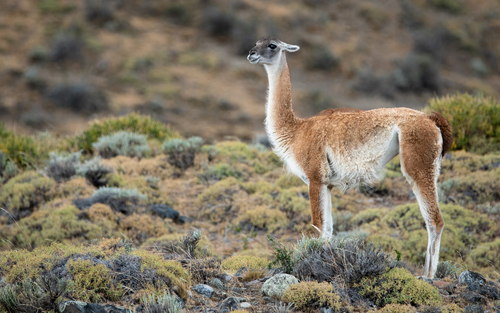
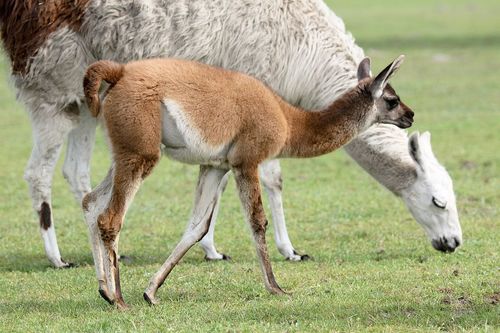
Species that share its range
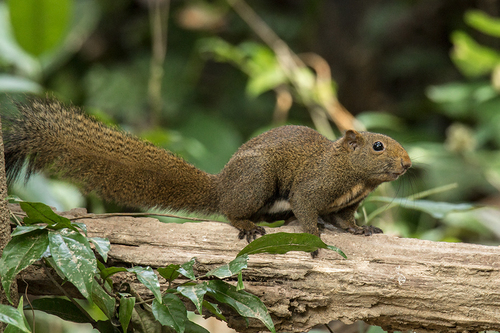
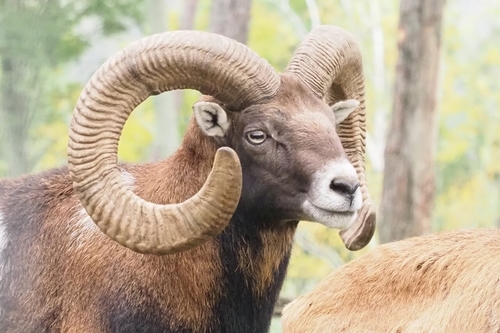
Sources
Conservation status, range description and population estimate come from the IUCN Red List assessment for Camelus ferus. Countries are derived from that range description, not from a mapped country list. Last refreshed on .
The distribution map is drawn from the IUCN Red List spatial data compiled in 2025. IUCN (International Union for Conservation of Nature)