
Waterbuck
Kobus ellipsiprymnus
Red List assessment
Least Concernon the IUCN Red List
- EXExtinct
- EWExtinct in the Wild
- CRCritically Endangered
- ENEndangered
- VUVulnerable
- NTNear Threatened
- LCLeast Concern
The Waterbuck is recorded in 9 countries across Africa. The IUCN Red List assesses the Waterbuck as Least Concern. Estimated at around 200,000 individuals across Africa, with populations generally stable within protected areas but declining in unprotected regions
- Family
- Bovidae
- Order
- Artiodactyla
- Genus
- Kobus
- Countries recorded
- 9
- Continents
- Africa
- Red List category
- Least Concern
- Data updated
- August 9, 2026
What is the Waterbuck?
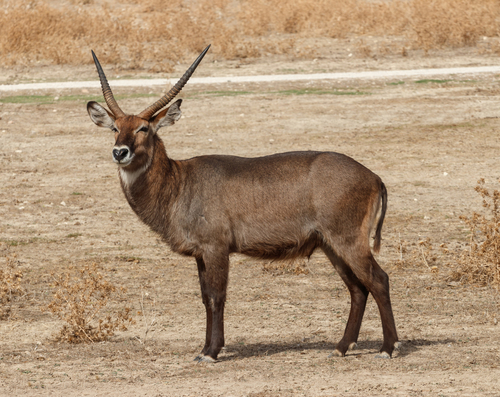
The waterbuck is a large, robust antelope native to sub-Saharan Africa, easily recognized by its shaggy grey-brown coat and distinctive white ring or patch on its rump. It is closely tied to water sources, rarely venturing far from rivers, lakes, or wetlands. Males possess long, ridged, forward-curving horns used in territorial displays and combat. This species is notable for its oily, musky-smelling skin secretion, which gives it the French name 'cobe onctueux' (oily kob).
Where does the Waterbuck live?
Sub-Saharan Africa, particularly East and Southern Africa including Kenya, Tanzania, Uganda, Zambia, and South Africa
Widely distributed across sub-Saharan Africa from Senegal in the west to Somalia and Kenya in the east, and south to Botswana, Zimbabwe, and South Africa. Populations are patchy, concentrated around permanent water bodies within savanna ecosystems.
Altitude and depth
0-2100m, typically found in lowland savannas but can occur at higher elevations near water in East African highlands
Seasonal movements
No true migration, but waterbuck may shift locally in response to seasonal water availability and forage quality, moving closer to permanent water during dry seasons
Habitat of the Waterbuck
Savanna woodlands, floodplains, and grasslands near permanent water sources; requires access to reeds, rushes, and water for drinking and thermoregulation. Avoids arid areas far from rivers or lakes.
Adaptations to its environment
Waterbuck have an oily, waterproof coat secretion that may help repel water and provide protection from parasites and predators through its strong odor. Their strong swimming ability allows them to escape predators by entering water, a behavior less common in other antelope species.
Conservation status and numbers
Least Concern (LC) according to IUCN, as populations remain relatively stable and widespread across protected areas, though localized declines occur outside reserves due to habitat loss and hunting.
Estimated population
Estimated at around 200,000 individuals across Africa, with populations generally stable within protected areas but declining in unprotected regions
What threatens the Waterbuck?
Habitat loss from agricultural expansion, poaching for bushmeat, competition with livestock for grazing and water resources, and human population encroachment near water sources
Diseases and parasites
Susceptible to rinderpest historically, along with ticks, gastrointestinal parasites, and trypanosomiasis transmitted by tsetse flies
What is being done to protect it?
Waterbuck are protected within numerous national parks and game reserves across their range, including Serengeti, Kruger, and Queen Elizabeth National Park. Trophy hunting is regulated in some countries, providing economic incentive for habitat conservation.
Recommended actions
Strengthen anti-poaching patrols, maintain and expand protected wetland habitats, promote community-based conservation programs, and monitor populations outside reserve boundaries
What the Waterbuck looks like
Shaggy, coarse grey-brown to reddish-brown coat with a distinctive white ring or patch on the rump, white markings on the face, throat, and chest. The coat has an oily texture and emits a musky odor.
Size
Shoulder height 120-136 cm, body length 177-235 cm
Weight
Males: 198-262 kg; Females: 161-214 kg
Distinctive features
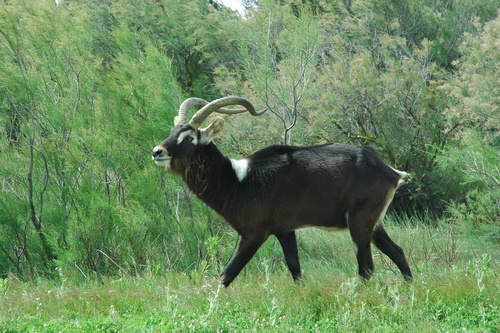
The white ring (ellipsen) or patch (defassa) on the rump distinguishes waterbuck from other similar-sized antelopes like kudu or eland; only males have the long, ridged, lyre-shaped horns.
Differences between males and females
Males are larger and heavier than females and possess long, ridged, forward-curving horns reaching 55-99 cm; females are hornless
Behaviour and diet of the Waterbuck
Waterbuck live in loose herds of 5-25 individuals, typically female groups with young, while males are territorial and solitary or form bachelor groups until establishing territories
When it is active
Primarily diurnal with peak activity in early morning and late afternoon, resting during the heat of midday, often near water or in shade
Diet
Herbivorous grazer feeding primarily on grasses, especially near water; will also browse on reeds, rushes, and occasionally foliage during dry seasons
Communication
Communication includes vocalizations such as snorts and grunts, scent marking via glandular secretions, and visual displays including horn threats and postural dominance signals between males
Interactions with other species
Major predators include lions, leopards, hyenas, and crocodiles near water; waterbuck often share habitat with other grazers like impala and zebra, though their meat is reportedly less palatable to predators due to skin secretions
Role in its ecosystem
As grazers, waterbuck play a role in shaping grassland structure and serve as prey for large carnivores, contributing to predator-prey population dynamics in African savanna ecosystems
Reproduction and lifecycle
Breeding occurs year-round with peaks during rainy seasons; gestation lasts approximately 7-9 months, typically resulting in a single calf
Raising the young
Females give birth in dense vegetation for concealment and hide calves for several weeks before introducing them to the herd; calves are weaned at around 6-8 months but may stay with mothers up to a year
Maturity and lifespan
Sexual maturity at 1-2 years for females, 2-3 years for males; lifespan averages 10-15 years in the wild, up to 18 years in captivity
Taxonomy and naming of the Waterbuck
Classification
Mammalia > Artiodactyla > Bovidae > Kobus > Kobus ellipsiprymnus
Subspecies
Two main subspecies groups: the common/defassa waterbuck complex including K. e. ellipsiprymnus (Ellipsen waterbuck, with white ring on rump, found in East and Southern Africa) and K. e. defassa (Defassa waterbuck, with white patch instead of ring, found in Central and West Africa); some taxonomies treat defassa as a separate species.
Scientific synonyms
Kobus defassa (sometimes treated as separate species), Antilope ellipsiprymnus (original combination)
What research says
Recent studies
Recent genetic and ecological studies have examined hybrid zones between waterbuck subspecies and investigated the antipredator function of their skin secretions
Genome and DNA
Diploid chromosome number 2n=56; genetic studies have been used to clarify subspecies boundaries and hybridization zones between ellipsiprymnus and defassa forms
Compared with similar species
Waterbuck resemble other Kobus species like the kob and lechwe but are larger and more robust, with the distinctive rump marking setting them apart; unlike kudu, waterbuck lack spiral horns and have a stockier build
The Waterbuck and people
Waterbuck skin secretes an oily, musky substance so pungent that some predators reportedly avoid eating them unless desperate. They are excellent swimmers and will readily enter water to escape predators, unusual behavior among antelopes.
Where and how to see it
Best observed during early morning or late afternoon near rivers and lakes in parks such as Kruger National Park, Serengeti, or Lake Nakuru; dry season offers higher visibility as animals congregate near remaining water sources
Risks to humans
No notable risk to humans
Human uses
Hunted for bushmeat in some regions and valued as a trophy species in regulated hunting programs; also attracts ecotourism revenue in national parks
Myths and legends
In some African folklore, the waterbuck's strong odor and association with water have led to it being seen as a symbol of resilience and protection near sacred water sources
Countries where the Waterbuck is recorded
The 9 countries named in the range description of its IUCN Red List assessment.
Questions about the Waterbuck
Where does the Waterbuck live?
The Waterbuck is recorded in Botswana, Kenya, Senegal, Somalia and South Africa, among 9 countries in total across Africa. These countries come from the range description of its IUCN Red List assessment, and they are what place the species on the interactive map.
Is the Waterbuck endangered?
The IUCN Red List assesses the Waterbuck as Least Concern. The species is widespread and abundant enough not to qualify for any threatened category. It does not mean the species is safe forever, only that nothing in the current data raises an alarm.
How many are left in the wild?
Estimated at around 200,000 individuals across Africa, with populations generally stable within protected areas but declining in unprotected regions This figure comes from the species assessment on the IUCN Red List; population estimates for wild mammals are ranges, not counts, and are revised at each assessment.
What habitat does the Waterbuck live in?
Savanna woodlands, floodplains, and grasslands near permanent water sources; requires access to reeds, rushes, and water for drinking and thermoregulation.
What is the scientific name of the Waterbuck?
The Waterbuck is Kobus ellipsiprymnus, in the family Bovidae, order Artiodactyla.
Other species in the genus Kobus
Other species in the family Bovidae
Species that share its range
Sources
Conservation status, range description and population estimate come from the IUCN Red List assessment for Kobus ellipsiprymnus. Countries are derived from that range description, not from a mapped country list. Last refreshed on .
The distribution map is drawn from the IUCN Red List spatial data compiled in 2008. IUCN (International Union for Conservation of Nature)