
Tree Bat
Ardops nichollsi
Red List assessment
Least Concernon the IUCN Red List
- EXExtinct
- EWExtinct in the Wild
- CRCritically Endangered
- ENEndangered
- VUVulnerable
- NTNear Threatened
- LCLeast Concern
The Tree Bat is recorded in 3 countries across North America. The IUCN Red List assesses the Tree Bat as Least Concern. No precise global population estimate exists for this species.
- Family
- Phyllostomidae
- Order
- Chiroptera
- Genus
- Ardops
- Countries recorded
- 3
- Continents
- North America
- Red List category
- Least Concern
- Data updated
- August 9, 2026
What is the Tree Bat?
Ardops nichollsi, the Lesser Antillean Tree Bat, is a small, frugivorous leaf-nosed bat (family Phyllostomidae) endemic to the Lesser Antilles island chain. It is the sole member of the genus Ardops, making it a monotypic and biogeographically distinct lineage. The species inhabits moist and dry forests, playing a critical ecological role as a seed disperser and contributing to forest regeneration. Its adaptation to island life across the volcanic arc of the Lesser Antilles makes it a remarkable example of insular speciation.
Where does the Tree Bat live?
Lesser Antilles, Caribbean (Martinique, Guadeloupe, Dominica, St. Lucia, St. Vincent, Montserrat, St. Kitts, Nevis, Saba, St. Eustatius, Barbados)
Restricted to the Lesser Antilles archipelago in the eastern Caribbean. Its range spans from Saba and St. Eustatius in the north through St. Kitts, Nevis, Montserrat, Guadeloupe, Dominica, Martinique, St. Lucia, and St. Vincent to Barbados in the south. Each major island typically hosts a distinct subspecies.
Altitude and depth
Recorded from sea level up to approximately 1,000 m elevation, though most common in mid-elevation forested zones (200–800 m) on volcanic islands where rainfall and fruit resources are abundant.
Seasonal movements
No long-distance seasonal migration, as the species is resident on its respective islands year-round. Activity levels may vary with fruiting seasonality; reproductive timing appears loosely correlated with peak fruit availability, typically in the wet season (June–November). No hibernation is recorded.
Habitat of the Tree Bat
Primarily found in humid tropical montane and lowland rainforests, but also occurs in semi-deciduous and dry coastal forests. It roosts in dense foliage of trees and shrubs, preferring areas with closed canopy. The species can persist in secondary forests and occasionally in agricultural areas with fruit-bearing trees.
Adaptations to its environment
Possesses a well-developed fleshy nose leaf that likely assists in echolocation directionality. Its robust jaw musculature and specialized dentition are adapted for processing tough tropical fruits and fibrous vegetation. The fur provides cryptic coloration among foliage, and its roosting behavior in leaf clusters rather than caves offers protection from terrestrial predators.
Conservation status and numbers
Listed as Least Concern (LC) on the IUCN Red List, as the species occurs across multiple islands, maintains stable populations in suitable forest habitats, and does not meet thresholds for threatened categories. However, individual island subspecies may face localized pressures, and the species' restricted endemic range makes it inherently vulnerable to catastrophic events.
Estimated population
No precise global population estimate exists for this species. Populations are presumed to number in the tens of thousands across their island range; population trend is considered stable overall, though some island populations may be declining due to localized habitat loss.
What threatens the Tree Bat?
The primary threats include deforestation and land conversion for agriculture, urban expansion, and tourism infrastructure across the Lesser Antilles. Catastrophic hurricanes (increasingly frequent and intense with climate change) can devastate forest habitat and directly kill individuals. Introduced predators such as mongooses (Herpestes auropunctatus) and feral cats also pose significant predation pressure.
Diseases and parasites
Like other phyllostomid bats, it likely harbors ectoparasites including bat flies (Streblidae, Nycteribiidae) and mites. Potential endoparasites include gastrointestinal helminths and blood protozoans. Caribbean bats may also carry coronaviruses and other RNA viruses, though specific data for A. nichollsi are limited.
What is being done to protect it?
The species benefits from forest reserves and national parks on several islands, including the Northern Forest Reserve in Dominica, Parc National de la Guadeloupe, and Parc Naturel Régional de la Martinique. The Convention on Biological Diversity and CITES Appendix listings on migratory bats offer indirect protections. Regional monitoring programs by organizations such as the IUCN SSC Bat Specialist Group contribute to knowledge of population status.
Recommended actions
Priority actions include strengthening and expanding protected forest areas on all occupied islands, enforcing restrictions on deforestation, and implementing invasive predator control programs. Post-hurricane habitat recovery monitoring is essential, along with standardized population surveys to track subspecies viability. Public education campaigns on the ecological importance of bats are recommended.
What the Tree Bat looks like
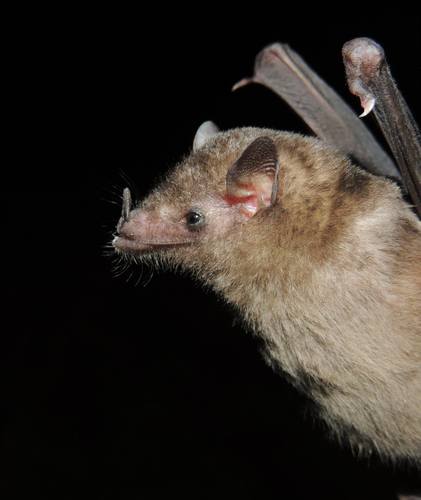
Fur on the dorsum is medium to dark brown or grayish-brown, while the venter is paler grayish or buffy. The face bears a prominent triangular nose leaf characteristic of phyllostomid bats. Ears are short and rounded, the muzzle is broad, and wing membranes are dark brown to black. The tail is vestigial or absent, and the uropatagium is greatly reduced.
Size
Body length approximately 55–75 mm; no free tail (uropatagium reduced). Forearm length typically 43–49 mm. Wingspan approximately 28–33 cm.
Weight
Typically 15–25 g; slight variation between islands and sexes.
Distinctive features
Ardops nichollsi is distinguished from other phyllostomid bats in the region by its monotypic genus status, its broad robust skull with strong zygomatic arches, and its combination of a prominent nose leaf with a virtually absent tail. Compared to Artibeus species (with which it may be confused), Ardops is smaller and has a distinctively shaped palate and different dental formula.
Differences between males and females
Sexual dimorphism is minimal; females may be marginally larger or heavier than males, particularly during pregnancy. No significant differences in fur coloration between sexes are reported.
Behaviour and diet of the Tree Bat
Ardops nichollsi is generally considered a solitary or loosely social roosting species, unlike cave-dwelling colonial bats. It roosts alone or in small groups (2–5 individuals) tucked within dense foliage or curled leaves. No complex social hierarchy is documented.
When it is active
Strictly nocturnal. Activity typically begins shortly after sunset and continues through the night, with foraging peaks in the early and late portions of the night corresponding to fruit bat foraging patterns generally observed in phyllostomids.
Diet
Primarily frugivorous, consuming a wide variety of soft tropical fruits including figs (Ficus spp.), Cecropia fruits, and various Melastomataceae and Moraceae species. It may also consume flowers, pollen, and nectar supplementally. Leaves have been reported in stomach contents, suggesting occasional folivory.
How it feeds and hunts
Forages by flying through the forest canopy and subcanopy, detecting ripe fruits through olfaction and echolocation. It plucks fruits in flight or lands briefly on fruit clusters. Short-range echolocation calls of low intensity (typical of foliage-gleaning phyllostomids) are used for obstacle avoidance in cluttered forest environments.
Communication
Communicates via ultrasonic echolocation calls for navigation and obstacle avoidance; calls are low-intensity and broadband, adapted for dense forest environments. Social vocalizations between individuals at roosts or during foraging likely exist but are poorly documented. Olfactory cues may also play a role in roost-site recognition.
Interactions with other species
Predators include owls (Tyto alba, Asio flammeus), introduced mongooses, feral cats, and possibly large snakes. It shares fruiting resources with other frugivorous bats (Artibeus jamaicensis, Brachyphylla cavernarum) and with fruit-eating birds. As a seed disperser, it has a mutualistic relationship with many tropical tree and shrub species.
Role in its ecosystem
A key seed disperser in Lesser Antillean forest ecosystems, contributing to forest regeneration and plant community structure. By dispersing seeds of pioneer and climax tree species, it plays a vital role in post-disturbance recovery following hurricanes and deforestation. It is considered a secondary or tertiary consumer in the forest food web as prey for raptors.
Reproduction and lifecycle
Typically gives birth to a single pup per reproductive event. Breeding appears to occur primarily in spring and early summer (approximately March–June), with births timed to coincide with peak fruit availability. Gestation is estimated at approximately 3–4 months, consistent with related phyllostomid species.
Raising the young
The mother provides sole parental care. Pups are carried clinging to the mother initially and later left at the roost while she forages. Weaning likely occurs at 1–2 months of age. Maternal investment is high given single-pup litters.
Maturity and lifespan
Sexual maturity is likely reached at 6–12 months of age, as is typical for small phyllostomid bats. Lifespan in the wild is estimated at 5–10 years; captive data for this species are not available.
Taxonomy and naming of the Tree Bat
Classification
Mammalia > Chiroptera > Phyllostomidae (subfamily Stenodermatinae) > Ardops > Ardops nichollsi
Subspecies
Several island-specific subspecies are recognized: A. n. nichollsi (Dominica), A. n. luciae (St. Lucia), A. n. annectens (Guadeloupe, Marie-Galante, Les Saintes), A. n. koopmani (St. Kitts, Nevis, Barbuda), A. n. montserratensis (Montserrat), and A. n. schwartzi (St. Vincent). Each subspecies shows slight morphological differences reflecting island isolation.
Scientific synonyms
Originally described as Stenoderma nichollsi by O. Thomas in 1891; the monotypic genus Ardops was erected by G. S. Miller in 1906. Also previously referenced under Phyllostoma in some early literature.
What research says
Recent studies
Recent phylogeographic studies using mitochondrial and nuclear markers have investigated the colonization sequence of the Lesser Antilles by Ardops, supporting a pattern of successive island colonization from north to south with subsequent diversification. Studies on Caribbean bat community ecology have highlighted the species' role as a frugivore and seed disperser in insular forest systems.
Genome and DNA
No published chromosome count or full genome sequence is available for Ardops nichollsi specifically. Phylogenomic studies of Stenodermatinae have included this species to investigate Lesser Antillean bat biogeography and colonization history.
Compared with similar species
Ardops nichollsi is most closely related to other stenodermatine phyllostomids of the Caribbean and mainland Neotropics, including Ariteus flavescens (Jamaican Fig-eating Bat) and Phyllops falcatus (Cuban Fig-eating Bat). Compared to the widespread Artibeus jamaicensis, Ardops nichollsi is smaller, has a reduced uropatagium, and is endemic to the Lesser Antilles rather than pan-Caribbean. The genera Ariteus and Phyllops represent parallel island-endemic lineages in the Greater Antilles.
The Tree Bat and people
Ardops nichollsi roosts in foliage rather than caves, making it nearly invisible as it resembles a curled leaf or seed cluster hanging in the canopy. Despite being restricted to small Caribbean islands, it has successfully colonized and differentiated across at least six island groups, demonstrating remarkable dispersal across open ocean. It is the only member of its entire genus, making every individual a representative of a unique evolutionary lineage found nowhere else on Earth.
Where and how to see it
Best observed at dusk in forested areas of Martinique, Guadeloupe, or Dominica, particularly near fruiting fig trees (Ficus) or Cecropia trees. Rainforest trails in the Parc National de la Guadeloupe or the forests of Morne Diablotin in Dominica offer good opportunities. A bat detector tuned to high-frequency ranges can help detect its echolocation calls in the canopy.
Risks to humans
No notable risk to humans. This bat is not venomous and is not known to be a vector of rabies or other diseases in the Lesser Antilles. It is a timid, fruit-eating bat that avoids human contact.
Human uses
No direct human uses are documented. The species is not hunted, farmed, or used in traditional medicine. Its primary value to humans is ecological, through seed dispersal services that support tropical forest regeneration and biodiversity on Caribbean islands.
Myths and legends
No specific myths or legends are directly associated with Ardops nichollsi. However, bats in general hold ambivalent cultural status in Caribbean folklore — sometimes seen as omens of misfortune or associated with the supernatural in local Creole traditions, though this applies broadly to bats rather than this species specifically.
Countries where the Tree Bat is recorded
The 3 countries named in the range description of its IUCN Red List assessment.
Questions about the Tree Bat
Where does the Tree Bat live?
The Tree Bat is recorded in Barbados, Dominica and St. Lucia across North America. These countries come from the range description of its IUCN Red List assessment, and they are what place the species on the interactive map.
Is the Tree Bat endangered?
The IUCN Red List assesses the Tree Bat as Least Concern. The species is widespread and abundant enough not to qualify for any threatened category. It does not mean the species is safe forever, only that nothing in the current data raises an alarm.
How many are left in the wild?
No precise global population estimate exists for this species. This figure comes from the species assessment on the IUCN Red List; population estimates for wild mammals are ranges, not counts, and are revised at each assessment.
What habitat does the Tree Bat live in?
Primarily found in humid tropical montane and lowland rainforests, but also occurs in semi-deciduous and dry coastal forests.
What is the scientific name of the Tree Bat?
The Tree Bat is Ardops nichollsi, in the family Phyllostomidae, order Chiroptera.
Other species in the family Phyllostomidae
Species that share its range

Sources
Conservation status, range description and population estimate come from the IUCN Red List assessment for Ardops nichollsi. Countries are derived from that range description, not from a mapped country list. Last refreshed on .
The distribution map is drawn from the IUCN Red List spatial data compiled in 2008. IUCN (International Union for Conservation of Nature)