
Thomson's Gazelle
Eudorcas thomsonii
Red List assessment
Least Concernon the IUCN Red List
- EXExtinct
- EWExtinct in the Wild
- CRCritically Endangered
- ENEndangered
- VUVulnerable
- NTNear Threatened
- LCLeast Concern
The Thomson's Gazelle is recorded in 2 countries across Africa. The IUCN Red List assesses the Thomson's Gazelle as Least Concern. Estimated total population of around 500,000-550,000 individuals, with a generally stable to slightly declining trend outside protected areas.
- Family
- Bovidae
- Order
- Artiodactyla
- Genus
- Eudorcas
- Countries recorded
- 2
- Continents
- Africa
- Red List category
- Least Concern
- Data updated
- August 9, 2026
What is the Thomson's Gazelle?
Thomson's Gazelle, often called 'Tommie,' is one of the most abundant and recognizable small antelopes of the East African plains. It is renowned for its speed, agility, and the distinctive stotting (pronking) behavior used to evade predators. Living in vast herds across the Serengeti-Mara ecosystem, it plays a key role as prey for many of Africa's large carnivores and is a symbol of the African savanna.
Where does the Thomson's Gazelle live?
East Africa, primarily Kenya and Tanzania, especially the Serengeti-Mara ecosystem
Found primarily in Kenya and Tanzania, concentrated in the Serengeti National Park, Ngorongoro Conservation Area, and Maasai Mara National Reserve, with populations extending into surrounding plains and conservancies.
Altitude and depth
Typically found at elevations of 900-2000 meters in the East African plains and highlands.
Seasonal movements
Undertakes seasonal migrations following the rains, moving with wildebeest and zebra herds between short-grass plains in the wet season and taller grasslands or woodlands in the dry season.
Habitat of the Thomson's Gazelle
Open short-grass plains, savanna, and semi-arid grasslands with scattered bushes; favors areas with short grass for grazing and good visibility to detect predators.
Adaptations to its environment
Highly efficient water conservation allows survival with minimal drinking water, relying on moisture from vegetation; exceptional speed (up to 80-90 km/h) and stotting behavior help evade predators; keen eyesight and hearing aid in early predator detection.
Conservation status and numbers
Least Concern (LC) according to IUCN, though some regional populations have declined due to habitat loss and competition with livestock; overall the species remains abundant across its range.
Estimated population
Estimated total population of around 500,000-550,000 individuals, with a generally stable to slightly declining trend outside protected areas.
What threatens the Thomson's Gazelle?
Habitat loss from agricultural expansion, competition with livestock for grazing land, poaching for bushmeat, and predation pressure exacerbated by human encroachment into wildlife corridors.
Diseases and parasites
Susceptible to parasitic infections including ticks and gastrointestinal worms, as well as diseases such as foot-and-mouth disease that can affect populations in contact with livestock.
What is being done to protect it?
Protected within major reserves including Serengeti National Park, Maasai Mara National Reserve, and Ngorongoro Conservation Area; conservancies around these parks help maintain migration corridors and reduce human-wildlife conflict.
Recommended actions
Maintain and expand wildlife corridors connecting protected areas, reduce livestock encroachment on grazing lands, strengthen anti-poaching patrols, and support community-based conservation initiatives.
What the Thomson's Gazelle looks like
Tan to reddish-brown upperparts with a distinctive black horizontal stripe along the flanks, contrasting white underparts and rump patch; face marked with black and white stripes running from eyes to nose.
Size
Shoulder height of 55-70 cm; body length approximately 80-120 cm.
Weight
Males typically weigh 20-35 kg, females slightly lighter at 15-25 kg.
Distinctive features
Distinguished from the similar Grant's Gazelle by its smaller size, prominent black side stripe, and shorter, more lyre-shaped horns present mainly in males.
Differences between males and females
Males are larger and possess long, ridged, lyre-shaped horns (25-43 cm), while females have much shorter, thinner, sometimes absent horns.
Behaviour and diet of the Thomson's Gazelle
Highly social, forming herds that can range from small family groups of females and young to large aggregations of hundreds or thousands during migration; males establish and defend territories during breeding season.
When it is active
Primarily diurnal, with peak activity during early morning and late afternoon to avoid the heat of midday.
Diet
Herbivorous grazer, primarily feeding on short grasses; will also browse on herbs, shoots, and foliage when grass is scarce, especially during dry seasons.
Communication
Communicates through visual signals like stotting and tail flicking, scent marking via preorbital glands to mark territory, and vocalizations including snorts and bleats especially between mothers and fawns.
Interactions with other species
Major prey species for cheetahs, lions, leopards, hyenas, and wild dogs; often found grazing alongside wildebeest and zebra, benefiting from shared predator vigilance during mixed-species herding.
Role in its ecosystem
Serves as a critical prey base supporting East Africa's large carnivore populations and contributes to grassland ecosystem dynamics through grazing pressure that maintains short-grass plains favored by many other herbivores.
Reproduction and lifecycle
Breeding can occur year-round but peaks with rainy seasons; gestation lasts about 5-6 months, typically resulting in a single fawn; females can breed twice a year in favorable conditions.
Raising the young
Females hide newborn fawns in tall grass for the first few weeks, visiting periodically to nurse; fawns join the herd after developing sufficient strength and speed to keep up, usually within a few weeks.
Maturity and lifespan
Sexual maturity reached at around 1-2 years of age; lifespan in the wild is typically 10-15 years, slightly longer in captivity.
Taxonomy and naming of the Thomson's Gazelle
Classification
Mammalia > Artiodactyla > Bovidae > Eudorcas > Eudorcas thomsonii
Subspecies
Some authorities recognize Eudorcas thomsonii thomsonii (Serengeti-Mara population) and Eudorcas thomsonii nasalis (Loita Plains, Kenya), though subspecies validity is debated.
Scientific synonyms
Gazella thomsonii; Gazella (Eudorcas) thomsonii
What research says
Recent studies
Recent research has focused on migration patterns using GPS tracking within the Serengeti ecosystem and genetic studies examining population structure and hybridization risks with other gazelle species.
Genome and DNA
Diploid chromosome number reported as 2n=58; genetic studies have helped clarify taxonomic relationships within the Eudorcas genus and its divergence from Gazella.
Compared with similar species
Similar to Grant's Gazelle but smaller, with a shorter tail, more pronounced black side stripe, and different horn shape; often found in the same habitats but Thomson's Gazelles favor shorter grass areas.
The Thomson's Gazelle and people
Thomson's Gazelles can reach speeds of up to 80-90 km/h in short bursts and are famous for 'stotting'—jumping stiff-legged into the air, possibly to signal fitness to predators. They are one of the primary prey species for cheetahs, the fastest land animal.
Where and how to see it
Best observed in the Serengeti National Park and Maasai Mara National Reserve, particularly during the Great Migration season (July-October) or the calving season (January-March) when large herds gather on the plains.
Risks to humans
No notable risk to humans; they are shy and avoid human contact, posing no direct threat.
Human uses
Historically hunted for bushmeat and hides by local communities; today primarily valued for ecotourism as a key species in East African wildlife safaris.
Myths and legends
In some East African cultures, gazelles symbolize grace, speed, and vigilance, often appearing in folklore as clever or swift characters that outwit predators.
Countries where the Thomson's Gazelle is recorded
The 2 countries named in the range description of its IUCN Red List assessment.
Questions about the Thomson's Gazelle
Where does the Thomson's Gazelle live?
The Thomson's Gazelle is recorded in Kenya and Tanzania across Africa. These countries come from the range description of its IUCN Red List assessment, and they are what place the species on the interactive map.
Is the Thomson's Gazelle endangered?
The IUCN Red List assesses the Thomson's Gazelle as Least Concern. The species is widespread and abundant enough not to qualify for any threatened category. It does not mean the species is safe forever, only that nothing in the current data raises an alarm.
How many are left in the wild?
Estimated total population of around 500,000-550,000 individuals, with a generally stable to slightly declining trend outside protected areas. This figure comes from the species assessment on the IUCN Red List; population estimates for wild mammals are ranges, not counts, and are revised at each assessment.
What habitat does the Thomson's Gazelle live in?
Open short-grass plains, savanna, and semi-arid grasslands with scattered bushes; favors areas with short grass for grazing and good visibility to detect predators.
What is the scientific name of the Thomson's Gazelle?
The Thomson's Gazelle is Eudorcas thomsonii, in the family Bovidae, order Artiodactyla.
Other species in the genus Eudorcas
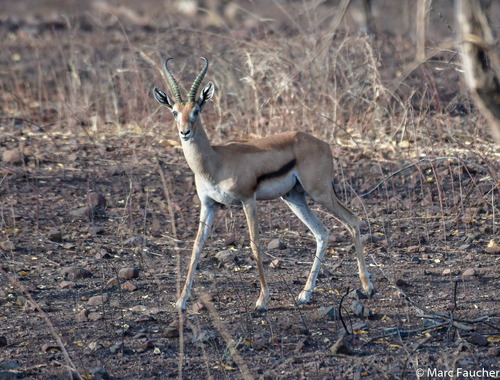
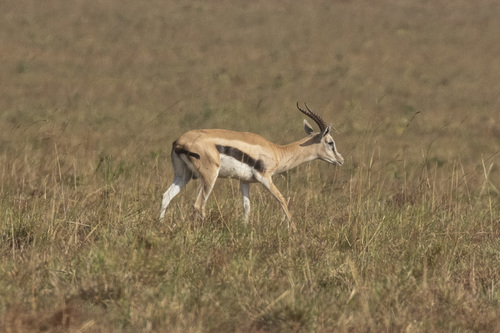
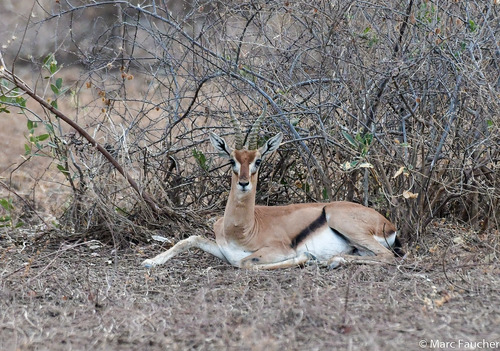
Other species in the family Bovidae
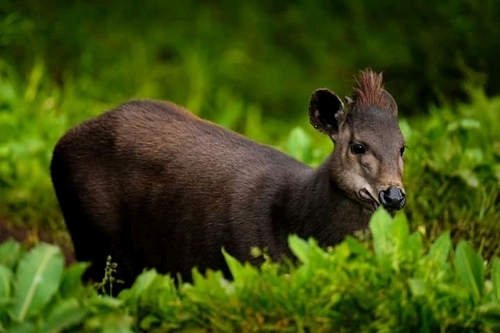
Species that share its range

Sources
Conservation status, range description and population estimate come from the IUCN Red List assessment for Eudorcas thomsonii. Countries are derived from that range description, not from a mapped country list. Last refreshed on .
The distribution map is drawn from the IUCN Red List spatial data compiled in 2008. IUCN (International Union for Conservation of Nature)