
Southern Tuco-tuco
Ctenomys australis
Red List assessment
Endangeredon the IUCN Red List
- EXExtinct
- EWExtinct in the Wild
- CRCritically Endangered
- ENEndangered
- VUVulnerable
- NTNear Threatened
- LCLeast Concern
The Southern Tuco-tuco is recorded in one country, Argentina across South America. The IUCN Red List assesses the Southern Tuco-tuco as Endangered. Exact population numbers are not well documented, but the population is considered to be declining due to ongoing habitat destruction along the Argentine coast.
- Family
- Ctenomyidae
- Order
- Rodentia
- Genus
- Ctenomys
- Countries recorded
- 1
- Continents
- South America
- Red List category
- Endangered
- Data updated
- August 9, 2026
What is the Southern Tuco-tuco?
The Southern Tuco-tuco is a burrowing rodent endemic to the coastal sand dunes of Buenos Aires Province, Argentina. It is one of the largest species in the genus Ctenomys, a group of subterranean rodents known as tuco-tucos. It is remarkable for its highly specialized fossorial lifestyle and its restricted, fragmented habitat along the Atlantic coast. Its extensive burrow systems and territorial vocalizations make it a keystone species in the coastal dune ecosystem.
Where does the Southern Tuco-tuco live?
Argentina, restricted to coastal Buenos Aires Province
Endemic to a narrow coastal strip in southeastern Buenos Aires Province, Argentina, extending roughly from Mar Chiquita to Necochea. The species has a highly fragmented and limited distribution restricted to specific dune habitats along the Atlantic coastline.
Altitude and depth
Found at sea level to a few meters elevation in coastal dunes; burrows typically extend 20-50 cm below the surface, with some tunnels reaching up to 1 meter deep.
Seasonal movements
No true hibernation or long-distance migration; however, activity levels and surface foraging may decrease during colder winter months and increase during breeding season in spring.
Habitat of the Southern Tuco-tuco
Inhabits coastal sand dune systems and adjacent sandy grasslands along the Atlantic coast. Prefers areas with loose, sandy soil suitable for digging extensive burrow networks. Habitat includes both fixed and mobile dunes with sparse vegetation cover.
Adaptations to its environment
Possesses strong forelimbs and claws adapted for digging, small eyes and ears reduced for subterranean life, and a robust, cylindrical body shape suited for tunnel navigation. Fur is dense and can vary in color to blend with sandy substrate, aiding camouflage when briefly surfacing.
Conservation status and numbers
Classified as Endangered (EN) by IUCN due to severe habitat loss and fragmentation from coastal urbanization and tourism development. Population has experienced significant decline over recent decades tied to shrinking dune habitat.
Estimated population
Exact population numbers are not well documented, but the population is considered to be declining due to ongoing habitat destruction along the Argentine coast.
What threatens the Southern Tuco-tuco?
Primary threats include coastal urban development, tourism infrastructure, sand dune stabilization projects, agriculture, and habitat fragmentation. Predation by domestic and feral animals in human-altered habitats is also a concern.
Diseases and parasites
Limited specific data exists, though like other Ctenomys species it may host ectoparasites such as fleas and mites, as well as endoparasites common to burrowing rodents.
What is being done to protect it?
Some populations occur within protected coastal reserves in Buenos Aires Province, though enforcement and habitat protection remain inconsistent. Research monitoring and academic studies have been conducted to better understand population status and ecology.
Recommended actions
Priority actions include expanding protected dune habitat, restricting coastal development in key areas, conducting population surveys, and raising public awareness about the species' endemic and endangered status.
What the Southern Tuco-tuco looks like
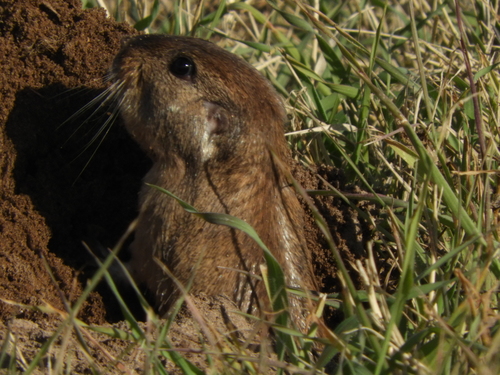
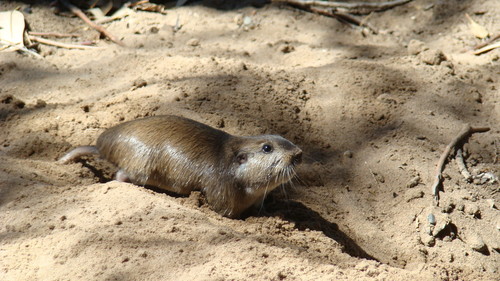
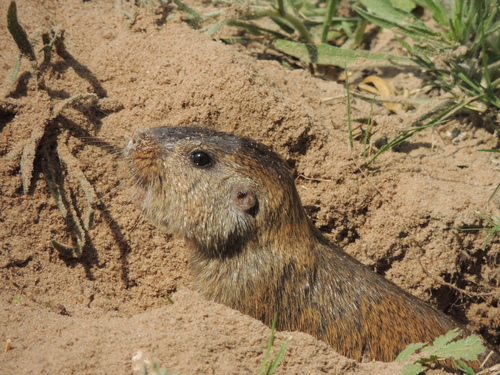
Has a robust, cylindrical body typical of burrowing rodents, with short limbs, small eyes, and small rounded ears. Fur coloration ranges from grayish-brown to yellowish-brown, providing camouflage against sandy dune substrate.
Size
Body length typically ranges from 20 to 25 cm, not including the tail, which adds approximately 6-8 cm.
Weight
Adults typically weigh between 200 and 350 grams, with males generally slightly larger than females.
Distinctive features
Distinguished from other Ctenomys species by its larger body size, specific skull morphology, and restricted coastal dune habitat. Genetic and cranial studies help differentiate it from closely related sympatric or parapatric tuco-tuco species.
Differences between males and females
Males are generally slightly larger and heavier than females, though the difference is not extreme.
Behaviour and diet of the Southern Tuco-tuco
Primarily solitary, with individuals maintaining separate burrow systems and being highly territorial against conspecifics. Social interactions are largely limited to brief encounters during mating season.
When it is active
Primarily diurnal to crepuscular, though most activity occurs underground within burrow systems; surface activity is limited and cautious due to predation risk.
Diet
Herbivorous, feeding mainly on roots, bulbs, stems, and leaves of dune vegetation. Diet composition shifts seasonally based on plant availability within its sandy habitat.
Communication
Communicates primarily through low-frequency vocalizations used for territorial signaling and mate attraction, as sound travels effectively through burrow tunnels. Scent marking via glandular secretions may also play a role in territory delineation.
Interactions with other species
Predators include birds of prey, foxes, and other carnivorous mammals that hunt near burrow entrances. Competes with other burrowing species for suitable dune habitat and may have complex interactions with sympatric Ctenomys species where ranges overlap.
Role in its ecosystem
As a burrowing species, it plays an important ecological role in soil aeration and nutrient cycling within dune ecosystems, and its burrows can be used by other species as shelter. It also serves as a prey base for various coastal predators.
Reproduction and lifecycle
Breeding season occurs typically in spring, with females producing one litter per year after a gestation period of approximately 100-120 days. Litter size is usually small, ranging from 1 to 4 pups.
Raising the young
Females provide most parental care, nursing and protecting pups within the burrow until they are weaned and capable of independent foraging, typically over several weeks. Young disperse to establish their own burrow systems after weaning.
Maturity and lifespan
Sexual maturity is typically reached around 6 months to 1 year of age. Lifespan in the wild is estimated at 2-4 years, though captive individuals may live slightly longer under controlled conditions.
Taxonomy and naming of the Southern Tuco-tuco
Classification
Class Mammalia > Order Rodentia > Family Ctenomyidae > Genus Ctenomys > Species Ctenomys australis
What research says
Recent studies
Recent research has focused on population genetics, habitat fragmentation effects, and phylogenetic relationships within the Ctenomys genus, helping clarify conservation priorities for this endemic species.
Genome and DNA
Ctenomys species are known for remarkable karyotype diversity across the genus; Ctenomys australis has been subject to some cytogenetic studies examining chromosome number variation typical of the genus.
Compared with similar species
Compared to other Ctenomys species, C. australis is notably larger and restricted to a much narrower coastal dune habitat, whereas many congeners occupy broader inland grassland or Andean habitats. Its specific ecological niche in dune systems sets it apart from more widespread tuco-tuco species.
The Southern Tuco-tuco and people
Southern Tuco-tucos spend the vast majority of their lives underground and are rarely seen above ground. Their name 'tuco-tuco' comes from the distinctive repetitive vocalization they make, audible even from within their burrows.
Where and how to see it
Best observed at dawn or dusk near burrow entrances in protected coastal dune reserves of Buenos Aires Province, Argentina, though sightings are rare due to their subterranean habits. Patience and quiet observation near active burrow mounds increase chances of spotting brief surface activity.
Risks to humans
No notable risk to humans; the species is not aggressive and poses no direct threat.
Countries where the Southern Tuco-tuco is recorded
The 1 countries named in the range description of its IUCN Red List assessment.
Questions about the Southern Tuco-tuco
Where does the Southern Tuco-tuco live?
The Southern Tuco-tuco is recorded in Argentina across South America. These countries come from the range description of its IUCN Red List assessment, and they are what place the species on the interactive map.
Is the Southern Tuco-tuco endangered?
Yes. The IUCN Red List assesses the Southern Tuco-tuco as Endangered, one of the three threatened categories. The species faces a very high risk of extinction in the wild — a step below Critically Endangered, but still on a trajectory that ends badly without intervention.
How many are left in the wild?
Exact population numbers are not well documented, but the population is considered to be declining due to ongoing habitat destruction along the Argentine coast. This figure comes from the species assessment on the IUCN Red List; population estimates for wild mammals are ranges, not counts, and are revised at each assessment.
What habitat does the Southern Tuco-tuco live in?
Inhabits coastal sand dune systems and adjacent sandy grasslands along the Atlantic coast.
What is the scientific name of the Southern Tuco-tuco?
The Southern Tuco-tuco is Ctenomys australis, in the family Ctenomyidae, order Rodentia.
Other species in the genus Ctenomys

Species that share its range
Sources
Conservation status, range description and population estimate come from the IUCN Red List assessment for Ctenomys australis. Countries are derived from that range description, not from a mapped country list. Last refreshed on .
The distribution map is drawn from the IUCN Red List spatial data compiled in 2017. IUCN SSC Small Mammal Specialist Group