
Southern Tamandua
Tamandua tetradactyla
Red List assessment
Least Concernon the IUCN Red List
- EXExtinct
- EWExtinct in the Wild
- CRCritically Endangered
- ENEndangered
- VUVulnerable
- NTNear Threatened
- LCLeast Concern
The Southern Tamandua is recorded in 6 countries across South America. The IUCN Red List assesses the Southern Tamandua as Least Concern. No precise global population estimate exists, but the species is considered common and stable across much of its range, with local declines in heavily deforested regions.
- Family
- Myrmecophagidae
- Order
- Pilosa
- Genus
- Tamandua
- Countries recorded
- 6
- Continents
- South America
- Red List category
- Least Concern
- Data updated
- August 9, 2026
What is the Southern Tamandua?
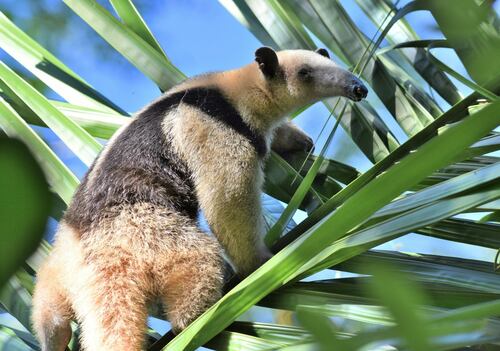
The Southern Tamandua is a medium-sized anteater found throughout much of South America east of the Andes. It is easily recognized by its prehensile tail, sharp claws, and distinctive black-and-tan 'vest' pattern in many populations. This arboreal and terrestrial mammal plays an important ecological role as a specialist predator of ants and termites. Unlike its larger relative the Giant Anteater, it is capable of climbing trees with agility using its prehensile tail.
Where does the Southern Tamandua live?
South America, primarily Brazil, Argentina, Uruguay, Paraguay, Bolivia, Venezuela, and the Guianas
Ranges from Venezuela and Trinidad south through the Guianas, Brazil, Bolivia, Paraguay, Uruguay, and northern Argentina. Its range is bounded by the Andes to the west, giving it a broad distribution across the lowlands of South America.
Altitude and depth
Sea level to approximately 2000m elevation
Seasonal movements
No true migration or hibernation; activity patterns may shift seasonally with rainfall, being more nocturnal in hot dry seasons and more diurnal in cooler, wetter periods.
Habitat of the Southern Tamandua
Inhabits a wide range of forested and semi-open habitats including tropical and subtropical rainforest, dry forest, savanna woodland, and gallery forest along rivers. Highly adaptable, it can also be found in secondary growth and disturbed habitats near human settlements.
Adaptations to its environment
Possesses powerful curved foreclaws for tearing open ant and termite nests, and a long sticky tongue (up to 40cm) for extracting prey. Its prehensile tail and semi-arboreal claws allow it to climb trees, while a strong odor gland near the anus deters predators, earning it the nickname 'stinker of the forest'.
Conservation status and numbers
Listed as Least Concern by the IUCN due to its wide distribution, adaptability to various habitats, and presumed large population, though local declines occur from habitat loss.
Estimated population
No precise global population estimate exists, but the species is considered common and stable across much of its range, with local declines in heavily deforested regions.
What threatens the Southern Tamandua?
Main threats include deforestation and habitat fragmentation, road mortality, hunting for meat or perceived pest control, and predation by domestic dogs. Forest conversion to agriculture and cattle ranching is a growing concern in parts of its range.
Diseases and parasites
Known to host various internal and external parasites including ticks, mites, and gastrointestinal nematodes; specific disease studies are limited compared to more economically significant species.
What is being done to protect it?
Protected in numerous national parks and reserves across its range, including in Brazil's Atlantic Forest and Pantanal regions. It benefits indirectly from broader Neotropical forest conservation initiatives and is included in some countries' wildlife protection legislation.
Recommended actions
Recommended actions include maintaining forest connectivity to reduce fragmentation, implementing wildlife road crossings to reduce vehicle strikes, public education to reduce unnecessary killing, and continued monitoring of populations in disturbed habitats.
What the Southern Tamandua looks like
Fur is short and dense, typically pale yellow to tan with a distinctive black 'vest' pattern covering the shoulders and back in most populations, though some individuals are entirely blonde or dark. The snout is elongated and tubular, eyes and ears are small, and the tail is prehensile and mostly hairless on the underside.
Size
Body length 53-88cm, with a prehensile tail adding another 40-67cm
Weight
3.2-8.4kg, with males typically slightly larger than females
Distinctive features
Distinguished from the Northern Tamandua by subtle differences in fur color pattern and geographic range separation at the Andes/Amazon boundary; distinguished from the Giant Anteater by its much smaller size, prehensile tail, and semi-arboreal lifestyle.
Differences between males and females
Minimal sexual dimorphism; males are slightly larger and heavier than females, but coloration and body structure are essentially the same between sexes.
Behaviour and diet of the Southern Tamandua
Solitary animals except during breeding encounters or when a mother is raising young. Individuals maintain overlapping home ranges and communicate largely through scent marking rather than direct interaction.
When it is active
Primarily nocturnal to crepuscular, though can be active during the day depending on temperature, predation pressure, and food availability.
Diet
Specialized insectivore feeding almost exclusively on ants and termites, consuming up to 9000 insects per day. It shows some dietary flexibility, occasionally eating bees and their honey.
How it feeds and hunts
Uses powerful foreclaws to tear open ant and termite nests, then extends its long sticky tongue rapidly (up to 160 times per minute) to lap up prey before moving to a new nest to avoid soldier ant bites.
Communication
Communicates primarily through scent marking using anal gland secretions with a strong, skunk-like odor, along with hissing sounds and defensive postures when threatened.
Interactions with other species
Natural predators include large cats such as jaguars and pumas, as well as large birds of prey; its powerful claws serve as an effective defense when threatened, often raising up on hind legs to slash at attackers.
Role in its ecosystem
Plays an important ecological role as a natural regulator of ant and termite populations, helping maintain insect population balance within forest and savanna ecosystems.
Reproduction and lifecycle
Breeding can occur year-round in many regions, though some seasonal peaks exist. Gestation lasts approximately 130-190 days, typically resulting in a single offspring.
Raising the young
The mother carries her single offspring on her back for several months until it becomes independent, teaching it foraging skills along the way; weaning occurs at around 3-4 months but the juvenile may stay with the mother for up to a year.
Maturity and lifespan
Reaches sexual maturity around 1 year of age; lifespan in the wild is estimated at 9-10 years, while captive individuals can live up to 15 years or more.
Taxonomy and naming of the Southern Tamandua
Classification
Mammalia > Pilosa > Myrmecophagidae > Tamandua > Tamandua tetradactyla
Subspecies
Several subspecies recognized including T. t. tetradactyla (Brazil, Paraguay), T. t. nigra, and T. t. straminea, distinguished mainly by fur coloration and geographic range, though taxonomy remains debated.
Scientific synonyms
Myrmecophaga tetradactyla (original Linnaean classification)
What research says
Recent studies
Recent studies have used camera trap and telemetry data to better understand home range size and habitat use in fragmented landscapes, revealing surprising adaptability to disturbed and agricultural areas.
Genome and DNA
Diploid chromosome number reported as 2n=54; genetic studies are limited but have been used to help clarify taxonomic boundaries between Tamandua species.
Compared with similar species
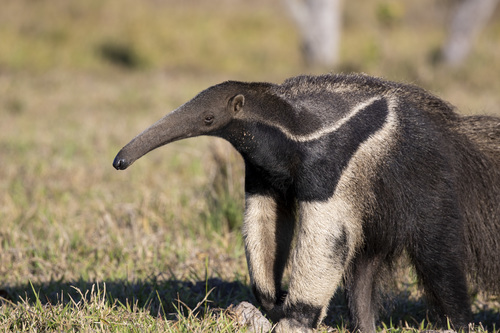
Compared to the Northern Tamandua (Tamandua mexicana), the Southern species has a slightly different color pattern and occupies a distinct, non-overlapping range south of the Amazon basin. It is much smaller and more arboreal than the Giant Anteater (Myrmecophaga tridactyla), which is fully terrestrial.
The Southern Tamandua and people
Its powerful anal gland secretion smells so strong it has earned the nickname 'stinker of the forest'. It can extend its tongue up to 40cm to reach deep into ant tunnels, and its sticky saliva helps trap hundreds of insects with each lick.
Where and how to see it
Best observed at dusk or during night walks in protected forest reserves in Brazil's Pantanal or Atlantic Forest regions, often spotted climbing trees or investigating fallen logs; a red-filtered flashlight can help minimize disturbance.
Risks to humans
No notable risk to humans under normal circumstances; if cornered, it can inflict painful scratches with its sharp claws, and its defensive odor spray can be unpleasant but is not dangerous.
Human uses
Occasionally hunted for bushmeat in some rural areas, and historically kept by local communities to control ant and termite infestations near homes, though this practice is now uncommon.
Myths and legends
In some South American folk traditions, the tamandua is viewed as a harmless, even comical creature, sometimes associated with local legends about forest spirits due to its strange appearance and nocturnal habits.
Countries where the Southern Tamandua is recorded
The 6 countries named in the range description of its IUCN Red List assessment.
Questions about the Southern Tamandua
Where does the Southern Tamandua live?
The Southern Tamandua is recorded in Argentina, Bolivia, Brazil, Paraguay and Uruguay, among 6 countries in total across South America. These countries come from the range description of its IUCN Red List assessment, and they are what place the species on the interactive map.
Is the Southern Tamandua endangered?
The IUCN Red List assesses the Southern Tamandua as Least Concern. The species is widespread and abundant enough not to qualify for any threatened category. It does not mean the species is safe forever, only that nothing in the current data raises an alarm.
How many are left in the wild?
No precise global population estimate exists, but the species is considered common and stable across much of its range, with local declines in heavily deforested regions. This figure comes from the species assessment on the IUCN Red List; population estimates for wild mammals are ranges, not counts, and are revised at each assessment.
What habitat does the Southern Tamandua live in?
Inhabits a wide range of forested and semi-open habitats including tropical and subtropical rainforest, dry forest, savanna woodland, and gallery forest along rivers.
What is the scientific name of the Southern Tamandua?
The Southern Tamandua is Tamandua tetradactyla, in the family Myrmecophagidae, order Pilosa.
Other species in the genus Tamandua
Other species in the family Myrmecophagidae
Species that share its range
Sources
Conservation status, range description and population estimate come from the IUCN Red List assessment for Tamandua tetradactyla. Countries are derived from that range description, not from a mapped country list. Last refreshed on .
The distribution map is drawn from the IUCN Red List spatial data compiled in 2024. IUCN (International Union for Conservation of Nature)