
Giant Anteater
Myrmecophaga tridactyla
Red List assessment
Vulnerableon the IUCN Red List
- EXExtinct
- EWExtinct in the Wild
- CRCritically Endangered
- ENEndangered
- VUVulnerable
- NTNear Threatened
- LCLeast Concern
The Giant Anteater is recorded in 5 countries across North America and South America. The IUCN Red List assesses the Giant Anteater as Vulnerable. Population size is unknown, but it is believed to be declining due to habitat loss
- Family
- Myrmecophagidae
- Order
- Pilosa
- Genus
- Myrmecophaga
- Countries recorded
- 5
- Continents
- North America and South America
- Red List category
- Vulnerable
- Data updated
- August 9, 2026
What is the Giant Anteater?
The Giant Anteater is the largest of the anteater species, known for its elongated snout and bushy tail. It inhabits grasslands, savannas, and forests across Central and South America. Remarkable for its specialized diet of ants and termites, it plays a crucial role in controlling insect populations. Its distinctive appearance and behavior make it a unique and iconic species in its range.
Where does the Giant Anteater live?
Central and South America, primarily Brazil, Bolivia, Paraguay, Argentina, and parts of Central America
Ranges from Honduras in Central America through Brazil, Bolivia, Paraguay, and northern Argentina in South America
Altitude and depth
0-2000m
Habitat of the Giant Anteater
Grasslands, savannas, and tropical forests, often near water sources
Adaptations to its environment
Strong forelimbs and claws for digging into ant and termite mounds; a long sticky tongue for extracting insects; keen sense of smell to locate food sources.
Conservation status and numbers
Vulnerable due to habitat loss and fragmentation, with population declines observed in various regions.
Estimated population
Population size is unknown, but it is believed to be declining due to habitat loss
What threatens the Giant Anteater?
Habitat destruction, road accidents, and hunting
What is being done to protect it?
Protected under various national laws; conservation programs focus on habitat preservation and connectivity
Recommended actions
Strengthen habitat protection, create wildlife corridors, and implement road-crossing structures to reduce vehicle collisions
What the Giant Anteater looks like
Grayish-brown fur with a distinctive black and white stripe pattern on the shoulders; long, bushy tail; elongated snout
Size
1.8-2.4m body length, including tail
Weight
27-50kg
Distinctive features
Distinguished by its size, elongated snout, and unique fur pattern compared to other anteater species
Behaviour and diet of the Giant Anteater
Generally solitary, with limited social interactions outside of mating
When it is active
Primarily diurnal, but can be crepuscular in hotter regions to avoid extreme temperatures
Diet
Insectivorous, feeding mainly on ants and termites
How it feeds and hunts
Uses powerful claws to break into ant and termite mounds, then extracts insects with a long, sticky tongue
Communication
Primarily uses body language and scent marking; vocalizations are limited
Interactions with other species
Preyed upon by jaguars and pumas; competes with other insectivores for food resources
Role in its ecosystem
Plays a significant role in controlling ant and termite populations, indirectly affecting vegetation health
Reproduction and lifecycle
Breeding can occur year-round; gestation lasts about 190 days, typically resulting in a single offspring
Raising the young
Mothers carry their young on their backs for several months, providing protection and teaching foraging skills
Maturity and lifespan
Reaches sexual maturity at 2-4 years; lifespan can be up to 16 years in the wild, longer in captivity
Taxonomy and naming of the Giant Anteater
Classification
Mammalia > Pilosa > Myrmecophagidae > Myrmecophaga > Myrmecophaga tridactyla
Scientific synonyms
Myrmecophaga jubata (historical synonym)
What research says
Recent studies
Recent studies focus on the impact of habitat fragmentation on genetic diversity and population connectivity
Compared with similar species
Similar to the Tamandua but larger in size and with a more specialized diet
The Giant Anteater and people
Giant Anteaters have no teeth and rely on their long tongues, which can extend up to 60 cm, to catch prey. They can consume up to 30,000 insects in a single day.
Where and how to see it
Best observed in the early morning or late afternoon in protected natural reserves within their range
Risks to humans
No notable risk to humans, but can defend itself with powerful claws if threatened
Myths and legends
In some indigenous cultures, the Giant Anteater is seen as a symbol of protection and resourcefulness
Countries where the Giant Anteater is recorded
The 5 countries named in the range description of its IUCN Red List assessment.
Questions about the Giant Anteater
Where does the Giant Anteater live?
The Giant Anteater is recorded in Argentina, Bolivia, Brazil, Honduras and Paraguay across North America and South America. These countries come from the range description of its IUCN Red List assessment, and they are what place the species on the interactive map.
Is the Giant Anteater endangered?
Yes. The IUCN Red List assesses the Giant Anteater as Vulnerable, one of the three threatened categories. The species faces a high risk of extinction in the wild. It is the first of the three threatened categories: numbers are falling, the range is shrinking, or the population is small enough that a single bad event could do lasting damage.
How many are left in the wild?
Population size is unknown, but it is believed to be declining due to habitat loss This figure comes from the species assessment on the IUCN Red List; population estimates for wild mammals are ranges, not counts, and are revised at each assessment.
What habitat does the Giant Anteater live in?
Grasslands, savannas, and tropical forests, often near water sources
What is the scientific name of the Giant Anteater?
The Giant Anteater is Myrmecophaga tridactyla, in the family Myrmecophagidae, order Pilosa.
Other species in the family Myrmecophagidae
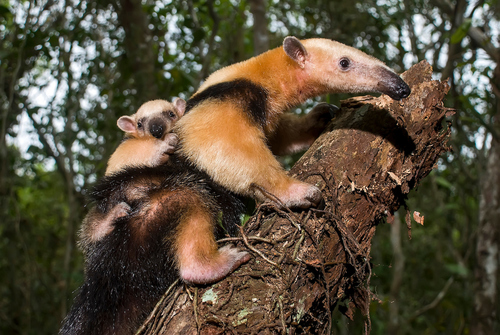
Species that share its range
Sources
Conservation status, range description and population estimate come from the IUCN Red List assessment for Myrmecophaga tridactyla. Countries are derived from that range description, not from a mapped country list. Last refreshed on .
The distribution map is drawn from the IUCN Red List spatial data compiled in 2024. IUCN (International Union for Conservation of Nature)