
Smoky Bat
Amorphochilus schnablii
Red List assessment
Vulnerableon the IUCN Red List
- EXExtinct
- EWExtinct in the Wild
- CRCritically Endangered
- ENEndangered
- VUVulnerable
- NTNear Threatened
- LCLeast Concern
The Smoky Bat is recorded in 3 countries across South America. The IUCN Red List assesses the Smoky Bat as Vulnerable. No reliable global population estimate exists.
- Family
- Furipteridae
- Order
- Chiroptera
- Genus
- Amorphochilus
- Countries recorded
- 3
- Continents
- South America
- Red List category
- Vulnerable
- Data updated
- August 9, 2026
What is the Smoky Bat?
The Smoky Bat (Amorphochilus schnablii) is a small, insectivorous bat and the sole member of the genus Amorphochilus, belonging to the rare family Furipteridae. It is most remarkable for its vestigial, nearly invisible thumbs that are largely enclosed within the wing membrane, a feature shared only with its distant relative Furipterus horrens. It inhabits some of the most arid environments in the world, including the hyperarid Pacific coastal deserts and dry Andean valleys of western South America. It is classified as Vulnerable due to its naturally restricted range, low population density, and ongoing habitat degradation.
Where does the Smoky Bat live?
Western South America: Pacific coast and western Andean slopes of Peru, southwestern Ecuador, and northern Chile
Restricted to the Pacific slope of South America, from southwestern Ecuador (Loja and El Oro provinces) through coastal and foothill regions of western and southern Peru (including Arequipa, Ica, Lima departments) to northern Chile. The range is naturally fragmented and associated with the Atacama and coastal Peruvian desert systems.
Altitude and depth
Typically recorded from near sea level up to approximately 1,500–2,000 m above sea level along the western Andean slopes and coastal desert zones; most records are below 1,500 m.
Seasonal movements
No documented seasonal migrations. Local movements likely occur in response to seasonal fluctuations in insect prey availability, particularly following sporadic rainfall events that trigger insect blooms in arid zones, but this remains poorly studied.
Habitat of the Smoky Bat
Occupies hyperarid and semi-arid coastal deserts, dry scrublands, rocky outcrops, steep canyon walls, and arid river valleys. Roosts in caves, rock crevices, cliff faces, and occasionally abandoned buildings or old structures near these environments.
Adaptations to its environment
The vestigial, membrane-enclosed thumb reduces aerodynamic drag and may enhance maneuverability during aerial pursuit of insects in confined rocky environments. Its smoky gray coloration provides excellent camouflage against the rocky substrates of its roost sites. The species is physiologically adapted to the scarce water and food resources characteristic of hyperarid coastal deserts.
Conservation status and numbers
Listed as Vulnerable (VU) on the IUCN Red List. The designation reflects the species' restricted and fragmented range, naturally low abundance, and ongoing loss and degradation of its arid habitat from human activities. Population decline is suspected but difficult to quantify due to limited survey data.
Estimated population
No reliable global population estimate exists. The species is considered naturally rare and sparsely distributed; the population trend is believed to be declining based on ongoing habitat loss across its range.
What threatens the Smoky Bat?
Primary threats include habitat destruction from agricultural expansion, mining operations, and urban development in coastal Peru and Chile. Disturbance and destruction of cave and rocky roost sites by recreational cavers, mining, and construction are significant concerns. Reduction of insect prey through broad-spectrum pesticide use in agricultural areas may also negatively impact the species.
Diseases and parasites
No species-specific parasite or disease studies have been published. Like other bats, it may host ectoparasites such as bat flies (Streblidae or Nycteribiidae) and endoparasitic helminths. As a bat, it could potentially harbor coronaviruses or other zoonotic pathogens, but no data exist for this species.
What is being done to protect it?
Some populations may occur within protected areas such as the Lomas de Atiquipa Reserved Zone and other coastal reserves in Peru. The species benefits from general bat and wildlife protection under Peruvian and Chilean national legislation, but no targeted conservation program specifically for this species is known to exist.
Recommended actions
Priority actions include systematic population surveys to define distribution and estimate abundance, formal protection of key roost caves and rock crevice sites, reduction of human disturbance at known colonies, monitoring of insect prey communities in occupied habitats, and integration of the species into national bat conservation strategies in Peru, Ecuador, and Chile.
What the Smoky Bat looks like
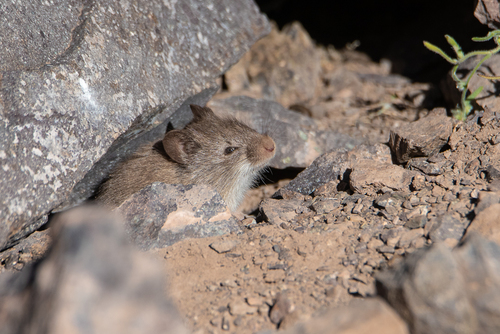
Fur is uniformly smoky gray to grayish-brown on the dorsal surface, with slightly paler coloration on the ventral side. The muzzle is short and broad, the ears are small and rounded, and the wing membranes are thin and dark. The thumb is vestigial and almost entirely enclosed within the propatagium, making it barely visible externally.
Size
Small bat: body length approximately 35–50 mm; forearm length approximately 37–43 mm; estimated wingspan approximately 20–25 cm.
Weight
Approximately 4–8 grams; no pronounced sexual size dimorphism has been reported.
Distinctive features
The near-total absence of a visible external thumb, enclosed within the wing membrane, is the most diagnostic feature and is unique to family Furipteridae worldwide. Compared to the only other furipterid, Furipterus horrens, Amorphochilus schnablii is distinguished by its geographic restriction to the arid Pacific coast, its smoky gray (versus brownish) coloration, and its larger overall body size.
Differences between males and females
Sexual dimorphism is minimal. Females may be marginally larger than males, as is typical for many small insectivorous bats, but no notable differences in coloration, wing morphology, or external features between sexes have been documented.
Behaviour and diet of the Smoky Bat
Roosts in small to medium-sized colonies in caves, rock crevices, and canyon walls. Exact colony sizes are poorly documented, but groups of tens to low hundreds of individuals have been recorded at roost sites. Social structure within colonies is not well studied.
When it is active
Strictly nocturnal. Individuals emerge after dusk to begin foraging for flying insects, using echolocation throughout the night, and return to roost sites before dawn.
Diet
Exclusively insectivorous. Diet consists primarily of small to medium-sized flying insects, with moths (Lepidoptera) suspected to be a significant prey item, along with other nocturnal arthropods available in arid environments.
How it feeds and hunts
Hunts entirely on the wing using high-frequency ultrasonic echolocation to detect and pursue flying insect prey in open aerial space. Wing morphology and the reduced thumb likely facilitate agile, open-space foraging in rocky canyon and cliff environments.
Communication
Uses ultrasonic echolocation calls for navigation and prey detection; call parameters for this species are not fully characterized in the literature. Social communication within roost colonies likely includes auditory and possibly olfactory signals, but no detailed behavioral studies have been published.
Interactions with other species
Natural predators likely include owls (Strigiformes) and other nocturnal raptors that hunt near bat emergence sites. May compete with other sympatric insectivorous bat species for prey resources. No symbiotic or mutualistic interspecific relationships have been documented.
Role in its ecosystem
As a nocturnal insectivore, it plays a role in regulating populations of flying insects, including potential agricultural pest species, in arid coastal ecosystems. Its ecological function as an insect predator in one of the world's driest biomes makes it a potentially important component of these fragile food webs.
Reproduction and lifecycle
Reproductive biology is poorly documented. It likely produces a single pup per reproductive event, as is common in most insectivorous bats. Birthing timing may coincide with peaks in insect availability during warmer or post-rainfall periods, but this has not been confirmed with field studies.
Raising the young
Maternal care is the norm, as in most bats; the mother nurses the pup at the roost and initially carries it during foraging flights. As the pup grows, it is left in the roost while the mother forages. Specific duration of lactation and age of independence have not been documented for this species.
Maturity and lifespan
Age of sexual maturity and lifespan have not been specifically documented for this species. By analogy with similar small insectivorous bats, sexual maturity is likely reached within the first one to two years of life, and wild lifespan may range from 5 to 15 years.
Taxonomy and naming of the Smoky Bat
Classification
Mammalia > Chiroptera > Furipteridae > Amorphochilus > Amorphochilus schnablii
Scientific synonyms
No widely recognized synonyms; originally described by Peters in 1867. Amorphochilus is a monotypic genus with no other species.
What research says
Recent studies
Molecular phylogenetic analyses have confirmed that Furipteridae, including Amorphochilus, belongs to the superfamily Noctilionoidea, closely allied with Thyropteridae (disc-winged bats) and Myzopodidae (sucker-footed bats). Studies on noctilionoid bat diversification have shed light on the biogeographic origins of this family in the context of South American aridification.
Compared with similar species
Amorphochilus schnablii is most closely related to Furipterus horrens (Thumbless Bat of Central and South America), the only other species in family Furipteridae, with both sharing the diagnostic vestigial enclosed thumb. However, Furipterus horrens inhabits humid tropical forests from Costa Rica to southeastern Brazil, while Amorphochilus schnablii is uniquely adapted to the hyperarid Pacific coast, representing a remarkable ecological divergence within the same small family. Both differ from all other bat families by their highly reduced external thumbs.
The Smoky Bat and people
The Smoky Bat is one of only two species in its entire family (Furipteridae), making it among the rarest bat lineages on Earth. Its 'thumbless' appearance so puzzled early naturalists that the family was considered one of the most morphologically aberrant of all bats — in reality the thumb is present but reduced to a tiny vestige hidden within the wing. This species manages to thrive in one of the driest places on Earth, the coastal Peruvian desert, finding enough nocturnal insect prey to sustain colonies in conditions where most mammals cannot survive.
Where and how to see it
Best observed at dusk in arid rocky canyons, coastal desert valleys, and deep gorges of western Peru, particularly in the Arequipa and Ica regions (e.g., Cotahuasi Canyon area). Use a bat detector to identify ultrasonic echolocation calls at emergence. Visits to known cave roost sites should be conducted with minimal disturbance and with guidance from local naturalists or conservation authorities.
Risks to humans
No notable direct risk to humans. As with all wild bats, there is a theoretical risk of rabies transmission through direct contact or bites; handling without proper protective equipment should be strictly avoided. The species should not be disturbed at roost sites.
Countries where the Smoky Bat is recorded
The 3 countries named in the range description of its IUCN Red List assessment.
Questions about the Smoky Bat
Where does the Smoky Bat live?
The Smoky Bat is recorded in Chile, Ecuador and Peru across South America. These countries come from the range description of its IUCN Red List assessment, and they are what place the species on the interactive map.
Is the Smoky Bat endangered?
Yes. The IUCN Red List assesses the Smoky Bat as Vulnerable, one of the three threatened categories. The species faces a high risk of extinction in the wild. It is the first of the three threatened categories: numbers are falling, the range is shrinking, or the population is small enough that a single bad event could do lasting damage.
How many are left in the wild?
No reliable global population estimate exists. This figure comes from the species assessment on the IUCN Red List; population estimates for wild mammals are ranges, not counts, and are revised at each assessment.
What habitat does the Smoky Bat live in?
Occupies hyperarid and semi-arid coastal deserts, dry scrublands, rocky outcrops, steep canyon walls, and arid river valleys.
What is the scientific name of the Smoky Bat?
The Smoky Bat is Amorphochilus schnablii, in the family Furipteridae, order Chiroptera.
Species that share its range
Sources
Conservation status, range description and population estimate come from the IUCN Red List assessment for Amorphochilus schnablii. Countries are derived from that range description, not from a mapped country list. Last refreshed on .
The distribution map is drawn from the IUCN Red List spatial data compiled in 2008. IUCN (International Union for Conservation of Nature)