
Siamang
Symphalangus syndactylus
Red List assessment
Endangeredon the IUCN Red List
- EXExtinct
- EWExtinct in the Wild
- CRCritically Endangered
- ENEndangered
- VUVulnerable
- NTNear Threatened
- LCLeast Concern
The Siamang is recorded in 3 countries across Asia. The IUCN Red List assesses the Siamang as Endangered. Estimated at around 20,000-22,000 individuals in Sumatra and fewer than a few thousand in Malaysia, with an overall declining trend.
- Family
- Hylobatidae
- Order
- Primates
- Genus
- Symphalangus
- Countries recorded
- 3
- Continents
- Asia
- Red List category
- Endangered
- Data updated
- August 9, 2026
What is the Siamang?
The siamang is the largest of the gibbon family, found in the rainforests of Sumatra and the Malay Peninsula. It is renowned for its distinctive throat sac used to produce loud, resonant calls that can be heard over a kilometer away. As a highly arboreal ape, it moves through the canopy via brachiation and plays an important role in seed dispersal in tropical forests.
Where does the Siamang live?
Sumatra (Indonesia) and the Malay Peninsula (Malaysia, southern Thailand)
Found on the island of Sumatra in Indonesia and across the Malay Peninsula including peninsular Malaysia and small populations in southern Thailand.
Altitude and depth
0-2000m, though most populations occur below 1500m elevation.
Seasonal movements
No true migration or hibernation; breeding can occur year-round but may show slight seasonal peaks correlated with fruit availability.
Habitat of the Siamang
Primary and secondary tropical rainforest, including lowland dipterocarp forest and hill forest with dense canopy cover essential for brachiation.
Adaptations to its environment
Long arms (longer relative to body size than other gibbons) and hook-like hands enable efficient brachiation through the canopy. The inflatable throat sac amplifies vocalizations for long-distance communication in dense forest.
Conservation status and numbers
Endangered (EN) according to IUCN, with population declines exceeding 50% over the past three generations due to habitat loss and hunting.
Estimated population
Estimated at around 20,000-22,000 individuals in Sumatra and fewer than a few thousand in Malaysia, with an overall declining trend.
What threatens the Siamang?
Deforestation for palm oil and logging, habitat fragmentation, illegal pet trade, and hunting for bushmeat or traditional medicine.
Diseases and parasites
Susceptible to various primate-borne parasites and diseases including intestinal parasites and respiratory infections, though specific studies are limited.
What is being done to protect it?
Protected under national wildlife laws in Indonesia and Malaysia; populations occur in protected areas such as Gunung Leuser National Park and Kerinci Seblat National Park; listed on CITES Appendix I.
Recommended actions
Strengthen anti-poaching enforcement, expand and connect protected forest corridors, combat illegal pet trade, and support community-based conservation and ecotourism initiatives.
What the Siamang looks like
Covered in dense black fur throughout the body, with long limbs and no tail. A distinctive gular (throat) sac, more pronounced in males, inflates during vocalizations.
Size
Body length approximately 45-90 cm (excluding no tail, as gibbons are tailless); arm span can reach up to 1.5 meters.
Weight
Males and females weigh similarly, ranging from 8 to 13 kg on average.
Distinctive features
Distinguished from other gibbons by its significantly larger size, black coloration, and prominent throat sac used for loud calls; also has partial webbing between the second and third toes, giving rise to the species name 'syndactylus'.
Differences between males and females
Minimal size dimorphism; males may have a slightly larger throat sac used more prominently in calling displays.
Behaviour and diet of the Siamang
Lives in monogamous family groups typically consisting of a mated pair and their offspring, usually 3-5 individuals per group, with strong pair bonding and cooperative territory defense.
When it is active
Diurnal, active during daylight hours, spending most time foraging, traveling through the canopy, and engaging in loud morning calls.
Diet
Primarily folivorous-frugivorous, feeding on leaves, fruits, flowers, and occasionally insects; leaves make up a higher proportion of diet compared to other gibbons.
Communication
Known for loud, complex duet calls between mated pairs, amplified by the inflatable throat sac; also uses body postures, facial expressions, and occasional scent cues for communication.
Interactions with other species
Few natural predators due to arboreal lifestyle, though large raptors and pythons may pose occasional threats to juveniles; competes with other primates and hornbills for fruit resources.
Role in its ecosystem
Plays a significant role as a seed disperser in tropical rainforest ecosystems, contributing to forest regeneration and plant diversity.
Reproduction and lifecycle
Breeding is not strictly seasonal; gestation lasts about 7-8 months, typically resulting in a single offspring; interbirth interval is around 2-3 years.
Raising the young
Both parents contribute to offspring care, with males often carrying and caring for infants after the first year, a behavior more pronounced than in other gibbon species.
Maturity and lifespan
Sexual maturity reached around 6-8 years; lifespan in the wild is approximately 25-30 years, with captive individuals sometimes living over 35 years.
Taxonomy and naming of the Siamang
Classification
Mammalia > Primates > Hylobatidae > Symphalangus > Symphalangus syndactylus
Subspecies
Sometimes two subspecies recognized: S. s. syndactylus (Sumatra) and S. s. continentis (Malay Peninsula), though taxonomic validity is debated.
Scientific synonyms
Hylobates syndactylus (former genus placement)
What research says
Recent studies
Recent studies have focused on vocal communication complexity, genetic diversity across fragmented populations, and the impact of habitat loss on gene flow between Sumatran and Malaysian populations.
Genome and DNA
Diploid chromosome number of 50; genomic studies have helped clarify phylogenetic relationships within Hylobatidae.
Compared with similar species
Larger and darker than other gibbon species such as the lar gibbon (Hylobates lar), with a more developed throat sac and greater emphasis on paternal care of infants.
The Siamang and people
Siamang calls can be heard up to 3-5 kilometers away in dense forest; they are the only gibbon species with partial toe webbing; males often become primary caregivers for infants after their first year, unusual among apes.
Where and how to see it
Best observed in early morning in protected forests such as Gunung Leuser National Park in Sumatra, when pairs perform their loud duet calls; patience and knowledgeable local guides increase chances of sighting.
Risks to humans
No notable risk; siamangs are shy and avoid human contact, though captive or habituated individuals may bite if threatened.
Human uses
Historically captured for the illegal pet trade and occasionally kept in zoos for conservation breeding programs and public education.
Myths and legends
In some local Southeast Asian folklore, the loud calls of siamangs are associated with forest spirits or omens, though specific documented myths are limited.
Countries where the Siamang is recorded
The 3 countries named in the range description of its IUCN Red List assessment.
Questions about the Siamang
Where does the Siamang live?
The Siamang is recorded in Indonesia, Malaysia and Thailand across Asia. These countries come from the range description of its IUCN Red List assessment, and they are what place the species on the interactive map.
Is the Siamang endangered?
Yes. The IUCN Red List assesses the Siamang as Endangered, one of the three threatened categories. The species faces a very high risk of extinction in the wild — a step below Critically Endangered, but still on a trajectory that ends badly without intervention.
How many are left in the wild?
Estimated at around 20,000-22,000 individuals in Sumatra and fewer than a few thousand in Malaysia, with an overall declining trend. This figure comes from the species assessment on the IUCN Red List; population estimates for wild mammals are ranges, not counts, and are revised at each assessment.
What habitat does the Siamang live in?
Primary and secondary tropical rainforest, including lowland dipterocarp forest and hill forest with dense canopy cover essential for brachiation.
What is the scientific name of the Siamang?
The Siamang is Symphalangus syndactylus, in the family Hylobatidae, order Primates.
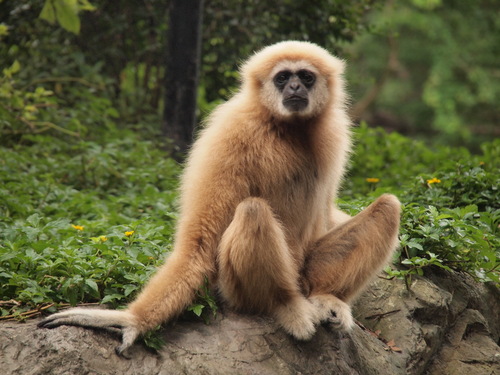
Other species in the family Hylobatidae
Species that share its range
Sources
Conservation status, range description and population estimate come from the IUCN Red List assessment for Symphalangus syndactylus. Countries are derived from that range description, not from a mapped country list. Last refreshed on .
The distribution map is drawn from the IUCN Red List spatial data compiled in 2008. IUCN (International Union for Conservation of Nature)