
Short-tailed Chinchilla
Chinchilla chinchilla
Red List assessment
Endangeredon the IUCN Red List
- EXExtinct
- EWExtinct in the Wild
- CRCritically Endangered
- ENEndangered
- VUVulnerable
- NTNear Threatened
- LCLeast Concern
The Short-tailed Chinchilla is recorded in 4 countries across South America. The IUCN Red List assesses the Short-tailed Chinchilla as Endangered. Population size is poorly known but estimated to be only in the low thousands, fragmented into small, isolated subpopulations; overall trend considered declining or at best stable in protected areas.
- Family
- Chinchillidae
- Order
- Rodentia
- Genus
- Chinchilla
- Countries recorded
- 4
- Continents
- South America
- Red List category
- Endangered
- Data updated
- August 9, 2026
What is the Short-tailed Chinchilla?
The short-tailed chinchilla is a small, densely-furred rodent native to the high Andean mountains of northern Chile. It is renowned for having the softest and densest fur of any land mammal, which historically drove it to the brink of extinction through overhunting. Today it survives in a few isolated, fragmented populations in remote, rocky, arid highlands. It is a highly social, burrowing species adapted to extreme cold and high altitude.
Where does the Short-tailed Chinchilla live?
Northern Chile, in the high Andes
Historically ranged across the Andes of Chile, Bolivia, Peru, and Argentina; today restricted almost entirely to a small number of isolated populations in northern Chile, primarily in the Antofagasta and Atacama regions, with a notable population in the Chinchilla National Reserve near Copiapó.
Altitude and depth
Approximately 2,000 to 5,000 meters above sea level
Seasonal movements
No true hibernation or migration, but activity and breeding are influenced by seasonal temperature extremes and food availability in the arid highland climate.
Habitat of the Short-tailed Chinchilla
Arid and semi-arid rocky slopes, scree fields, and boulder outcrops in high-altitude Andean shrubland and steppe. Vegetation is sparse, dominated by low shrubs, grasses, and cacti. Animals shelter in rock crevices and burrows among boulders.
Adaptations to its environment
Extremely dense fur (up to 60 hairs per follicle) provides insulation against cold nights and thermal regulation at high altitude. Compact body, short ears and tail reduce heat loss, while strong hind legs allow agile movement across rocky terrain. Efficient kidneys and behavior help conserve water in the arid environment.
Conservation status and numbers
Endangered (EN) according to IUCN, due to a drastic population decline of over 90% historically from fur trade hunting, with continuing fragmentation and small population sizes limiting recovery.
Estimated population
Population size is poorly known but estimated to be only in the low thousands, fragmented into small, isolated subpopulations; overall trend considered declining or at best stable in protected areas.
What threatens the Short-tailed Chinchilla?
Historical and ongoing illegal hunting for the fur trade, habitat degradation from mining and livestock grazing, small and fragmented population sizes leading to genetic isolation, and predation.
Diseases and parasites
Wild populations can be affected by external parasites such as mites and fleas, as well as gastrointestinal parasites; specific disease studies in wild populations are limited.
What is being done to protect it?
Protected under Chilean law and CITES Appendix I, with key subpopulations conserved within the Las Chinchillas National Reserve and other protected areas; captive breeding of domestic chinchillas (mostly derived from the related Chinchilla lanigera) has reduced pressure on wild populations for fur.
Recommended actions
Strengthen anti-poaching enforcement, expand and connect protected habitat corridors, conduct population monitoring and genetic studies, and promote community-based conservation and ecotourism initiatives in the region.
What the Short-tailed Chinchilla looks like
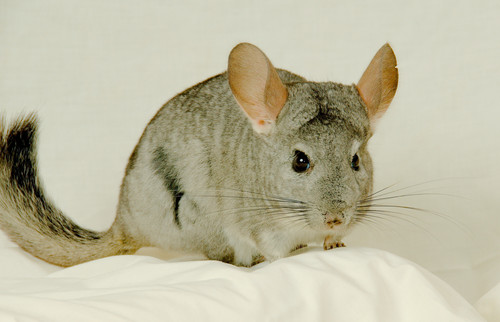
The short-tailed chinchilla has soft, thick, blue-grey to yellowish-grey fur, a rounded body, large rounded ears, and large dark eyes adapted for nocturnal vision. Its tail is notably shorter and thicker than that of its long-tailed relative.
Size
Body length approximately 25-38 cm, with a notably short tail of about 7-10 cm.
Weight
Adults typically weigh between 400 and 800 grams, with females generally slightly larger than males.
Distinctive features
Distinguished from the long-tailed chinchilla (Chinchilla lanigera) by its shorter tail, more compact and rounder body shape, shorter ears, and denser fur.
Differences between males and females
Sexual dimorphism is subtle; females tend to be slightly larger and heavier than males, which is unusual among mammals.
Behaviour and diet of the Short-tailed Chinchilla
Highly social and gregarious, living in colonies that can range from a few dozen to several hundred individuals, often sharing communal burrows and rock crevices for shelter and protection from predators.
When it is active
Primarily crepuscular and nocturnal, being most active during dawn, dusk, and nighttime hours to avoid daytime heat and predators, while resting in burrows during the day.
Diet
Strict herbivore, feeding on grasses, herbs, shrubs, cacti, and other sparse vegetation found in its arid habitat; it obtains most of its water from food due to the dry environment.
Communication
Communicates through a range of vocalizations including chirps, barks, and squeaks, as well as body postures and scent marking to convey alarm, social status, or reproductive state within the colony.
Interactions with other species
Preyed upon by foxes, birds of prey, and other Andean carnivores; competes with other small herbivorous mammals for limited vegetation in its sparse habitat.
Role in its ecosystem
As a herbivore in a fragile high-altitude ecosystem, it plays a role in seed dispersal and vegetation dynamics, while also serving as a prey base for Andean predators.
Reproduction and lifecycle
Breeding typically occurs during the cooler months, with a long gestation period of about 105-115 days, and litters usually consisting of 1-3 pups. Young are born well-developed (precocial) with fur and open eyes.
Raising the young
Females are the primary caregivers, nursing and protecting the young within the safety of communal burrows; pups are weaned within 6-8 weeks but may remain within the social group for extended periods.
Maturity and lifespan
Sexual maturity is typically reached around 8 months of age; lifespan in the wild is estimated at 8-10 years, while captive individuals of related species can live 15-20 years or more.
Taxonomy and naming of the Short-tailed Chinchilla
Classification
Class Mammalia > Order Rodentia > Family Chinchillidae > Genus Chinchilla > Species Chinchilla chinchilla
Scientific synonyms
Chinchilla brevicaudata; Chinchilla boliviana
What research says
Recent studies
Recent conservation genetics studies have focused on assessing genetic diversity and population structure of remaining wild populations to guide reintroduction and management strategies.
Genome and DNA
Chinchilla species have a diploid chromosome number of 2n=64; genetic studies have focused mainly on domesticated chinchillas, with limited genomic research specifically on wild Chinchilla chinchilla.
Compared with similar species
Compared to the long-tailed chinchilla (Chinchilla lanigera), the short-tailed chinchilla is more robust, has a shorter tail and ears, and inhabits higher, more extreme Andean environments; it is also rarer and more endangered in the wild.
The Short-tailed Chinchilla and people
Its fur is so dense that up to 60 hairs can grow from a single follicle, making it nearly impossible for parasites like fleas to survive in its coat. Nearly all domesticated pet chinchillas today descend from the more common long-tailed species, not this rarer short-tailed relative.
Where and how to see it
Best observed at dawn or dusk in protected reserves such as Las Chinchillas National Reserve in Chile, using patience and quiet observation near rocky outcrops where colonies shelter.
Risks to humans
No notable risk to humans; it is a small, non-aggressive herbivorous rodent.
Human uses
Historically hunted extensively for its extremely soft fur, which nearly drove the species to extinction; today wild hunting is illegal, though fur farming continues using domesticated long-tailed chinchillas instead.
Myths and legends
In Andean folklore, chinchillas have sometimes been associated with mountain spirits due to their elusive nature and association with remote, rugged terrain, though specific legends are not well documented.
Countries where the Short-tailed Chinchilla is recorded
The 4 countries named in the range description of its IUCN Red List assessment.
Questions about the Short-tailed Chinchilla
Where does the Short-tailed Chinchilla live?
The Short-tailed Chinchilla is recorded in Argentina, Bolivia, Chile and Peru across South America. These countries come from the range description of its IUCN Red List assessment, and they are what place the species on the interactive map.
Is the Short-tailed Chinchilla endangered?
Yes. The IUCN Red List assesses the Short-tailed Chinchilla as Endangered, one of the three threatened categories. The species faces a very high risk of extinction in the wild — a step below Critically Endangered, but still on a trajectory that ends badly without intervention.
How many are left in the wild?
Population size is poorly known but estimated to be only in the low thousands, fragmented into small, isolated subpopulations; overall trend considered declining or at best stable in protected areas. This figure comes from the species assessment on the IUCN Red List; population estimates for wild mammals are ranges, not counts, and are revised at each assessment.
What habitat does the Short-tailed Chinchilla live in?
Arid and semi-arid rocky slopes, scree fields, and boulder outcrops in high-altitude Andean shrubland and steppe.
What is the scientific name of the Short-tailed Chinchilla?
The Short-tailed Chinchilla is Chinchilla chinchilla, in the family Chinchillidae, order Rodentia.
Other species in the genus Chinchilla
Species that share its range
Sources
Conservation status, range description and population estimate come from the IUCN Red List assessment for Chinchilla chinchilla. Countries are derived from that range description, not from a mapped country list. Last refreshed on .
The distribution map is drawn from the IUCN Red List spatial data compiled in 2016. IUCN SSC Small Mammal Specialist Group