
Short-beaked Echidna
Tachyglossus aculeatus
Red List assessment
Least Concernon the IUCN Red List
- EXExtinct
- EWExtinct in the Wild
- CRCritically Endangered
- ENEndangered
- VUVulnerable
- NTNear Threatened
- LCLeast Concern
The Short-beaked Echidna is recorded in 3 countries across Asia and Oceania. The IUCN Red List assesses the Short-beaked Echidna as Least Concern. Population size is not precisely quantified but believed to be in the hundreds of thousands to millions; overall trend considered stable, though some regional populations are declining.
- Family
- Tachyglossidae
- Order
- Monotremata
- Genus
- Tachyglossus
- Countries recorded
- 3
- Continents
- Asia and Oceania
- Red List category
- Least Concern
- Data updated
- August 9, 2026
What is the Short-beaked Echidna?
The short-beaked echidna is one of only five living monotreme species, egg-laying mammals found exclusively in Australia and New Guinea. It is a small, spine-covered insectivore recognized for its unique reproductive biology and remarkable adaptability across diverse habitats. Widely distributed and highly cryptic, it is one of Australia's most successful and resilient native mammals.
Where does the Short-beaked Echidna live?
Australia (all states including Tasmania) and lowland New Guinea
Widespread across mainland Australia, Tasmania, Kangaroo Island, and the lowlands to mid-montane regions of New Guinea (Papua New Guinea and Indonesian Papua). Absent only from the most extreme deserts lacking ant/termite prey.
Altitude and depth
Sea level to approximately 2,500 m in New Guinea highlands; found from coastal plains to alpine areas in Australia
Seasonal movements
Enters torpor and hibernation during cooler months in temperate and alpine regions, particularly in Tasmania; activity patterns shift seasonally, becoming more diurnal in winter and nocturnal in hot summer months
Habitat of the Short-beaked Echidna
Found in nearly all Australian habitats including forests, woodlands, heathlands, grasslands, arid deserts, and alpine regions, as well as tropical rainforest and montane grassland in New Guinea. Highly adaptable due to its generalist burrowing and foraging behavior.
Adaptations to its environment
Powerful digging claws and a muscular body allow rapid burrowing to escape heat, predators, or fire; low body temperature (~32°C) and ability to enter torpor conserve energy in resource-poor environments. Spines provide defense, and a long sticky tongue with electroreceptors in the snout aid in locating prey in soil and leaf litter.
Conservation status and numbers
Listed as Least Concern by the IUCN due to its wide distribution, large population, and tolerance of habitat modification. However, localized populations face pressure from habitat loss and vehicle strikes.
Estimated population
Population size is not precisely quantified but believed to be in the hundreds of thousands to millions; overall trend considered stable, though some regional populations are declining.
What threatens the Short-beaked Echidna?
Vehicle collisions, habitat fragmentation from agriculture and urban development, predation by introduced foxes and dogs, and bushfires exacerbated by climate change.
Diseases and parasites
Susceptible to mucormycosis (a fungal disease) in some populations, as well as various ticks, mites, and intestinal parasites; disease impacts are generally localized rather than population-wide.
What is being done to protect it?
Protected under Australian state and federal wildlife legislation; found within numerous national parks and reserves; wildlife rescue and rehabilitation networks address roadkill and bushfire injuries.
Recommended actions
Continued monitoring of regional population trends, mitigation of roadkill through wildlife crossings, control of introduced predators, and habitat connectivity conservation to buffer against climate-driven fire regimes.
What the Short-beaked Echidna looks like
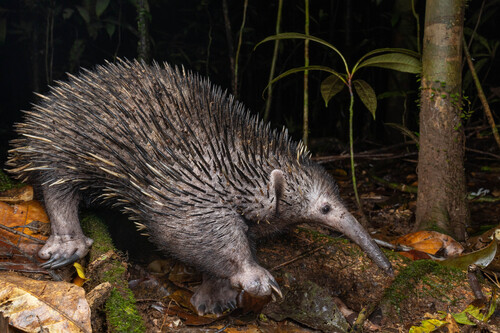
Covered in coarse brown to black fur interspersed with sharp, cream-colored spines (modified hairs) up to 6 cm long; possesses a small head, tiny eyes, a slender toothless snout, and short powerful limbs with strong digging claws.
Size
Body length typically 30-45 cm, with a short, tubular snout of about 7.5 cm
Weight
Typically 2-7 kg, with New Guinea individuals sometimes reaching up to 10 kg
Distinctive features
Distinguished from the long-beaked echidnas (Zaglossus spp.) by its much shorter snout, smaller body size, and denser fur-to-spine ratio; the only echidna species found in mainland Australia.
Differences between males and females
Minimal external sexual dimorphism; males are slightly larger on average and possess a non-venomous spur on the hind foot (unlike the venomous spur of the platypus).
Behaviour and diet of the Short-beaked Echidna
Largely solitary and non-territorial, with home ranges that may overlap; forms temporary mating trains of multiple males following a single female during breeding season.
When it is active
Primarily nocturnal or crepuscular in warm climates, shifting to diurnal activity in cooler regions or seasons to conserve energy.
Diet
Specialized insectivore feeding mainly on ants and termites, supplemented with other soil invertebrates such as beetle larvae and earthworms.
How it feeds and hunts
Uses a highly sensitive, electroreception-equipped snout to detect prey movement in soil, then employs a long, sticky, rapidly extending tongue to capture insects, which are ground against the palate using spines since it lacks teeth.
Communication
Communication is limited and primarily involves scent marking, tactile cues during mating trains, and occasional low grunting or hissing sounds; vision and hearing are poor compared to their acute sense of smell and electroreception.
Interactions with other species
Preyed upon occasionally by dingoes, foraging birds of prey, goannas, and introduced foxes and dogs, particularly targeting juveniles; otherwise faces few natural predators due to spine defense.
Role in its ecosystem
Plays an important ecological role as a natural regulator of ant and termite populations and as a soil engineer through its extensive digging, which aerates soil and promotes nutrient cycling.
Reproduction and lifecycle
Breeding occurs in austral winter (June-September); after mating, the female lays a single soft-shelled egg directly into a temporary pouch about 22 days later, which hatches after roughly 10 days.
Raising the young
The hatchling ('puggle') remains in the mother's pouch feeding on milk secreted from mammary patches (no nipples) for about 45-55 days until its spines develop, after which it is left in a burrow and nursed periodically until weaning at around 7 months.
Maturity and lifespan
Reaches sexual maturity around 5 years of age; lifespan in the wild is estimated at 14-16 years, while captive individuals have been recorded living over 45 years.
Taxonomy and naming of the Short-beaked Echidna
Classification
Mammalia > Monotremata > Tachyglossidae > Tachyglossus > Tachyglossus aculeatus
Subspecies
Five recognized subspecies: T. a. aculeatus (mainland Australia), T. a. setosus (Tasmania), T. a. multiaculeatus (Kangaroo Island), T. a. lawesii (New Guinea lowlands), T. a. acanthion (arid central/western Australia)
Scientific synonyms
Echidna aculeata, Ornithorhynchus hystrix (historical misclassification), Tachyglossus setosus
What research says
Recent studies
Recent research using citizen science data (e.g., Echidna CSI project) has revealed broader distribution and finer-scale movement patterns than previously known, along with insights into their surprising cognitive abilities and thermoregulation strategies.
Genome and DNA
Possesses a unique multiple sex chromosome system (5X-5Y in males) shared with other monotremes; genome sequencing has provided insight into the evolution of egg-laying in mammals.
Compared with similar species
Compared to the four New Guinea long-beaked echidna species (Zaglossus), the short-beaked echidna is smaller, has a shorter snout, denser spine coverage, and a broader, more generalist diet focused on ants and termites rather than earthworms.
The Short-beaked Echidna and people
Despite being a mammal, it lays eggs and produces milk without nipples, oozing it directly through skin pores; it can dig itself vertically into the ground within minutes to evade threats, appearing to 'sink' into the earth; and it has one of the lowest body temperatures of any mammal.
Where and how to see it
Best observed in early morning or late afternoon in bushland, woodland edges, or along walking trails in Australian national parks such as Kangaroo Island or the Grampians; look for distinctive conical digging marks in soil or leaf litter.
Risks to humans
No notable risk to humans; the spines can cause minor injury if handled carelessly, but echidnas are non-aggressive and pose no venomous or predatory threat.
Human uses
Not commercially exploited; historically featured in Aboriginal traditional stories and occasionally as a minor traditional food source, though this is now largely discontinued due to conservation awareness.
Myths and legends
Featured in Aboriginal Dreamtime stories as a creature associated with cleverness and protection due to its spines; often symbolizes resilience and adaptability in Australian folklore.
Countries where the Short-beaked Echidna is recorded
The 3 countries named in the range description of its IUCN Red List assessment.
Questions about the Short-beaked Echidna
Where does the Short-beaked Echidna live?
The Short-beaked Echidna is recorded in Australia, Indonesia and Papua New Guinea across Asia and Oceania. These countries come from the range description of its IUCN Red List assessment, and they are what place the species on the interactive map.
Is the Short-beaked Echidna endangered?
The IUCN Red List assesses the Short-beaked Echidna as Least Concern. The species is widespread and abundant enough not to qualify for any threatened category. It does not mean the species is safe forever, only that nothing in the current data raises an alarm.
How many are left in the wild?
Population size is not precisely quantified but believed to be in the hundreds of thousands to millions; overall trend considered stable, though some regional populations are declining. This figure comes from the species assessment on the IUCN Red List; population estimates for wild mammals are ranges, not counts, and are revised at each assessment.
What habitat does the Short-beaked Echidna live in?
Found in nearly all Australian habitats including forests, woodlands, heathlands, grasslands, arid deserts, and alpine regions, as well as tropical rainforest and montane grassland in New Guinea.
What is the scientific name of the Short-beaked Echidna?
The Short-beaked Echidna is Tachyglossus aculeatus, in the family Tachyglossidae, order Monotremata.
Other species in the family Tachyglossidae
Species that share its range

Sources
Conservation status, range description and population estimate come from the IUCN Red List assessment for Tachyglossus aculeatus. Countries are derived from that range description, not from a mapped country list. Last refreshed on .
The distribution map is drawn from the IUCN Red List spatial data compiled in 2008. IUCN (International Union for Conservation of Nature)