
Western Long-beaked Echidna
Zaglossus bruijnii
Red List assessment
Critically Endangeredon the IUCN Red List
- EXExtinct
- EWExtinct in the Wild
- CRCritically Endangered
- ENEndangered
- VUVulnerable
- NTNear Threatened
- LCLeast Concern
The Western Long-beaked Echidna is recorded in one country, Indonesia across Asia. The IUCN Red List assesses the Western Long-beaked Echidna as Critically Endangered. Population size unknown but believed to be very small and declining, likely in the low thousands or fewer, restricted to a fragmented range in the Cyclops Mountains.
- Family
- Tachyglossidae
- Order
- Monotremata
- Genus
- Zaglossus
- Countries recorded
- 1
- Continents
- Asia
- Red List category
- Critically Endangered
- Data updated
- August 9, 2026
What is the Western Long-beaked Echidna?
The Western Long-beaked Echidna is one of the most primitive living mammals, belonging to the egg-laying monotremes alongside the platypus. It is found only in the mountainous rainforests of New Guinea, particularly Papua Province, Indonesia. This elusive, spine-covered creature uses its elongated snout to probe for earthworms and is remarkable for combining reptilian reproduction with mammalian traits like fur and milk production.
Where does the Western Long-beaked Echidna live?
New Guinea, primarily in the Cyclops Mountains and other remote highland areas of Papua, Indonesia
Endemic to the island of New Guinea, with confirmed populations restricted to the Cyclops Mountains near Jayapura in Papua, Indonesia; historically may have had a wider range across the island's highlands.
Altitude and depth
700-4,000 meters above sea level
Seasonal movements
No significant migration; activity may shift seasonally with rainfall patterns affecting prey availability, but detailed seasonal behavior remains poorly studied due to the species' rarity and elusive nature.
Habitat of the Western Long-beaked Echidna
Montane tropical rainforest and alpine grassland, typically in areas with thick leaf litter and soft soil suitable for burrowing and foraging for invertebrates.
Adaptations to its environment
Powerful claws for digging and burrowing, an elongated curved beak-like snout with electroreceptors for detecting prey, and a covering of spines mixed with fur providing camouflage and defense in dense forest leaf litter.
Conservation status and numbers
Critically Endangered (CR) according to IUCN, due to a suspected population decline exceeding 80% over the past three generations from hunting pressure and habitat loss; considered possibly extinct in parts of its former range.
Estimated population
Population size unknown but believed to be very small and declining, likely in the low thousands or fewer, restricted to a fragmented range in the Cyclops Mountains.
What threatens the Western Long-beaked Echidna?
Illegal hunting for bushmeat by local communities, habitat destruction from logging and agricultural expansion, and low reproductive rate limiting population recovery.
Diseases and parasites
Specific pathogens and parasites are poorly documented, though monotremes in general can host ticks and various endoparasites.
What is being done to protect it?
Protected under Indonesian law and listed on CITES Appendix II; conservation groups have conducted camera-trap surveys in the Cyclops Mountains and work with local communities on awareness and monitoring programs.
Recommended actions
Strengthen anti-poaching enforcement, expand protected area coverage, conduct further population surveys using camera traps and environmental DNA, and engage indigenous communities in sustainable conservation practices.
What the Western Long-beaked Echidna looks like
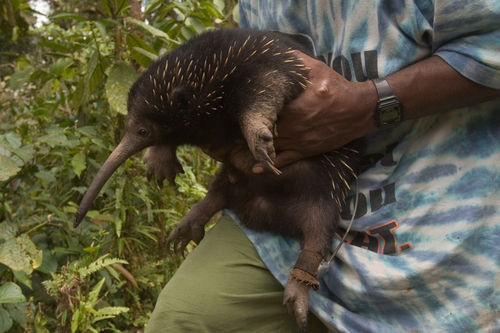
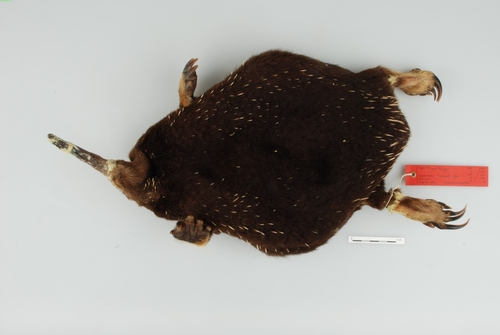
Covered in dark brown to black fur interspersed with cream-colored spines, with a long downward-curving snout making up roughly two-thirds of the skull length, small eyes, and no visible external ears.
Size
Body length approximately 45-77 cm, not including the short tail
Weight
Typically 5-10 kg, with some individuals recorded up to 16.5 kg
Distinctive features
Distinguished from short-beaked echidnas by its much longer, more curved snout, fewer and less visible spines relative to fur coverage, and five claws on the hind feet compared to the short-beaked echidna's fewer claws.
Differences between males and females
Minimal external sexual dimorphism; males possess a spur on the hind foot (non-venomous in this species) and are sometimes slightly larger than females.
Behaviour and diet of the Western Long-beaked Echidna
Solitary and largely asocial, with individuals maintaining separate home ranges and coming together only briefly for mating.
When it is active
Primarily nocturnal or crepuscular, resting during the day in burrows or under vegetation and emerging at night to forage.
Diet
Specialized insectivore feeding mainly on earthworms, supplemented occasionally with other soil invertebrates such as insect larvae.
How it feeds and hunts
Uses its long snout equipped with electroreceptors to locate earthworms in soil and leaf litter, then extends a long sticky tongue to extract and consume prey.
Communication
Limited vocalizations; communication likely relies primarily on scent marking and tactile cues, though detailed studies on this species are scarce due to its rarity.
Interactions with other species
Few natural predators due to its remote habitat and defensive spines, though introduced dogs and pigs may pose threats to eggs and juveniles; ecological interactions with other New Guinea fauna remain understudied.
Role in its ecosystem
Plays a role in soil aeration and invertebrate population control through its digging and foraging activities, contributing to nutrient cycling in montane forest ecosystems.
Reproduction and lifecycle
Breeding season believed to occur around July, with females laying a single soft-shelled egg that is incubated in a temporary pouch for about 10 days before hatching.
Raising the young
After hatching, the young (puggle) is nursed with milk secreted through specialized mammary patches in the mother's pouch for several months until its spines develop, after which it is left in a burrow while the mother forages.
Maturity and lifespan
Sexual maturity likely reached around 5 years of age; lifespan can exceed 30-45 years in captivity, though wild longevity data is limited.
Taxonomy and naming of the Western Long-beaked Echidna
Classification
Class Mammalia > Order Monotremata > Family Tachyglossidae > Genus Zaglossus > Species Zaglossus bruijnii
Scientific synonyms
Tachyglossus bruijnii; Proechidna bruijnii
What research says
Recent studies
Recent camera-trap expeditions in the Cyclops Mountains (2023) rediscovered the species after decades without confirmed sightings, providing renewed hope and data on its persistence in the wild.
Genome and DNA
Monotremes possess a unique genome with characteristics intermediate between reptiles and mammals, including multiple sex chromosomes; specific genomic studies on Zaglossus bruijnii remain limited compared to the platypus.
Compared with similar species
Similar to other Zaglossus species like the Eastern Long-beaked Echidna (Zaglossus bartoni) but distinguished by geographic range and subtle morphological differences in claw number and snout curvature.
The Western Long-beaked Echidna and people
This species was rediscovered in 2023 after not being confirmed in the wild for over 60 years; it is named after Dutch naturalist Anton Bruijn; it is one of only five living monotreme species on Earth.
Where and how to see it
Extremely difficult to observe due to its rarity, nocturnal habits, and remote mountainous habitat; any sightings would require expert-guided expeditions into the Cyclops Mountains with appropriate permits.
Risks to humans
No notable risk to humans; the species is shy and non-aggressive, though its spines can cause minor injury if handled.
Human uses
Historically hunted by local Papuan communities for bushmeat, which has contributed significantly to its population decline.
Myths and legends
Local Papuan communities have traditional stories regarding the echidna's elusive nature, though specific documented folklore is limited in Western literature.
Countries where the Western Long-beaked Echidna is recorded
The 1 countries named in the range description of its IUCN Red List assessment.
Questions about the Western Long-beaked Echidna
Where does the Western Long-beaked Echidna live?
The Western Long-beaked Echidna is recorded in Indonesia across Asia. These countries come from the range description of its IUCN Red List assessment, and they are what place the species on the interactive map.
Is the Western Long-beaked Echidna endangered?
Yes. The IUCN Red List assesses the Western Long-beaked Echidna as Critically Endangered, one of the three threatened categories. The species faces an extremely high risk of extinction in the wild. This is the last category before extinction, and it is reached through a very small or steeply declining population, a tiny range, or both.
How many are left in the wild?
Population size unknown but believed to be very small and declining, likely in the low thousands or fewer, restricted to a fragmented range in the Cyclops Mountains. This figure comes from the species assessment on the IUCN Red List; population estimates for wild mammals are ranges, not counts, and are revised at each assessment.
What habitat does the Western Long-beaked Echidna live in?
Montane tropical rainforest and alpine grassland, typically in areas with thick leaf litter and soft soil suitable for burrowing and foraging for invertebrates.
What is the scientific name of the Western Long-beaked Echidna?
The Western Long-beaked Echidna is Zaglossus bruijnii, in the family Tachyglossidae, order Monotremata.
Other species in the genus Zaglossus
Other species in the family Tachyglossidae
Species that share its range
Sources
Conservation status, range description and population estimate come from the IUCN Red List assessment for Zaglossus bruijnii. Countries are derived from that range description, not from a mapped country list. Last refreshed on .
The distribution map is drawn from the IUCN Red List spatial data compiled in 2010. IUCN (International Union for Conservation of Nature)