
Ring-tailed Lemur
Lemur catta
Red List assessment
Endangeredon the IUCN Red List
- EXExtinct
- EWExtinct in the Wild
- CRCritically Endangered
- ENEndangered
- VUVulnerable
- NTNear Threatened
- LCLeast Concern
The Ring-tailed Lemur is recorded in one country, Madagascar across Africa. The IUCN Red List assesses the Ring-tailed Lemur as Endangered. Estimated wild population has declined dramatically, with some estimates suggesting fewer than 2,000-2,400 mature individuals remaining, though numbers are difficult to verify; trend is declining.
- Family
- Lemuridae
- Order
- Primates
- Genus
- Lemur
- Countries recorded
- 1
- Continents
- Africa
- Red List category
- Endangered
- Data updated
- August 9, 2026
What is the Ring-tailed Lemur?
The Ring-tailed Lemur is one of the most iconic primates of Madagascar, easily recognized by its long, black-and-white banded tail used mainly for communication rather than climbing. It lives in social troops in the dry forests and scrublands of southern Madagascar and is highly terrestrial compared to other lemurs. Its distinctive vocalizations, scent-marking behavior, and matriarchal social structure make it a key subject for primatology research. It is a flagship species for Madagascar conservation efforts.
Where does the Ring-tailed Lemur live?
Madagascar (southern and southwestern regions)
Endemic to Madagascar, restricted to the southern and southwestern parts of the island, including areas around Berenty, Isalo, Andringitra, and the spiny forest ecoregion.
Altitude and depth
Sea level up to approximately 2600 m in mountainous areas such as Andringitra.
Seasonal movements
Births are highly synchronized to occur at the start of the rainy season (September-October) to align infant weaning with peak food abundance; activity patterns shift seasonally with food and water availability.
Habitat of the Ring-tailed Lemur
Inhabits gallery forests, dry deciduous forests, spiny forests, and rocky scrubland (canyons and outcrops) in southern Madagascar. It is more terrestrial than most lemurs, spending significant time foraging on the ground between forest patches.
Adaptations to its environment
Possesses specialized scent glands on wrists and chest for communication and territory marking, and a highly flexible omnivorous diet allowing survival in arid, resource-scarce habitats. Its terrestrial locomotion and tolerance of open, sun-exposed terrain are unusual among lemurs and aid in exploiting fragmented forest patches.
Conservation status and numbers
Endangered (EN) according to IUCN, with the species experiencing severe population declines estimated at over 95% in some surveyed regions since the 1990s due to habitat loss and hunting.
Estimated population
Estimated wild population has declined dramatically, with some estimates suggesting fewer than 2,000-2,400 mature individuals remaining, though numbers are difficult to verify; trend is declining.
What threatens the Ring-tailed Lemur?
Habitat destruction from slash-and-burn agriculture (tavy), charcoal production, illegal logging, hunting for bushmeat, and capture for the illegal pet trade are the primary threats.
Diseases and parasites
Known to host various endoparasites including nematodes and protozoa, as well as ectoparasites such as mites; captive populations can be susceptible to introduced diseases from human contact.
What is being done to protect it?
Protected under Malagasy law and CITES Appendix I; conservation efforts include protected areas such as Berenty Reserve, Isalo National Park, and Andringitra National Park, along with captive breeding and reintroduction programs led by organizations like the Duke Lemur Center.
Recommended actions
Priority actions include strengthening enforcement against illegal logging and hunting, expanding and connecting protected habitat corridors, community-based conservation incentives, and continued population monitoring and genetic management of captive populations.
What the Ring-tailed Lemur looks like
Has soft gray to brownish-gray fur on the back, whitish underside, and a distinctive black-and-white ringed tail with 13-14 alternating bands. The face features dark triangular eye patches and a white muzzle, giving it a mask-like appearance.
Size
Body length (head-body) of 39-46 cm, with an additional tail length of 56-63 cm.
Weight
Typically weighs between 2.2 and 3.5 kg, with minimal difference between males and females.
Distinctive features
The long, boldly ringed tail is unique among lemurs and serves as a key visual identifier, distinguishing it from other Lemur and Eulemur species which typically have solid-colored tails.
Differences between males and females
Minimal sexual dimorphism in size or coloration, though females are socially dominant over males in troop hierarchy.
Behaviour and diet of the Ring-tailed Lemur
Highly social, living in matriarchal troops of 6 to 30 individuals with a strict dominance hierarchy led by a dominant female. Troops maintain territories and engage in 'stink fights' where males wave scent-marked tails at rivals.
When it is active
Cathemeral, meaning active during both day and night, but predominantly diurnal, especially active in the early morning and late afternoon.
Diet
Omnivorous, primarily frugivorous, feeding on fruits (especially tamarind), leaves, flowers, bark, sap, and occasionally insects, spiders, and small vertebrates.
Communication
Uses a rich repertoire of vocalizations including cat-like meows, clicks, and alarm calls, along with extensive scent marking via wrist and genital glands, and visual signals like tail-waving and staring.
Interactions with other species
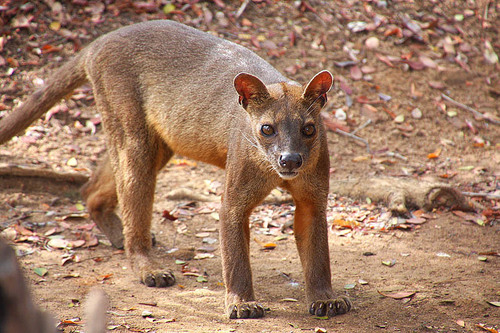
Natural predators include the fossa, birds of prey (such as the Madagascar buzzard), and introduced predators like domestic dogs and cats. It has few direct competitors but coexists with other lemur species like sifakas in overlapping habitats.
Role in its ecosystem
Plays an important ecological role as a seed disperser for many native Malagasy plant species, contributing to forest regeneration and biodiversity maintenance in its habitat.
Reproduction and lifecycle
Breeding is seasonal, occurring once a year typically in April; gestation lasts about 135-138 days, resulting in a single infant (occasionally twins), born around September.
Raising the young
Infants cling to their mother's belly and later ride on her back; mothers provide primary care, with occasional alloparenting by other females in the troop. Infants are weaned by around 5-6 months of age.
Maturity and lifespan
Reaches sexual maturity around 2-3 years of age; lifespan in the wild is typically 16-19 years, while in captivity individuals can live up to 27 years or more.
Taxonomy and naming of the Ring-tailed Lemur
Classification
Mammalia > Primates > Lemuridae > Lemur > Lemur catta
Scientific synonyms
Prosimia catta, Lemur mococo, Maki catta
What research says
Recent studies
Recent research has focused on the species' rapid population decline through camera-trap and survey studies (2020s), revealing habitat fragmentation effects and informing updated IUCN assessments and conservation prioritization.
Genome and DNA
Diploid chromosome number is 2n=56; genomic studies have been used to assess genetic diversity and inbreeding risks in fragmented wild populations.
Compared with similar species
Unlike the closely related Eulemur species which have solid-colored tails and more arboreal habits, Lemur catta is unique in its heavily terrestrial lifestyle and iconic ringed tail, making it more visually and behaviorally distinct.
The Ring-tailed Lemur and people
Ring-tailed Lemurs engage in 'sunbathing,' sitting upright with arms outstretched to absorb morning sun, a behavior unique among lemurs. Males engage in 'stink fights' by wafting their scent-marked tails at rivals during confrontations. They are also one of the most vocal primates, with a distinct meow-like call.
Where and how to see it
Best observed in reserves such as Berenty Private Reserve or Anja Community Reserve in southern Madagascar, particularly in the early morning when troops are most active and engage in sunbathing behavior.
Risks to humans
No notable risk to humans; they are generally non-aggressive toward people, though habituated individuals in tourist areas may approach for food.
Human uses
Historically hunted for bushmeat in some regions and increasingly popular in illegal pet trade; also serves as a major ecotourism attraction supporting local economies through wildlife tourism in Madagascar.
Myths and legends
In parts of Madagascar, lemurs are considered sacred or taboo (fady) animals linked to ancestral spirits, and killing them is traditionally forbidden in some communities, though this belief system is weakening under economic pressures.
Countries where the Ring-tailed Lemur is recorded
The 1 countries named in the range description of its IUCN Red List assessment.
Questions about the Ring-tailed Lemur
Where does the Ring-tailed Lemur live?
The Ring-tailed Lemur is recorded in Madagascar across Africa. These countries come from the range description of its IUCN Red List assessment, and they are what place the species on the interactive map.
Is the Ring-tailed Lemur endangered?
Yes. The IUCN Red List assesses the Ring-tailed Lemur as Endangered, one of the three threatened categories. The species faces a very high risk of extinction in the wild — a step below Critically Endangered, but still on a trajectory that ends badly without intervention.
How many are left in the wild?
Estimated wild population has declined dramatically, with some estimates suggesting fewer than 2,000-2,400 mature individuals remaining, though numbers are difficult to verify; trend is declining. This figure comes from the species assessment on the IUCN Red List; population estimates for wild mammals are ranges, not counts, and are revised at each assessment.
What habitat does the Ring-tailed Lemur live in?
Inhabits gallery forests, dry deciduous forests, spiny forests, and rocky scrubland (canyons and outcrops) in southern Madagascar.
What is the scientific name of the Ring-tailed Lemur?
The Ring-tailed Lemur is Lemur catta, in the family Lemuridae, order Primates.
Species that share its range


Sources
Conservation status, range description and population estimate come from the IUCN Red List assessment for Lemur catta. Countries are derived from that range description, not from a mapped country list. Last refreshed on .
The distribution map is drawn from the IUCN Red List spatial data compiled in 2020. IUCN (International Union for Conservation of Nature)