
Plains Zebra
Equus quagga
Red List assessment
Near Threatenedon the IUCN Red List
- EXExtinct
- EWExtinct in the Wild
- CRCritically Endangered
- ENEndangered
- VUVulnerable
- NTNear Threatened
- LCLeast Concern
The Plains Zebra is recorded in 10 countries across Africa. The IUCN Red List assesses the Plains Zebra as Near Threatened. Approximately 150,000-250,000 individuals remaining in the wild, with an overall declining population trend across much of its range.
- Family
- Equidae
- Order
- Perissodactyla
- Genus
- Equus
- Countries recorded
- 10
- Continents
- Africa
- Red List category
- Near Threatened
- Data updated
- August 9, 2026
What is the Plains Zebra?
The Plains Zebra is the most common and widespread zebra species, instantly recognizable by its bold black-and-white striped coat. It inhabits grasslands and savannas across eastern and southern Africa, often forming large mixed herds with wildebeest and other grazers. This highly social equid is famous for its role in the Great Migration and its unique stripe patterns, which are as individual as human fingerprints.
Where does the Plains Zebra live?
Eastern and Southern Africa, including Kenya, Tanzania, Botswana, Zambia, Zimbabwe, South Africa, and Namibia
Ranges across eastern and southern Africa from South Sudan and Ethiopia through Kenya, Tanzania, Zambia, Botswana, Zimbabwe, Mozambique to South Africa and Namibia. Population is fragmented but still occupies a significant portion of its historic range.
Altitude and depth
0-4000m, typically found in lowland to mid-altitude savannas, with some populations occurring in highland grasslands.
Seasonal movements
Undertakes seasonal migrations tracking rainfall and fresh grass growth, most notably part of the Serengeti-Mara ecosystem's Great Migration alongside wildebeest, covering hundreds of kilometers annually.
Habitat of the Plains Zebra
Open savannas, grasslands, and light woodlands with access to water sources. Avoids dense forests and extreme deserts, preferring areas with short to medium grass cover for optimal grazing.
Adaptations to its environment
Distinctive stripes may help deter biting flies and provide camouflage through motion dazzle when in herds. Efficient digestive system allows processing of low-quality, fibrous grasses, and strong social bonds provide protection against predators.
Conservation status and numbers
Near Threatened (NT) according to IUCN, with population declining due to habitat loss and poaching, though still relatively abundant compared to other zebra species.
Estimated population
Approximately 150,000-250,000 individuals remaining in the wild, with an overall declining population trend across much of its range.
What threatens the Plains Zebra?
Habitat loss from agricultural expansion, competition with livestock for grazing land, poaching for meat and skins, and fragmentation of migration routes due to fencing and human settlement.
Diseases and parasites
Susceptible to African horse sickness, anthrax, and various internal and external parasites including ticks and intestinal worms. Can also contract equine influenza and other viral diseases affecting equids.
What is being done to protect it?
Protected within numerous national parks and reserves including Serengeti, Maasai Mara, Kruger, and Etosha. CITES Appendix II listing regulates international trade, and transboundary conservation initiatives aim to preserve migration corridors.
Recommended actions
Maintain and restore migration corridors, reduce human-wildlife conflict through community-based conservation, strengthen anti-poaching efforts, and monitor population trends across fragmented habitats.
What the Plains Zebra looks like
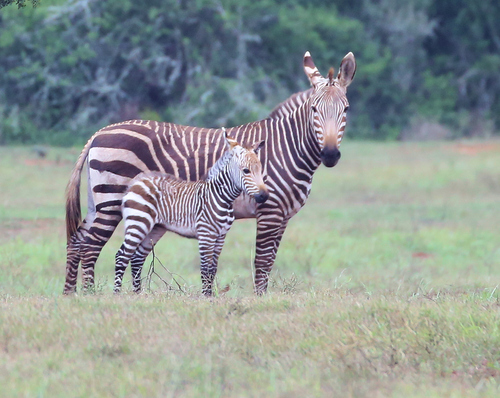
Distinctive black and white striped coat covering the entire body, with stripe patterns unique to each individual. The belly is typically white, and stripes may fade to brownish 'shadow stripes' in some subspecies, particularly in southern populations.
Size
Body length 217-246 cm, shoulder height 110-145 cm, with a tail measuring 47-57 cm.
Weight
Males (stallions) typically weigh 220-322 kg, while females (mares) weigh slightly less at 175-250 kg.
Distinctive features
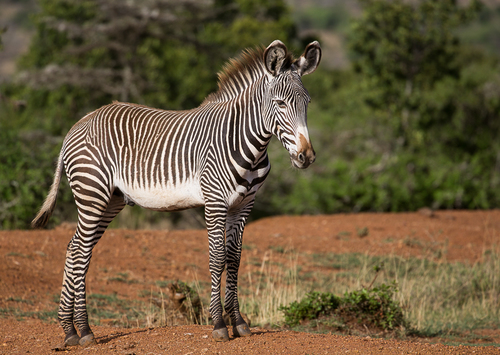
Distinguished from Grevy's zebra by broader stripes and lack of stripes on the belly, and from mountain zebra by absence of a dewlap and different stripe patterns on the rump. Plains zebras often show shadow striping between main black stripes.
Differences between males and females
Minimal sexual dimorphism; males are slightly larger and more muscular than females, particularly around the neck, but coloration and stripe patterns are similar between sexes.
Behaviour and diet of the Plains Zebra
Highly social, living in stable family groups called harems consisting of one stallion, several mares, and their offspring. These family units may join larger herds of hundreds to thousands during migration, though the core social bonds remain within family groups.
When it is active
Primarily diurnal with activity peaks in early morning and late afternoon, resting during the heat of midday and continuing some activity at night, particularly grazing under moonlight.
Diet
Primarily grazers feeding on grasses, though they will also consume leaves, shrubs, and bark when grasses are scarce. They prefer shorter grasses but can process tougher, more fibrous vegetation than many ruminants.
Communication
Communicates through a range of vocalizations including barks, snorts, and a distinctive high-pitched 'kwa-ha-ha' bray. Body language, ear positions, and scent marking also play important roles in social interactions and predator alerts.
Interactions with other species
Major predators include lions, hyenas, and crocodiles at water crossings. Forms mutualistic associations with wildebeest and other grazers during migration, benefiting from shared vigilance against predators and complementary grazing patterns.
Role in its ecosystem
Plays a crucial role as a primary grazer in savanna ecosystems, helping maintain grassland health through grazing pressure and seed dispersal. Serves as important prey species supporting predator populations and contributes to nutrient cycling.
Reproduction and lifecycle
Breeding occurs year-round with peaks during rainy seasons; gestation lasts approximately 12-13 months, producing a single foal that can stand and walk within an hour of birth. Mares typically give birth every 1-3 years.
Raising the young
Foals are primarily cared for by their mothers, who nurse them for 7-11 months, though the entire family group provides protection. Foals imprint on their mother's stripe pattern and scent within days of birth to avoid confusion in large herds.
Maturity and lifespan
Sexual maturity reached at 3-6 years for females and slightly later for males; lifespan averages 20-25 years in the wild, with captive individuals sometimes living up to 30 years.
Taxonomy and naming of the Plains Zebra
Classification
Mammalia > Perissodactyla > Equidae > Equus > Equus quagga
Subspecies
Six recognized subspecies including E. q. boehmi (Grant's zebra, East Africa), E. q. chapmani (Chapman's zebra, southern Africa), E. q. burchellii (Burchell's zebra, South Africa), E. q. crawshaii (Crawshay's zebra, Zambia/Malawi), E. q. borensis (northern regions), and the extinct E. q. quagga (quagga, South Africa, extinct 1883).
Scientific synonyms
Equus burchellii (formerly considered a separate species, now synonymized), Hippotigris quagga
What research says
Recent studies
Recent research has focused on the evolutionary purpose of stripes, with studies suggesting thermoregulation and fly deterrence as primary functions rather than purely camouflage, using experimental coat manipulations and fly behavior observations.
Genome and DNA
Diploid chromosome number of 44; genetic studies have revealed complex hybridization history with other zebra species and helped resolve taxonomic relationships within the Equus genus.
Compared with similar species
Similar to Grevy's zebra but with broader stripes and smaller body size; distinguished from mountain zebra by lack of dewlap and different rump stripe patterns. The extinct quagga subspecies notably had stripes only on the front portion of its body.
The Plains Zebra and people
No two zebras have identical stripe patterns, similar to human fingerprints. Zebra stripes may create a 'motion dazzle' effect that confuses predators and biting insects, and their braying call sounds remarkably like a barking dog combined with a horse whinny.
Where and how to see it
Best observed in East African parks like Serengeti and Maasai Mara during the Great Migration (July-October), or in southern African reserves like Kruger and Etosha year-round. Early morning and late afternoon game drives offer optimal viewing opportunities near water sources.
Risks to humans
No notable risk to humans under normal circumstances, though wild zebras can bite or kick if threatened or cornered. They are generally not aggressive toward humans unless provoked or protecting young.
Human uses
Historically hunted for meat, hide, and sport; today primarily valued for ecotourism revenue in national parks and reserves. Limited use in some regions for leather products, though this is now heavily regulated under conservation laws.
Myths and legends
In various African cultures, zebras symbolize individuality and community balance due to their unique stripes yet strong herd cohesion. Some traditional stories associate zebras with themes of freedom given their wild, untamable nature compared to domesticated horses.
Countries where the Plains Zebra is recorded
The 10 countries named in the range description of its IUCN Red List assessment.
Questions about the Plains Zebra
Where does the Plains Zebra live?
The Plains Zebra is recorded in Botswana, Ethiopia, Kenya, Mozambique and Namibia, among 10 countries in total across Africa. These countries come from the range description of its IUCN Red List assessment, and they are what place the species on the interactive map.
Is the Plains Zebra endangered?
The IUCN Red List assesses the Plains Zebra as Near Threatened. The species does not qualify as threatened today, but it is close to the thresholds and likely to cross them soon. It is the category that most often changes at the next assessment.
How many are left in the wild?
Approximately 150,000-250,000 individuals remaining in the wild, with an overall declining population trend across much of its range. This figure comes from the species assessment on the IUCN Red List; population estimates for wild mammals are ranges, not counts, and are revised at each assessment.
What habitat does the Plains Zebra live in?
Open savannas, grasslands, and light woodlands with access to water sources.
What is the scientific name of the Plains Zebra?
The Plains Zebra is Equus quagga, in the family Equidae, order Perissodactyla.
Other species in the genus Equus
Species that share its range

Sources
Conservation status, range description and population estimate come from the IUCN Red List assessment for Equus quagga. Countries are derived from that range description, not from a mapped country list. Last refreshed on .
The distribution map is drawn from the IUCN Red List spatial data compiled in 2016. IUCN (International Union for Conservation of Nature)