
Mountain Zebra
Equus zebra
Red List assessment
Vulnerableon the IUCN Red List
- EXExtinct
- EWExtinct in the Wild
- CRCritically Endangered
- ENEndangered
- VUVulnerable
- NTNear Threatened
- LCLeast Concern
The Mountain Zebra is recorded in 3 countries across Africa. The IUCN Red List assesses the Mountain Zebra as Vulnerable. Approximately 35,000 individuals in the wild combining both subspecies, with the Cape mountain zebra population around 4,700 and increasing, and Hartmann's zebra population around 30,000 and stable to slightly declining.
- Family
- Equidae
- Order
- Perissodactyla
- Genus
- Equus
- Countries recorded
- 3
- Continents
- Africa
- Red List category
- Vulnerable
- Data updated
- August 9, 2026
What is the Mountain Zebra?
The Mountain Zebra is a striped equid native to the rugged mountainous and hilly terrains of southwestern Africa. It is smaller and more agile than the plains zebra, with distinctive narrow stripes and a dewlap on the throat. Well adapted to arid, rocky habitats, it is notable for its endurance and sure-footedness on steep terrain. The species has recovered from near-extinction in the 20th century thanks to targeted conservation efforts.
Where does the Mountain Zebra live?
Namibia, South Africa, and southwestern Angola
Found in South Africa (Western and Eastern Cape provinces), Namibia (central and western regions), and southwestern Angola. Populations are fragmented and occur mainly in protected reserves and private conservancies.
Altitude and depth
Typically found at elevations between 1000 and 2000 meters, though some populations occur at lower elevations near escarpments.
Seasonal movements
No true migration, but individuals may shift locally between seasonal grazing areas and water sources depending on rainfall patterns.
Habitat of the Mountain Zebra
Mountainous, hilly, and escarpment terrain including rocky slopes, plateaus, and adjacent grasslands; also found in semi-arid scrubland and open woodland at the edges of mountain ranges.
Adaptations to its environment
Hard, pointed hooves and strong legs allow it to navigate steep, rocky terrain with agility. It can survive on sparse vegetation and go several days without water by digging for underground water sources. Its coat pattern may also help with thermoregulation and insect deterrence.
Conservation status and numbers
Listed as Vulnerable (VU) by the IUCN; the Cape mountain zebra subspecies was once critically endangered with fewer than 100 individuals in the 1950s but has since recovered through intensive conservation, while Hartmann's zebra faces ongoing habitat pressure.
Estimated population
Approximately 35,000 individuals in the wild combining both subspecies, with the Cape mountain zebra population around 4,700 and increasing, and Hartmann's zebra population around 30,000 and stable to slightly declining.
What threatens the Mountain Zebra?
Habitat loss due to farming and fencing, competition with livestock for grazing and water, occasional poaching, and fragmentation of populations limiting genetic diversity.
Diseases and parasites
Susceptible to African horse sickness, internal parasites such as strongyles, and external parasites including ticks.
What is being done to protect it?
Protected within national parks and reserves such as Mountain Zebra National Park (South Africa) and Namib-Naukluft Park (Namibia); translocation programs have successfully reintroduced zebras to former range areas; hunting regulations and community conservancies support sustainable population management.
Recommended actions
Expand and connect protected habitats, reduce fencing barriers between populations, monitor genetic diversity, and strengthen anti-poaching and land-use policies in border regions.
What the Mountain Zebra looks like
Distinctive black-and-white striped coat with narrower stripes than the plains zebra, a white belly, and a pronounced dewlap on the throat. The stripes do not extend onto the belly, which remains white.
Size
Shoulder height of 1.16 to 1.5 meters; body length approximately 2.1 to 2.6 meters.
Weight
Adults typically weigh between 240 and 372 kg, with males slightly heavier than females on average.
Distinctive features
Distinguished from the plains zebra by its gridiron pattern of narrow stripes on the rump, lack of shadow stripes, and the presence of a throat dewlap; smaller and more compact than the Grévy's zebra.
Differences between males and females
Males and females are similar in appearance, though males tend to be slightly larger and heavier; stallions often have thicker necks.
Behaviour and diet of the Mountain Zebra
Lives in small family groups called harems consisting of one stallion, several mares, and their offspring; bachelor males form separate groups until they can establish their own harem.
When it is active
Primarily diurnal, most active during cooler parts of the day such as early morning and late afternoon, resting during the hottest midday hours.
Diet
Herbivorous, feeding mainly on grasses but also browsing on leaves, bark, and shrubs when grass is scarce, particularly during dry seasons.
Communication
Communicates through vocalizations such as barks and snorts, body postures, ear positioning, and scent marking via dung piles to establish territory boundaries.
Interactions with other species
Preyed upon by lions, leopards, spotted hyenas, and occasionally cheetahs; competes with other herbivores such as kudu and springbok for grazing resources in shared habitats.
Role in its ecosystem
Plays an important role as a grazer that helps maintain grassland structure and provides a prey base for large predators in mountainous ecosystems.
Reproduction and lifecycle
Breeding can occur year-round but often peaks during the rainy season; gestation lasts approximately 12 months, typically resulting in a single foal.
Raising the young
Foals are cared for primarily by the mother, who nurses them for about 10 months; foals can stand and move shortly after birth and remain close to their mother within the harem for protection.
Maturity and lifespan
Sexual maturity is reached around 3 to 6 years of age; lifespan in the wild is typically 20 to 25 years, with slightly longer lifespans recorded in captivity.
Taxonomy and naming of the Mountain Zebra
Classification
Class Mammalia > Order Perissodactyla > Family Equidae > Genus Equus > Species Equus zebra
Subspecies
Equus zebra zebra (Cape mountain zebra) restricted to mountainous areas of the Western and Eastern Cape, South Africa; Equus zebra hartmannae (Hartmann's mountain zebra) found in western Namibia and southwestern Angola.
Scientific synonyms
Equus hartmannae (now considered a subspecies), Hippotigris zebra (older generic classification)
What research says
Recent studies
Recent genetic research has focused on assessing genetic diversity within the small Cape mountain zebra population to guide translocation strategies and prevent inbreeding depression.
Genome and DNA
Equus zebra has a diploid chromosome number of 32; genetic studies have been used to distinguish subspecies and guide conservation breeding programs.
Compared with similar species
Compared to the plains zebra (Equus quagga), the mountain zebra has narrower stripes, no shadow striping, and a dewlap; it is more specialized for rocky terrain, whereas the Grévy's zebra is larger with much narrower, more numerous stripes and a different social structure.
The Mountain Zebra and people
Mountain zebras can dig their own water holes in dry riverbeds using their hooves; their unique stripe patterns are as individual as human fingerprints, allowing researchers to identify specific animals.
Where and how to see it
Best observed in South Africa's Mountain Zebra National Park or Namibia's Namib-Naukluft Park, particularly in early morning or late afternoon when they are most active near water sources.
Risks to humans
No notable risk to humans; wild individuals generally avoid human contact, though they may act defensively if cornered or threatened.
Human uses
Historically hunted for hide and meat; today primarily valued for ecotourism, wildlife photography, and conservation-based education programs.
Myths and legends
In some southern African folklore, zebras are seen as symbols of individuality and balance due to their contrasting black and white stripes; they also feature in indigenous San rock art as important cultural and spiritual symbols.
Countries where the Mountain Zebra is recorded
The 3 countries named in the range description of its IUCN Red List assessment.
Questions about the Mountain Zebra
Where does the Mountain Zebra live?
The Mountain Zebra is recorded in Angola, Namibia and South Africa across Africa. These countries come from the range description of its IUCN Red List assessment, and they are what place the species on the interactive map.
Is the Mountain Zebra endangered?
Yes. The IUCN Red List assesses the Mountain Zebra as Vulnerable, one of the three threatened categories. The species faces a high risk of extinction in the wild. It is the first of the three threatened categories: numbers are falling, the range is shrinking, or the population is small enough that a single bad event could do lasting damage.
How many are left in the wild?
Approximately 35,000 individuals in the wild combining both subspecies, with the Cape mountain zebra population around 4,700 and increasing, and Hartmann's zebra population around 30,000 and stable to slightly declining. This figure comes from the species assessment on the IUCN Red List; population estimates for wild mammals are ranges, not counts, and are revised at each assessment.
What habitat does the Mountain Zebra live in?
Mountainous, hilly, and escarpment terrain including rocky slopes, plateaus, and adjacent grasslands; also found in semi-arid scrubland and open woodland at the edges of mountain ranges.
What is the scientific name of the Mountain Zebra?
The Mountain Zebra is Equus zebra, in the family Equidae, order Perissodactyla.
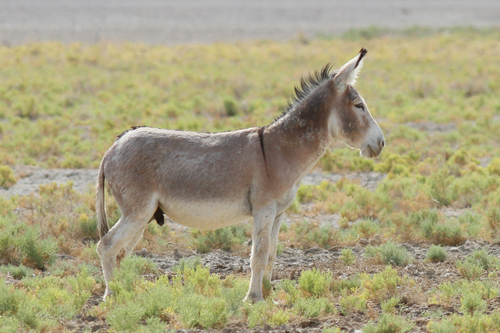
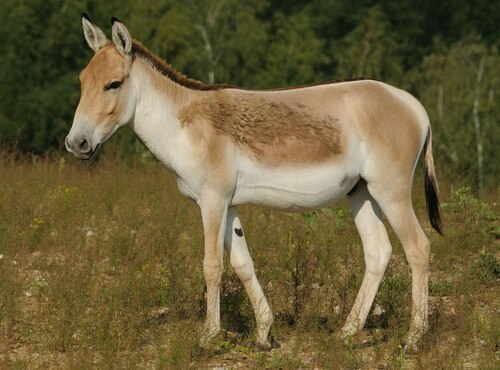
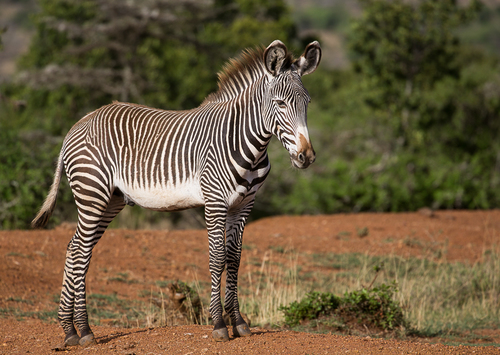
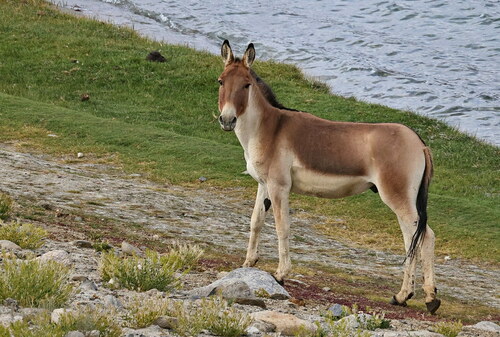
Other species in the genus Equus
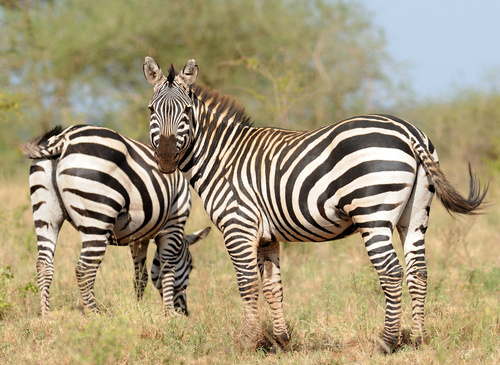
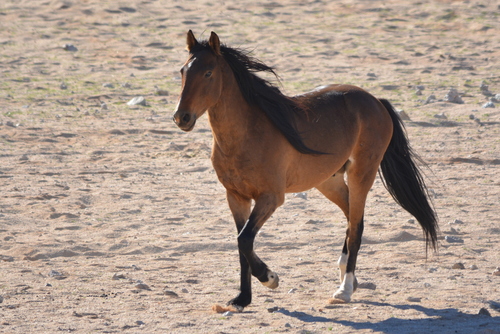
Species that share its range
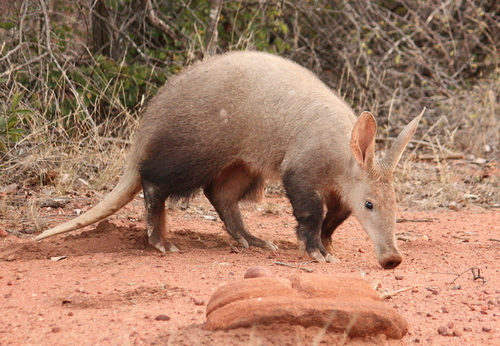
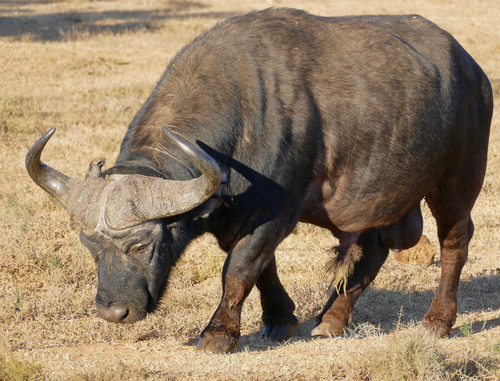
Sources
Conservation status, range description and population estimate come from the IUCN Red List assessment for Equus zebra. Countries are derived from that range description, not from a mapped country list. Last refreshed on .
The distribution map is drawn from the IUCN Red List spatial data compiled in 2019. IUCN