
Pine Marten
Martes martes
Red List assessment
Least Concernon the IUCN Red List
- EXExtinct
- EWExtinct in the Wild
- CRCritically Endangered
- ENEndangered
- VUVulnerable
- NTNear Threatened
- LCLeast Concern
The Pine Marten is recorded in 3 countries across Europe. The IUCN Red List assesses the Pine Marten as Least Concern. European population estimated in the hundreds of thousands, with an overall stable or increasing trend, particularly notable recoveries in the UK and Ireland since legal protection.
- Family
- Mustelidae
- Order
- Carnivora
- Genus
- Martes
- Countries recorded
- 3
- Continents
- Europe
- Red List category
- Least Concern
- Data updated
- August 9, 2026
What is the Pine Marten?
The Pine Marten is a slender, agile mustelid native to European forests, known for its arboreal skill and elusive nature. It plays an important ecological role as both predator and seed disperser. Once heavily persecuted, it has made notable recoveries in parts of its range, including Britain and Ireland. Its bushy tail, cream-colored throat patch, and rich brown fur make it a distinctive woodland species.
Where does the Pine Marten live?
Widespread across Europe, from the British Isles and Iberia to Scandinavia and Russia, extending into parts of the Middle East and Caucasus
Found throughout most of Europe from Ireland and Britain to Scandinavia, continental Europe, the Balkans, and into western Russia and parts of Asia Minor and the Caucasus. Absent from most Mediterranean islands and parts of southern Iberia.
Altitude and depth
Sea level up to approximately 2000m in mountainous regions such as the Alps and Carpathians
Seasonal movements
No true hibernation or migration; however activity patterns shift seasonally with reduced movement in harsh winter weather and increased foraging range during mating season in summer
Habitat of the Pine Marten
Primarily found in mature coniferous and deciduous forests with dense canopy cover, though also uses mixed woodland, scrubland, and rocky areas. Requires tree cavities or dense vegetation for denning and shelter.
Adaptations to its environment
Semi-retractable claws and flexible ankle joints allow exceptional climbing and even descending trees head-first. Thick fur provides insulation in cold climates, and a varied omnivorous diet allows adaptability to seasonal food scarcity.
Conservation status and numbers
Listed as Least Concern by IUCN due to a large range and stable-to-increasing population in most of Europe, though historically depleted by persecution and habitat loss in Britain and Ireland.
Estimated population
European population estimated in the hundreds of thousands, with an overall stable or increasing trend, particularly notable recoveries in the UK and Ireland since legal protection.
What threatens the Pine Marten?
Habitat fragmentation from deforestation, road mortality, historical trapping for fur, and competition or predation pressure in some regions. Illegal killing still occurs in areas where martens are perceived as pests.
Diseases and parasites
Susceptible to mange, canine distemper, and various internal parasites such as roundworms and tapeworms
What is being done to protect it?
Protected under the Bern Convention and EU Habitats Directive across much of its range; reintroduction and monitoring programs have been implemented in Britain, with legal protection against trapping and hunting in many countries.
Recommended actions
Continued habitat connectivity through forest corridors, monitoring of population trends, mitigation of road mortality, and public education to reduce illegal killing.
What the Pine Marten looks like
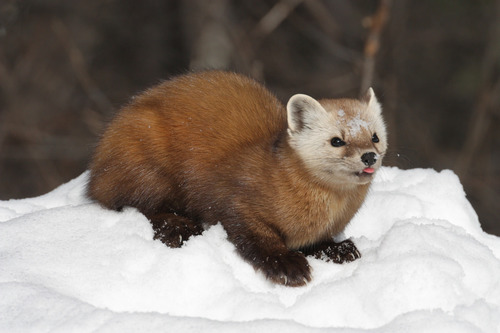
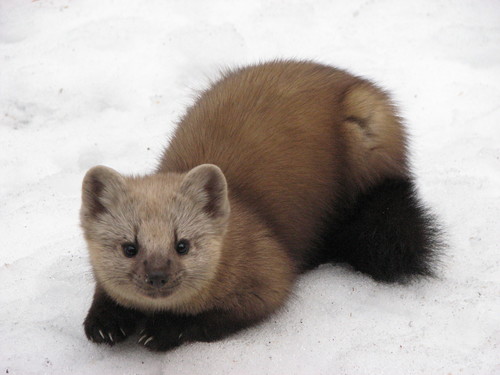
Rich chocolate-brown fur with a distinctive cream to yellow throat and chest patch, a long bushy tail, and large rounded ears. The body is slender and elongated, well-suited to arboreal movement.
Size
Body length 45-58 cm, with a tail of 16-28 cm, giving a total length up to about 80 cm
Weight
Males typically 1.2-2.2 kg, females slightly smaller at 0.8-1.5 kg
Distinctive features
Distinguished from the closely related Stone Marten by its cream/yellow (rather than white) throat patch and more forest-dependent habitat preference.
Differences between males and females
Males are noticeably larger and heavier than females, though coloration is similar between sexes
Behaviour and diet of the Pine Marten
Largely solitary and territorial, with individuals maintaining and scent-marking home ranges that may overlap slightly between sexes but not among same-sex individuals
When it is active
Primarily nocturnal and crepuscular, though can be active during the day especially in undisturbed areas
Diet
Omnivorous diet including small mammals like voles, birds and eggs, insects, fruits (especially berries), and occasionally carrion; diet shifts seasonally with fruit consumption increasing in autumn
How it feeds and hunts
Uses stealth and agility to stalk and pounce on prey both on the ground and in trees, relying on keen senses of smell and hearing rather than pursuit speed
Communication
Communicates through scent marking via anal and abdominal glands, as well as vocalizations including chattering, purring, and huffing sounds during social or aggressive encounters
Interactions with other species
Preyed upon occasionally by larger carnivores such as foxes and birds of prey; competes with other mustelids and may benefit forest ecosystems through seed dispersal of berries consumed
Role in its ecosystem
Functions as a mesopredator regulating small mammal and bird populations, while also acting as a seed disperser for various fruiting plants, contributing to forest regeneration
Reproduction and lifecycle
Mating occurs in summer (July-August) with delayed implantation resulting in births the following spring (March-April); litters typically contain 2-5 kits after a gestation period of about 30 days post-implantation
Raising the young
Females raise young alone in tree cavities or dens, nursing kits for about 6-7 weeks; young become independent by autumn but may remain near the natal area for a period after weaning
Maturity and lifespan
Sexual maturity reached around 2-3 years; lifespan averages 8-10 years in the wild, with captive individuals living up to 18 years
Taxonomy and naming of the Pine Marten
Classification
Mammalia > Carnivora > Mustelidae > Martes > Martes martes
Subspecies
Several subspecies recognized including M. m. martes (Northern Europe), M. m. ruthena (Eastern Europe/Russia), M. m. latinorum (Italy), and M. m. borealis (Scandinavia), though taxonomy is debated and some are considered synonymous.
Scientific synonyms
Mustela martes (original Linnaean classification)
What research says
Recent studies
Recent genetic and camera-trap studies have documented the natural recolonization and reintroduction success of pine martens in Britain, as well as their positive ecological effect on suppressing invasive grey squirrel populations.
Genome and DNA
Diploid chromosome number of 2n=38; genetic studies have been used to assess population structure and recovery patterns in Britain
Compared with similar species
Similar in size and appearance to the Stone Marten (Martes foina), but distinguished by habitat preference (forest vs. rural/rocky areas) and throat patch color (cream/yellow vs. white).
The Pine Marten and people
Pine martens can rotate their hind ankles nearly 180 degrees, allowing them to climb down trees headfirst. Their presence has been linked to declines in invasive grey squirrels, indirectly benefiting native red squirrel populations in Britain.
Where and how to see it
Best observed at dusk or dawn in quiet mature woodlands in Scotland, Ireland, or Scandinavia, often using bait stations or camera traps due to their shy and elusive nature.
Risks to humans
No notable risk to humans; bites can occur if handled but they generally avoid human contact
Human uses
Historically trapped for their valuable fur, though this practice has significantly declined due to legal protections and reduced demand.
Myths and legends
In some European folklore, martens were associated with cunning and stealth, occasionally featuring in regional myths as clever tricksters similar to foxes.
Countries where the Pine Marten is recorded
The 3 countries named in the range description of its IUCN Red List assessment.
Questions about the Pine Marten
Where does the Pine Marten live?
The Pine Marten is recorded in Ireland, Russia and United Kingdom across Europe. These countries come from the range description of its IUCN Red List assessment, and they are what place the species on the interactive map.
Is the Pine Marten endangered?
The IUCN Red List assesses the Pine Marten as Least Concern. The species is widespread and abundant enough not to qualify for any threatened category. It does not mean the species is safe forever, only that nothing in the current data raises an alarm.
How many are left in the wild?
European population estimated in the hundreds of thousands, with an overall stable or increasing trend, particularly notable recoveries in the UK and Ireland since legal protection. This figure comes from the species assessment on the IUCN Red List; population estimates for wild mammals are ranges, not counts, and are revised at each assessment.
What habitat does the Pine Marten live in?
Primarily found in mature coniferous and deciduous forests with dense canopy cover, though also uses mixed woodland, scrubland, and rocky areas.
What is the scientific name of the Pine Marten?
The Pine Marten is Martes martes, in the family Mustelidae, order Carnivora.
Other species in the genus Martes

Other species in the family Mustelidae

Sources
Conservation status, range description and population estimate come from the IUCN Red List assessment for Martes martes. Countries are derived from that range description, not from a mapped country list. Last refreshed on .
The distribution map is drawn from the IUCN Red List spatial data compiled in 2016. IUCN (International Union for Conservation of Nature)