
Panay Cloud Rat
Crateromys heaneyi
Red List assessment
Endangeredon the IUCN Red List
- EXExtinct
- EWExtinct in the Wild
- CRCritically Endangered
- ENEndangered
- VUVulnerable
- NTNear Threatened
- LCLeast Concern
The Panay Cloud Rat is recorded in one country, Philippines across Asia. The IUCN Red List assesses the Panay Cloud Rat as Endangered. No precise population estimate exists, but the species is considered rare with a declining population trend due to continuous habitat loss on Panay Island.
- Family
- Muridae
- Order
- Rodentia
- Genus
- Crateromys
- Countries recorded
- 1
- Continents
- Asia
- Red List category
- Endangered
- Data updated
- August 9, 2026
What is the Panay Cloud Rat?
The Panay Cloud Rat is a large, arboreal rodent endemic to the island of Panay in the central Philippines. It is one of the rarest and least-known members of the cloud rat group, restricted to a few remaining patches of old-growth forest. Its bushy tail, soft dense fur, and nocturnal habits make it a distinctive but elusive component of Philippine forest fauna. The species is of high conservation concern due to its extremely restricted range and ongoing habitat loss.
Where does the Panay Cloud Rat live?
Endemic to Panay Island, Philippines
Restricted entirely to the island of Panay in the Western Visayas region of the Philippines, with records concentrated in the Panay mountain range including areas like Mt. Madja-as and the Central Panay Mountain Range.
Altitude and depth
Found roughly between 500 and 1600 meters above sea level, mostly in mid- to high-elevation forest.
Habitat of the Panay Cloud Rat
Primarily inhabits primary and old-growth montane and mossy forests, favoring areas with large trees providing tree hollows for nesting. It is rarely found in degraded or secondary forest, indicating a strong dependence on intact forest structure.
Adaptations to its environment
Its long prehensile-like tail and strong claws aid in climbing and moving through the forest canopy. Nocturnal and arboreal habits reduce competition with diurnal ground-dwelling species and help avoid predators. Dense fur provides insulation in cooler montane forest conditions.
Conservation status and numbers
Classified as Endangered (EN) by the IUCN due to its extremely limited distribution, ongoing habitat destruction, and small, fragmented population size. Continued deforestation on Panay Island threatens to further reduce its already restricted range.
Estimated population
No precise population estimate exists, but the species is considered rare with a declining population trend due to continuous habitat loss on Panay Island.
What threatens the Panay Cloud Rat?
Major threats include deforestation and habitat degradation from logging, agricultural expansion, and human settlement. Hunting for bushmeat also poses a threat in some areas where local communities consume forest rodents.
What is being done to protect it?
The species occurs within some protected areas such as the Central Panay Mountains Natural Park, which offers partial habitat protection. Conservation groups and Philippine agencies have highlighted it as a priority species for forest conservation programs.
Recommended actions
Priority actions include strengthening enforcement of protected area boundaries, curbing illegal logging, conducting population surveys, and promoting community-based conservation and alternative livelihoods to reduce hunting pressure.
What the Panay Cloud Rat looks like
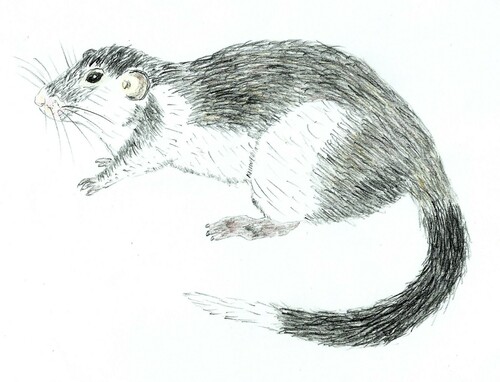
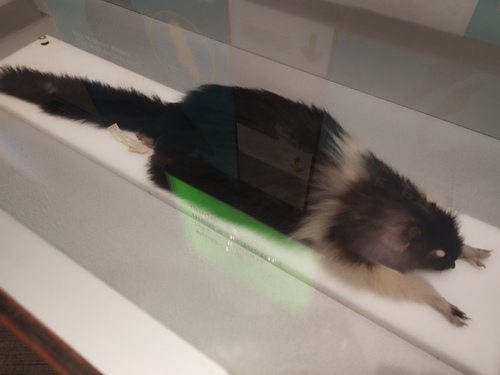
It has soft, dense grayish-brown to blackish fur, a robust body, and a long bushy tail that is notably furred, unlike typical rats. The face is somewhat rounded with large eyes adapted for nocturnal vision.
Size
Body length approximately 32-40 cm, with a bushy tail of similar or greater length, giving a total length that can exceed 60-70 cm.
Weight
Estimated weight around 500-900 grams, though precise data are limited due to the species' rarity.
Distinctive features
Distinguished from other cloud rats by its specific fur coloration and skull morphology, as well as its restriction to Panay Island, differentiating it from related Crateromys species found on other Philippine islands like Luzon.
Behaviour and diet of the Panay Cloud Rat
Believed to be largely solitary or living in small family groups, consistent with other arboreal cloud rats, though detailed social behavior remains poorly studied.
When it is active
Nocturnal, spending daylight hours resting in tree hollows and becoming active at night to forage in the forest canopy.
Diet
Herbivorous, feeding primarily on leaves, fruits, and bark from forest trees, similar to other cloud rat species.
Communication
Likely uses vocalizations and scent marking typical of nocturnal rodents, though specific communication methods have not been well documented for this species.
Interactions with other species
Faces predation risk from forest raptors and possibly snakes; competes with other arboreal mammals for tree cavity nesting sites and food resources.
Role in its ecosystem
As a folivore/frugivore, it likely plays a role in forest nutrient cycling and possibly minor seed dispersal, contributing to the health of Panay's montane forest ecosystem.
Reproduction and lifecycle
Reproductive biology is poorly documented, but likely similar to related cloud rats with small litter sizes and reliance on tree cavities for nesting.
Raising the young
Presumed that females provide primary care for offspring in nest cavities, though specific parental behaviors have not been thoroughly studied in the wild.
Maturity and lifespan
Specific data on age of sexual maturity and lifespan are lacking, but related cloud rat species are estimated to live several years in the wild.
Taxonomy and naming of the Panay Cloud Rat
Classification
Class Mammalia > Order Rodentia > Family Muridae > Genus Crateromys > Species Crateromys heaneyi
What research says
Recent studies
Recent biodiversity surveys on Panay have focused on documenting the species' remaining range and assessing habitat quality, highlighting its critical conservation status.
Compared with similar species
Compared to its relative Crateromys schadenbergi (Luzon cloud rat), C. heaneyi is generally smaller and restricted to a much smaller geographic range, reflecting the isolated evolutionary history of Panay's fauna.
The Panay Cloud Rat and people
It was only formally described in 1996, making it one of the more recently discovered large mammals in the Philippines. Its bushy tail resembles that of a squirrel more than a typical rat, giving it a unique appearance among rodents.
Where and how to see it
Best observed at night in remaining forest patches of the Central Panay Mountains, though sightings are extremely rare due to its elusive nature and endangered status; guided ecological surveys with local conservation groups offer the best chance.
Risks to humans
No notable risk to humans.
Human uses
Occasionally hunted by local communities for bushmeat, though it holds no significant commercial or traditional medicinal use.
Countries where the Panay Cloud Rat is recorded
The 1 countries named in the range description of its IUCN Red List assessment.
Questions about the Panay Cloud Rat
Where does the Panay Cloud Rat live?
The Panay Cloud Rat is recorded in Philippines across Asia. These countries come from the range description of its IUCN Red List assessment, and they are what place the species on the interactive map.
Is the Panay Cloud Rat endangered?
Yes. The IUCN Red List assesses the Panay Cloud Rat as Endangered, one of the three threatened categories. The species faces a very high risk of extinction in the wild — a step below Critically Endangered, but still on a trajectory that ends badly without intervention.
How many are left in the wild?
No precise population estimate exists, but the species is considered rare with a declining population trend due to continuous habitat loss on Panay Island. This figure comes from the species assessment on the IUCN Red List; population estimates for wild mammals are ranges, not counts, and are revised at each assessment.
What habitat does the Panay Cloud Rat live in?
Primarily inhabits primary and old-growth montane and mossy forests, favoring areas with large trees providing tree hollows for nesting.
What is the scientific name of the Panay Cloud Rat?
The Panay Cloud Rat is Crateromys heaneyi, in the family Muridae, order Rodentia.
Other species in the genus Crateromys

Other species in the family Muridae
Species that share its range
Sources
Conservation status, range description and population estimate come from the IUCN Red List assessment for Crateromys heaneyi. Countries are derived from that range description, not from a mapped country list. Last refreshed on .
The distribution map is drawn from the IUCN Red List spatial data compiled in 2017. IUCN SSC Small Mammal Specialist Group