
Luzon Bushy-tailed Cloud Rat
Crateromys schadenbergi
Red List assessment
Endangeredon the IUCN Red List
- EXExtinct
- EWExtinct in the Wild
- CRCritically Endangered
- ENEndangered
- VUVulnerable
- NTNear Threatened
- LCLeast Concern
The Luzon Bushy-tailed Cloud Rat is recorded in one country, Philippines across Asia. The IUCN Red List assesses the Luzon Bushy-tailed Cloud Rat as Endangered. Exact population size is unknown but believed to be small and declining, given the species' restricted range and continued habitat degradation.
- Family
- Muridae
- Order
- Rodentia
- Genus
- Crateromys
- Countries recorded
- 1
- Continents
- Asia
- Red List category
- Endangered
- Data updated
- August 9, 2026
What is the Luzon Bushy-tailed Cloud Rat?
Crateromys schadenbergi, also known as the Luzon Bushy-tailed Cloud Rat, is one of the largest and most striking members of the endemic Philippine cloud rat group. It inhabits high-elevation mossy and montane forests in the Cordillera Central of Luzon, where it lives an arboreal, nocturnal lifestyle. The species is remarkable for its long bushy tail, thick soft fur adapted to cool mountain climates, and its rarity, making it a flagship species for Philippine montane forest conservation.
Where does the Luzon Bushy-tailed Cloud Rat live?
Endemic to the island of Luzon in the Philippines, restricted to the Cordillera Central mountain range.
Restricted to the island of Luzon, Philippines, primarily within the Cordillera Central mountain range including areas around Mount Data, Mount Pulag, and adjacent forested regions of Benguet and Ifugao provinces.
Altitude and depth
Approximately 1,200 to 2,850 meters above sea level.
Habitat of the Luzon Bushy-tailed Cloud Rat
Primary and secondary montane and mossy forests with dense canopy cover, often in areas with abundant epiphytes and tree cavities used for nesting.
Adaptations to its environment
Possesses strong curved claws and a long tail for balance during arboreal locomotion, thick fur for insulation in cool montane climates, and nocturnal habits to avoid daytime predators and conserve energy in a resource-limited forest environment.
Conservation status and numbers
Classified as Endangered (EN) by the IUCN due to a small, fragmented population and ongoing habitat loss; population trend is decreasing as forest cover continues to shrink across its restricted range.
Estimated population
Exact population size is unknown but believed to be small and declining, given the species' restricted range and continued habitat degradation.
What threatens the Luzon Bushy-tailed Cloud Rat?
Deforestation from logging, agricultural expansion, and small-scale mining, combined with hunting for local subsistence, are the primary threats reducing suitable habitat and population numbers.
What is being done to protect it?
Protected under Philippine wildlife protection laws, with some populations occurring within protected areas such as Mount Pulag National Park; limited field surveys and awareness programs have been initiated by conservation groups.
Recommended actions
Expand protected forest areas, conduct thorough population surveys, engage local communities in sustainable forest use, and strengthen enforcement against illegal logging and hunting.
What the Luzon Bushy-tailed Cloud Rat looks like
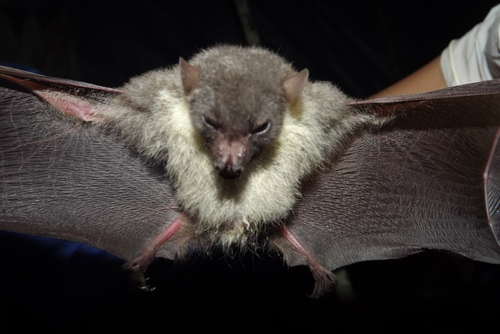
Covered in long, soft fur that is grayish-brown to blackish on the back with paler, cream to whitish underparts; the tail is notably bushy, resembling that of a large squirrel, and the ears and eyes are relatively large, aiding nocturnal vision.
Size
Body length approximately 32-40 cm, with a bushy tail of similar or slightly greater length (30-38 cm).
Weight
Estimated body weight ranges from about 1,200 to 2,600 grams, making it one of the largest cloud rat species.
Distinctive features
Distinguished from related cloud rats by its very large size, exceptionally bushy tail longer than its body, and specific coloration pattern unique among Crateromys species.
Differences between males and females
Minimal sexual dimorphism reported, though males may be marginally larger than females.
Behaviour and diet of the Luzon Bushy-tailed Cloud Rat
Generally solitary or found in loose pairs, spending most time alone in tree canopies except during breeding.
When it is active
Strictly nocturnal, foraging and moving through the forest canopy at night while resting in tree hollows during the day.
Diet
Herbivorous, feeding primarily on leaves, fruits, bark, and possibly seeds found within its montane forest habitat.
Communication
Likely uses vocalizations and scent marking for communication, though specific studies on this species' communication methods are lacking.
Interactions with other species
Potential predators include large raptors and civets; the species may also compete with other arboreal mammals for food and nesting sites within its forest habitat.
Role in its ecosystem
Plays a role in forest ecosystem dynamics as a herbivore and potential seed disperser, contributing to the health and regeneration of montane forest vegetation.
Reproduction and lifecycle
Breeding biology is poorly documented, but like other cloud rats it likely produces small litters (probably a single offspring) with a gestation period of several weeks.
Raising the young
Females likely provide sole parental care, nursing and protecting the single offspring within a tree cavity nest until it becomes independent.
Maturity and lifespan
Specific data on age of sexual maturity and lifespan are unknown, but related cloud rat species are estimated to live several years in the wild, potentially longer in captivity.
Taxonomy and naming of the Luzon Bushy-tailed Cloud Rat
Classification
Class Mammalia > Order Rodentia > Family Muridae > Genus Crateromys > Species Crateromys schadenbergi
What research says
Recent studies
Recent phylogenetic studies on Philippine murid rodents have helped clarify the evolutionary relationships of Crateromys species, though detailed ecological studies specific to C. schadenbergi remain scarce.
Compared with similar species
Compared to the smaller Panay Cloud Rat (Crateromys paulus), C. schadenbergi is notably larger with a more pronounced bushy tail; it is also distinct from the giant cloud rats of genus Phloeomys, which are heavier-bodied and lack the extreme tail bushiness.
The Luzon Bushy-tailed Cloud Rat and people
Its tail can be nearly as long as its entire body, giving it an almost squirrel-like appearance; it was first described in the late 19th century and named after the German naturalist Alexander Schadenberg who studied Philippine wildlife.
Where and how to see it
Best observed at night in the mossy forests of Mount Pulag or Mount Data with the guidance of local rangers or researchers familiar with its nocturnal habits and nesting sites.
Risks to humans
No notable risk to humans.
Human uses
Occasionally hunted by local indigenous communities for subsistence, but there is no significant commercial trade associated with this species.
Countries where the Luzon Bushy-tailed Cloud Rat is recorded
The 1 countries named in the range description of its IUCN Red List assessment.
Questions about the Luzon Bushy-tailed Cloud Rat
Where does the Luzon Bushy-tailed Cloud Rat live?
The Luzon Bushy-tailed Cloud Rat is recorded in Philippines across Asia. These countries come from the range description of its IUCN Red List assessment, and they are what place the species on the interactive map.
Is the Luzon Bushy-tailed Cloud Rat endangered?
Yes. The IUCN Red List assesses the Luzon Bushy-tailed Cloud Rat as Endangered, one of the three threatened categories. The species faces a very high risk of extinction in the wild — a step below Critically Endangered, but still on a trajectory that ends badly without intervention.
How many are left in the wild?
Exact population size is unknown but believed to be small and declining, given the species' restricted range and continued habitat degradation. This figure comes from the species assessment on the IUCN Red List; population estimates for wild mammals are ranges, not counts, and are revised at each assessment.
What habitat does the Luzon Bushy-tailed Cloud Rat live in?
Primary and secondary montane and mossy forests with dense canopy cover, often in areas with abundant epiphytes and tree cavities used for nesting.
What is the scientific name of the Luzon Bushy-tailed Cloud Rat?
The Luzon Bushy-tailed Cloud Rat is Crateromys schadenbergi, in the family Muridae, order Rodentia.
Other species in the genus Crateromys

Other species in the family Muridae
Species that share its range
Sources
Conservation status, range description and population estimate come from the IUCN Red List assessment for Crateromys schadenbergi. Countries are derived from that range description, not from a mapped country list. Last refreshed on .
The distribution map is drawn from the IUCN Red List spatial data compiled in 2017. IUCN SSC Small Mammal Specialist Group