
Narwhal
Monodon monoceros
Red List assessment
Least Concernon the IUCN Red List
- EXExtinct
- EWExtinct in the Wild
- CRCritically Endangered
- ENEndangered
- VUVulnerable
- NTNear Threatened
- LCLeast Concern
The Narwhal is recorded in 4 countries across Europe and North America. The IUCN Red List assesses the Narwhal as Least Concern. Approximately 170,000 individuals globally, with the population trend considered stable, though regional subpopulations vary in status.
- Family
- Monodontidae
- Order
- Cetartiodactyla
- Genus
- Monodon
- Countries recorded
- 4
- Continents
- Europe and North America
- Red List category
- Least Concern
- Data updated
- August 9, 2026
What is the Narwhal?
The narwhal is a medium-sized toothed whale famous for the long spiral tusk protruding from the upper jaw of males, earning it the nickname 'unicorn of the sea'. It inhabits the icy Arctic waters of Canada, Greenland, and Norway, living in close association with pack ice. This elusive cetacean is remarkable for its deep-diving abilities and its unique tusk, which is actually an elongated canine tooth with sensory capabilities.
Where does the Narwhal live?
Arctic waters of Canada, Greenland, Norway (Svalbard), and Russia
Found primarily in the Canadian Arctic Archipelago, Baffin Bay, Davis Strait, Greenland waters, and the Barents Sea region including Svalbard, Norway. Small populations also occur near Franz Josef Land, Russia.
Altitude and depth
Dives regularly to 800-1500m, with maximum recorded dives exceeding 1800m, making them among the deepest-diving marine mammals.
Seasonal movements
Narwhals migrate seasonally between summer coastal/fjord habitats and deep offshore wintering grounds under pack ice, following the advance and retreat of sea ice.
Habitat of the Narwhal
Narwhals inhabit cold Arctic marine waters, particularly areas with dense pack ice and deep fjords. They are closely associated with sea ice edges and polynyas (areas of open water surrounded by ice) throughout much of the year.
Adaptations to its environment
Thick blubber layer (up to 10cm) provides insulation against frigid Arctic waters, while a reduced dorsal ridge instead of a fin allows easier movement under ice. The tusk, containing millions of nerve endings, may help sense changes in water salinity or temperature.
Conservation status and numbers
Listed as Least Concern by the IUCN, though some subpopulations face localized pressures. Overall population trends are considered stable but data remains limited due to the species' remote habitat.
Estimated population
Approximately 170,000 individuals globally, with the population trend considered stable, though regional subpopulations vary in status.
What threatens the Narwhal?
Climate change and reduced sea ice are major threats, increasing predation risk from killer whales and altering prey availability. Additional threats include hunting, shipping noise, and industrial development in the Arctic.
Diseases and parasites
Narwhals can be affected by parasites such as nematodes and various skin conditions, along with occasional exposure to pathogens linked to changing Arctic conditions.
What is being done to protect it?
Managed through indigenous subsistence hunting quotas in Canada and Greenland under co-management agreements. Protected under CITES Appendix II, regulating international trade of tusks and other products.
Recommended actions
Continued monitoring of population trends amid climate change, stricter regulation of Arctic shipping and industrial activity, and sustainable management of indigenous hunting quotas.
What the Narwhal looks like
Narwhals have mottled gray, black, and white skin that lightens with age, becoming almost entirely white in old individuals. They lack a dorsal fin, instead having a low dorsal ridge, and possess small rounded flippers.
Size
Body length ranges from 3.95 to 5.5 meters, with males typically longer than females; the tusk itself can add an additional 1.5 to 3.1 meters.
Weight
Adults typically weigh between 800 and 1600 kg, with males generally heavier than females.
Distinctive features
The most distinctive feature is the male's long, spiraled ivory tusk, an elongated left canine tooth that can grow up to 3 meters. Unlike other cetaceans, narwhals also lack a true dorsal fin.
Differences between males and females
Males are notably larger than females and possess the iconic spiral tusk, while females rarely develop a tusk and are smaller in overall body size.
Behaviour and diet of the Narwhal
Narwhals are highly social, typically forming groups of 2-10 individuals, though summer aggregations can number in the hundreds to thousands. Groups are often segregated by sex and age.
When it is active
Narwhals are active both day and night, with activity patterns influenced more by ice cover, prey availability, and tidal cycles than by daylight.
Diet
Their diet mainly consists of Arctic cod, Greenland halibut, and squid, supplemented by shrimp and other fish species depending on season and location.
How it feeds and hunts
Narwhals hunt using deep diving techniques to reach prey near the seafloor, employing echolocation to locate food in the dark, ice-covered waters. They are thought to use suction feeding, drawing prey into their mouths rather than biting.
Communication
Narwhals communicate through a variety of clicks, whistles, and pulsed calls used for echolocation and social interaction. Tusk-rubbing between males may also serve as a form of communication or dominance display.
Interactions with other species
Killer whales and polar bears are primary predators, particularly targeting narwhals trapped in ice entrapments called 'savssats'. They may also share habitat with belugas, their closest living relatives.
Role in its ecosystem
As mid-level to apex predators in the Arctic marine food web, narwhals help regulate populations of Arctic cod and other fish species. Their presence and health are considered indicators of Arctic marine ecosystem status.
Reproduction and lifecycle
Breeding occurs in early spring, with gestation lasting about 14-15 months, resulting in a single calf. Calves are typically born in summer and nurse for up to 20 months.
Raising the young
Calves stay close to their mothers for extended periods, relying on maternal care for nursing and protection during their first years of life. Social bonds within maternal groups can persist for years.
Maturity and lifespan
Sexual maturity is reached around 6-9 years for females and slightly later for males; narwhals can live up to 50 years or more in the wild.
Taxonomy and naming of the Narwhal
Classification
Class Mammalia > Order Cetartiodactyla > Family Monodontidae > Genus Monodon > Species Monodon monoceros
Scientific synonyms
Narwhalus microcephalus
What research says
Recent studies
Recent research using tagging and drone technology has revealed novel tusk behaviors, including using the tusk to stun fish before feeding. Studies also highlight how shrinking sea ice is altering migration patterns and predation risk.
Genome and DNA
Narwhals have 2n=42 chromosomes; genetic studies have revealed hybridization events with beluga whales, producing rare hybrid offspring known as 'narlugas'.
Compared with similar species
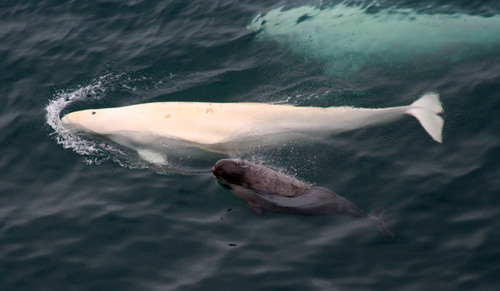
Narwhals are closely related to beluga whales, sharing the family Monodontidae, but differ notably in their lack of a dorsal fin, mottled coloration, and the presence of a tusk. Unlike belugas, narwhals are more specialized for deep, ice-covered habitats.
The Narwhal and people
The narwhal's tusk is actually a tooth with millions of nerve endings, possibly used for sensing environmental changes. Occasionally, males develop two tusks, and rare hybrids with belugas called 'narlugas' have been documented.
Where and how to see it
Best observed during summer months in Arctic fjords of Canada (Baffin Island), Greenland, or Svalbard, often via guided boat tours or from ice floes. Patience and calm waters improve chances of sighting these elusive whales.
Risks to humans
No notable risk to humans as narwhals are not aggressive and rarely interact directly with people.
Human uses
Indigenous Arctic communities have traditionally hunted narwhals for meat, skin (muktuk), and ivory tusks, which are still traded internationally under strict regulation. Tusks have historically been valued as artistic and ceremonial objects.
Myths and legends
Medieval Europeans sold narwhal tusks as unicorn horns, believed to have magical healing properties and worth more than their weight in gold. Inuit legends describe the narwhal's tusk originating from a woman transformed while harpooning a whale.
Countries where the Narwhal is recorded
The 4 countries named in the range description of its IUCN Red List assessment.
Questions about the Narwhal
Where does the Narwhal live?
The Narwhal is recorded in Canada, Greenland, Norway and Russia across Europe and North America. These countries come from the range description of its IUCN Red List assessment, and they are what place the species on the interactive map.
Is the Narwhal endangered?
The IUCN Red List assesses the Narwhal as Least Concern. The species is widespread and abundant enough not to qualify for any threatened category. It does not mean the species is safe forever, only that nothing in the current data raises an alarm.
How many are left in the wild?
Approximately 170,000 individuals globally, with the population trend considered stable, though regional subpopulations vary in status. This figure comes from the species assessment on the IUCN Red List; population estimates for wild mammals are ranges, not counts, and are revised at each assessment.
What habitat does the Narwhal live in?
Narwhals inhabit cold Arctic marine waters, particularly areas with dense pack ice and deep fjords.
What is the scientific name of the Narwhal?
The Narwhal is Monodon monoceros, in the family Monodontidae, order Cetartiodactyla.
Other species in the family Monodontidae
Species that share its range
Sources
Conservation status, range description and population estimate come from the IUCN Red List assessment for Monodon monoceros. Countries are derived from that range description, not from a mapped country list. Last refreshed on .
The distribution map is drawn from the IUCN Red List spatial data compiled in 2008. IUCN (International Union for Conservation of Nature)