
Mountain Pygmy Possum
Burramys parvus
Red List assessment
Critically Endangeredon the IUCN Red List
- EXExtinct
- EWExtinct in the Wild
- CRCritically Endangered
- ENEndangered
- VUVulnerable
- NTNear Threatened
- LCLeast Concern
The Mountain Pygmy Possum is recorded in 2 countries across Europe and Oceania. The IUCN Red List assesses the Mountain Pygmy Possum as Critically Endangered. Estimated total population of around 2,000-2,600 mature individuals, with a declining trend across most populations, though some recovery has occurred locally after targeted conservation actions.
- Family
- Burramyidae
- Order
- Diprotodontia
- Genus
- Burramys
- Countries recorded
- 2
- Continents
- Europe and Oceania
- Red List category
- Critically Endangered
- Data updated
- August 9, 2026
What is the Mountain Pygmy Possum?
The Mountain Pygmy Possum is a small marsupial restricted to alpine and subalpine boulder-fields in southeastern Australia, making it the only Australian mammal confined to alpine habitat. It was first known only from fossils and was thought extinct until a living individual was found in a ski lodge in 1966. It is the only hibernating marsupial in Australia and is critically endangered due to its extremely restricted, fragmented range.
Where does the Mountain Pygmy Possum live?
Australia (alpine regions of Victoria and New South Wales)
Found only in three isolated alpine areas of southeastern Australia: Mount Kosciuszko in New South Wales, and Mount Buller and the Bogong High Plains/Mount Higginbotham-Loch area in Victoria. Total occupied habitat is estimated at less than 10 square kilometers.
Altitude and depth
1,400-2,228 meters above sea level
Seasonal movements
Undergoes true hibernation for up to 7 months during winter (April-October), lowering body temperature and metabolic rate to survive beneath snow cover; active during the warmer spring and summer months when food is abundant.
Habitat of the Mountain Pygmy Possum
Restricted to alpine and subalpine boulder-field habitats above the winter snowline, typically associated with periglacial talus slopes covered in dense heathland shrubs such as Mountain Plum Pine (Podocarpus lawrencei). These boulder fields provide insulated cavities used for winter hibernation.
Adaptations to its environment
Possesses the ability to enter deep torpor and hibernation, an extremely rare trait among marsupials, allowing survival through harsh alpine winters. It also has a unique reliance on Bogong Moths as a seasonal fat-rich food source and stores seeds to supplement its diet before and after hibernation.
Conservation status and numbers
Critically Endangered (IUCN) due to an extremely restricted and fragmented range, ongoing habitat loss, and rapid population decline linked to climate change and reduced snow cover affecting hibernation success.
Estimated population
Estimated total population of around 2,000-2,600 mature individuals, with a declining trend across most populations, though some recovery has occurred locally after targeted conservation actions.
What threatens the Mountain Pygmy Possum?
Climate change reducing snow cover essential for insulated hibernation, habitat fragmentation from ski resort development and infrastructure, decline of the Bogong Moth (a key food source) due to agricultural and light pollution impacts, and predation by introduced predators such as foxes and cats.
Diseases and parasites
Limited documented disease information, though ectoparasites such as mites and ticks have been recorded; population stress from habitat fragmentation may increase susceptibility to disease.
What is being done to protect it?
Captive breeding and reintroduction programs (notably at Healesville Sanctuary and Mount Buller), construction of habitat corridors like the Mount Hotham tunnel to reconnect fragmented populations, predator control programs, and legal protection under Australian federal and state threatened species legislation.
Recommended actions
Expand and protect habitat corridors between fragmented populations, mitigate climate change impacts on snowpack, control introduced predators, restore Bogong Moth migration routes, and continue captive breeding with genetic diversity management.
What the Mountain Pygmy Possum looks like
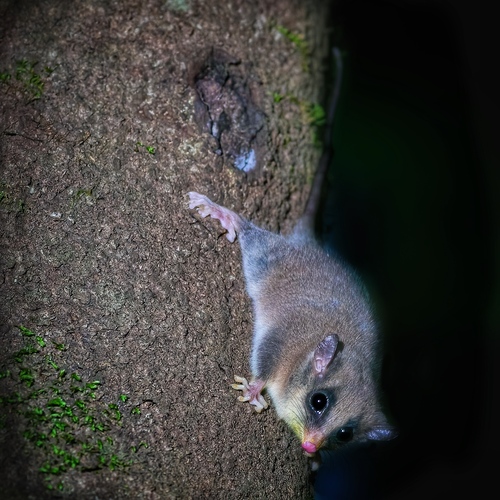
Small grey-brown possum with a lighter underside, large dark eyes adapted for nocturnal activity, and a long, prehensile, slightly scaly tail used for gripping vegetation and rocks. Its fur is dense, providing insulation against cold alpine temperatures.
Size
Body length approximately 10-11 cm, with an additional prehensile tail of about 13-15 cm
Weight
Typically 35-82 grams, with weight fluctuating seasonally as individuals accumulate fat reserves before hibernation
Distinctive features
Distinguished from other pygmy possums by its larger size, alpine-specific habitat restriction, and true hibernation behavior, which is unusual among marsupials. Its long prehensile tail and rounded ears also differentiate it from related Burramyidae species.
Differences between males and females
Minimal sexual dimorphism; females are slightly larger than males and possess a forward-opening pouch with four teats for raising young.
Behaviour and diet of the Mountain Pygmy Possum
Generally solitary outside of breeding season, though sexes occupy somewhat separate microhabitats within boulder fields, with males often found at higher, cooler elevations and females at lower, warmer sites.
When it is active
Nocturnal, active primarily at night during the snow-free months, while entering deep hibernation during the winter under insulating snow cover.
Diet
Omnivorous, feeding heavily on Bogong Moths during their seasonal migration, as well as other invertebrates, seeds (notably from Mountain Plum Pine), and fruits, which it caches for use during and after hibernation.
How it feeds and hunts
Forages actively at night among rocks and vegetation, using keen smell and touch to locate insects and seeds; caches food reserves in rock crevices for post-hibernation use.
Communication
Communicates primarily through scent marking to establish territory and detect mates, along with tactile interactions during breeding; vocalizations are limited and not well documented.
Interactions with other species
Preyed upon by introduced predators such as red foxes and feral cats, as well as native predators like currawongs; depends heavily on the Bogong Moth for a critical seasonal food resource, linking its survival closely to moth population health.
Role in its ecosystem
Plays a role in seed dispersal for alpine plants such as Mountain Plum Pine and acts as a link in alpine food webs by consuming and being preyed upon by various invertebrates and vertebrates, respectively.
Reproduction and lifecycle
Breeding occurs once yearly shortly after emergence from hibernation in spring (October-November); gestation lasts about 3 weeks, with litters of up to 4 young that remain in the pouch before being left in a nest and weaned by early summer.
Raising the young
Females provide all parental care, carrying young in the pouch initially and later leaving them in nests while foraging; weaning occurs around 3-4 months after birth, after which juveniles become independent.
Maturity and lifespan
Reaches sexual maturity around 1 year of age; lifespan in the wild is typically 5-6 years for females (longer than most small marsupials due to hibernation), while males often live only 1-2 years.
Taxonomy and naming of the Mountain Pygmy Possum
Classification
Class Mammalia > Order Diprotodontia > Family Burramyidae > Genus Burramys > Species Burramys parvus
Scientific synonyms
Burramys parvus Broom, 1896 (originally described from fossil remains before living population was discovered in 1966)
What research says
Recent studies
Recent research has focused on the decline of Bogong Moth migrations linked to agricultural changes and its cascading effects on possum survival, as well as the success of artificial habitat corridors like the Mount Hotham tunnel in reconnecting fragmented populations.
Genome and DNA
Genetic studies have revealed significant population structuring and reduced genetic diversity among the three isolated populations, informing targeted genetic rescue efforts through translocation programs.
Compared with similar species
Unlike other pygmy possums (genus Cercartetus), Burramys parvus is larger, restricted to alpine habitats, and is the only member of its genus, making it taxonomically and ecologically distinct within Burramyidae.
The Mountain Pygmy Possum and people
It is the only Australian mammal restricted entirely to alpine environments and the only marsupial known to undergo prolonged hibernation. It was first described from fossils over 20,000 years old before a living population was discovered in a Victorian ski lodge in 1966.
Where and how to see it
Best observed with guided tours or scientific programs in protected boulder-field habitats such as Mount Buller and the Bogong High Plains in Victoria during late spring to early autumn when active outside hibernation.
Risks to humans
No notable risk to humans
Countries where the Mountain Pygmy Possum is recorded
The 2 countries named in the range description of its IUCN Red List assessment.
Questions about the Mountain Pygmy Possum
Where does the Mountain Pygmy Possum live?
The Mountain Pygmy Possum is recorded in Australia and United Kingdom across Europe and Oceania. These countries come from the range description of its IUCN Red List assessment, and they are what place the species on the interactive map.
Is the Mountain Pygmy Possum endangered?
Yes. The IUCN Red List assesses the Mountain Pygmy Possum as Critically Endangered, one of the three threatened categories. The species faces an extremely high risk of extinction in the wild. This is the last category before extinction, and it is reached through a very small or steeply declining population, a tiny range, or both.
How many are left in the wild?
Estimated total population of around 2,000-2,600 mature individuals, with a declining trend across most populations, though some recovery has occurred locally after targeted conservation actions. This figure comes from the species assessment on the IUCN Red List; population estimates for wild mammals are ranges, not counts, and are revised at each assessment.
What habitat does the Mountain Pygmy Possum live in?
Restricted to alpine and subalpine boulder-field habitats above the winter snowline, typically associated with periglacial talus slopes covered in dense heathland shrubs such as Mountain Plum Pine (Podocarpus lawrencei).
What is the scientific name of the Mountain Pygmy Possum?
The Mountain Pygmy Possum is Burramys parvus, in the family Burramyidae, order Diprotodontia.
Other species in the family Burramyidae
Species that share its range

Sources
Conservation status, range description and population estimate come from the IUCN Red List assessment for Burramys parvus. Countries are derived from that range description, not from a mapped country list. Last refreshed on .
The distribution map is drawn from the IUCN Red List spatial data compiled in 2008. IUCN (International Union for Conservation of Nature)