
Mountain Anoa
Bubalus quarlesi
Red List assessment
Endangeredon the IUCN Red List
- EXExtinct
- EWExtinct in the Wild
- CRCritically Endangered
- ENEndangered
- VUVulnerable
- NTNear Threatened
- LCLeast Concern
The Mountain Anoa is recorded in one country, Indonesia across Asia. The IUCN Red List assesses the Mountain Anoa as Endangered. Estimated at a few thousand individuals or fewer, with a continuing declining population trend.
- Family
- Bovidae
- Order
- Artiodactyla
- Genus
- Bubalus
- Countries recorded
- 1
- Continents
- Asia
- Red List category
- Endangered
- Data updated
- August 9, 2026
What is the Mountain Anoa?
The Mountain Anoa is one of the smallest wild bovids in the world, endemic to the mountainous forests of Sulawesi, Indonesia. It resembles a miniature buffalo and is remarkable for its solitary, elusive nature and adaptation to dense, high-altitude tropical forest. As one of the least-studied bovids due to its shy behavior and remote habitat, it remains poorly understood compared to its lowland relative, the Lowland Anoa.
Where does the Mountain Anoa live?
Indonesia (mountainous interior regions of Sulawesi)
Endemic to the island of Sulawesi, Indonesia, primarily found in the central mountainous interior regions, distinct from the coastal lowland habitat of Bubalus depressicornis.
Altitude and depth
Typically found at higher elevations, roughly 500-2300 meters above sea level, in contrast to the lowland anoa which stays near sea level.
Seasonal movements
No strong seasonal migration; breeding can occur year-round without a strict seasonal pattern, though some local variation in birth timing may exist.
Habitat of the Mountain Anoa
Dense tropical montane forest, often in steep, rugged terrain with thick undergrowth providing cover; prefers areas near water sources and away from human disturbance.
Adaptations to its environment
Smaller body size and shorter, straighter horns aid movement through dense montane vegetation; thick dark hide offers protection against thorny undergrowth; excellent balance and agility suited to steep terrain.
Conservation status and numbers
Endangered (EN) according to IUCN, due to a suspected population decline of over 50% in the past few decades caused mainly by habitat loss and hunting.
Estimated population
Estimated at a few thousand individuals or fewer, with a continuing declining population trend.
What threatens the Mountain Anoa?
Habitat destruction from logging and agricultural expansion, illegal hunting for meat and horns, and increasing human encroachment into remaining forest.
Diseases and parasites
Susceptible to common bovid parasites such as ticks and gastrointestinal worms; specific disease studies are limited due to the species' rarity.
What is being done to protect it?
Protected under Indonesian law; present in several protected areas and national parks in Sulawesi such as Lore Lindu National Park; captive breeding programs exist in a few zoos worldwide.
Recommended actions
Strengthen anti-poaching enforcement, expand protected forest habitat, conduct population surveys using camera traps, and support community-based conservation and habitat corridors.
What the Mountain Anoa looks like
Dark brown to blackish short-haired coat, sturdy compact body, small straight or slightly curved horns, and white markings on the lower legs and sometimes face.
Size
Shoulder height around 60-75 cm; body length approximately 130-160 cm.
Weight
Adults typically weigh between 150-300 kg, with males generally slightly larger than females.
Distinctive features
Smaller size and straighter, more slender horns compared to the Lowland Anoa; adapted to higher elevation forest rather than lowland swampy habitat.
Differences between males and females
Males tend to have slightly thicker horns and larger body size than females, though the difference is subtle compared to other bovids.
Behaviour and diet of the Mountain Anoa
Generally solitary or found in small family groups of mother and calf; adult males are mostly solitary and territorial.
When it is active
Primarily crepuscular and nocturnal, resting during the heat of the day in dense cover and being most active at dawn, dusk, and night.
Diet
Herbivorous, feeding on grasses, leaves, ferns, fruits, and aquatic plants found in the forest understorey.
Communication
Communicates through vocalizations such as grunts and snorts, along with scent marking and body posturing to signal territory or alarm.
Interactions with other species
Few natural predators remain due to loss of large carnivores on Sulawesi; humans are the primary threat through hunting; may share habitat with other Sulawesi endemic mammals like the babirusa.
Role in its ecosystem
Acts as a browser and grazer, helping to shape forest understorey vegetation and disperse seeds through its droppings within its mountain forest ecosystem.
Reproduction and lifecycle
Gestation lasts around 275-315 days, with females typically giving birth to a single calf; breeding can occur throughout the year.
Raising the young
Calves are cared for exclusively by the mother, nursing for several months and remaining close to her until they are independent, generally around one year old.
Maturity and lifespan
Reaches sexual maturity around 2-3 years of age; lifespan in the wild is estimated at 20-25 years, with captive individuals occasionally living longer.
Taxonomy and naming of the Mountain Anoa
Classification
Class Mammalia > Order Artiodactyla > Family Bovidae > Genus Bubalus > Species Bubalus quarlesi
Scientific synonyms
Anoa quarlesi; sometimes considered a synonym or subspecies of Bubalus depressicornis by some taxonomists
What research says
Recent studies
Recent camera-trap surveys in Sulawesi's protected areas have provided rare footage and updated distribution data, though comprehensive population studies remain scarce due to the species' elusive nature.
Genome and DNA
Limited genetic studies exist; some research has focused on differentiating Bubalus quarlesi from Bubalus depressicornis at the genetic level, though taxonomic status remains debated.
Compared with similar species
Closely related to the Lowland Anoa (Bubalus depressicornis), but smaller in size, with straighter horns and a preference for higher-altitude forest rather than lowland swamp habitat.
The Mountain Anoa and people
The Mountain Anoa is one of the smallest wild cattle species in the world; it is so elusive that scientists have very limited direct observational data on its behavior in the wild; some experts still debate whether it is truly a distinct species or a subspecies of the Lowland Anoa.
Where and how to see it
Best chances of observation are within protected reserves like Lore Lindu National Park, during early morning or dusk hours near forest streams, though sightings remain rare due to the animal's shy and elusive nature.
Risks to humans
No notable risk to humans under normal circumstances, though like any wild bovid it could act defensively if cornered or threatened.
Human uses
Historically hunted by local communities for meat and horns; now primarily significant for ecotourism and conservation value rather than commercial use.
Myths and legends
In some local Sulawesi communities, anoa are viewed as a symbol of the island's unique wildlife heritage, though specific folklore is not widely documented outside regional traditions.
Countries where the Mountain Anoa is recorded
The 1 countries named in the range description of its IUCN Red List assessment.
Questions about the Mountain Anoa
Where does the Mountain Anoa live?
The Mountain Anoa is recorded in Indonesia across Asia. These countries come from the range description of its IUCN Red List assessment, and they are what place the species on the interactive map.
Is the Mountain Anoa endangered?
Yes. The IUCN Red List assesses the Mountain Anoa as Endangered, one of the three threatened categories. The species faces a very high risk of extinction in the wild — a step below Critically Endangered, but still on a trajectory that ends badly without intervention.
How many are left in the wild?
Estimated at a few thousand individuals or fewer, with a continuing declining population trend. This figure comes from the species assessment on the IUCN Red List; population estimates for wild mammals are ranges, not counts, and are revised at each assessment.
What habitat does the Mountain Anoa live in?
Dense tropical montane forest, often in steep, rugged terrain with thick undergrowth providing cover; prefers areas near water sources and away from human disturbance.
What is the scientific name of the Mountain Anoa?
The Mountain Anoa is Bubalus quarlesi, in the family Bovidae, order Artiodactyla.
Other species in the genus Bubalus
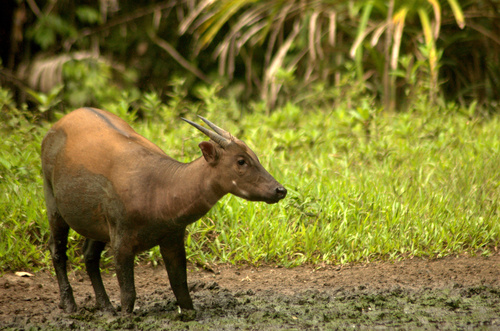
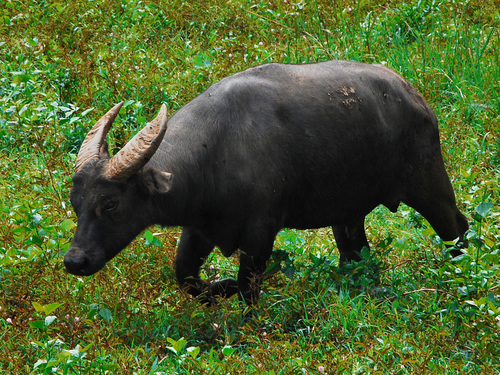
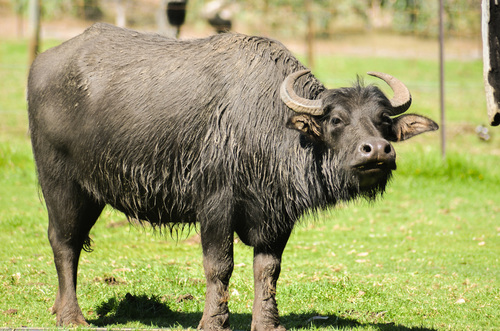
Other species in the family Bovidae
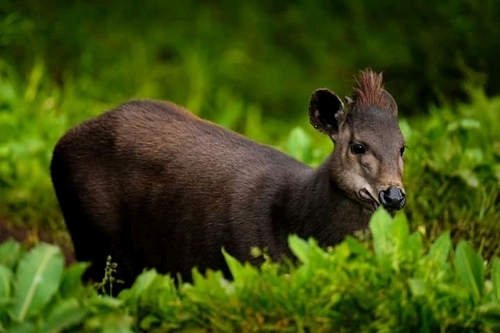
Species that share its range
Sources
Conservation status, range description and population estimate come from the IUCN Red List assessment for Bubalus quarlesi. Countries are derived from that range description, not from a mapped country list. Last refreshed on .
The distribution map is drawn from the IUCN Red List spatial data compiled in 2016. IUCN (International Union for Conservation of Nature)