
Lowland Anoa
Bubalus depressicornis
Red List assessment
Endangeredon the IUCN Red List
- EXExtinct
- EWExtinct in the Wild
- CRCritically Endangered
- ENEndangered
- VUVulnerable
- NTNear Threatened
- LCLeast Concern
The Lowland Anoa is recorded in one country, Indonesia across Asia. The IUCN Red List assesses the Lowland Anoa as Endangered. Population estimated at a few thousand individuals, with a continuing declining trend.
- Family
- Bovidae
- Order
- Artiodactyla
- Genus
- Bubalus
- Countries recorded
- 1
- Continents
- Asia
- Red List category
- Endangered
- Data updated
- August 9, 2026
What is the Lowland Anoa?
The Lowland Anoa is a small wild buffalo endemic to the lowland forests of Sulawesi, Indonesia. It is one of the smallest members of the wild cattle family, resembling a miniature buffalo with short, backward-curving horns. Highly secretive and solitary, it is remarkable for its restricted range and status as one of Sulawesi's unique endemic megafauna. Its shy, forest-dwelling lifestyle makes it rarely observed despite its cultural and ecological importance.
Where does the Lowland Anoa live?
Indonesia (island of Sulawesi and nearby Buton Island)
Restricted to the island of Sulawesi and the smaller Buton Island in Indonesia, primarily in lowland and coastal forest areas.
Altitude and depth
Sea level up to approximately 1,000 m elevation.
Habitat of the Lowland Anoa
Lowland tropical rainforest, swampy forest, and dense vegetation near water sources; prefers undisturbed primary forest with thick understory for cover.
Adaptations to its environment
Small body size and short legs aid movement through dense undergrowth; enjoys wallowing in mud and water to regulate body temperature and deter parasites. Solitary, secretive habits reduce predation risk and human detection.
Conservation status and numbers
Endangered (EN) according to IUCN, due to a rapid population decline exceeding 50% over the last three generations caused by habitat loss and hunting.
Estimated population
Population estimated at a few thousand individuals, with a continuing declining trend.
What threatens the Lowland Anoa?
Deforestation and habitat conversion for agriculture, illegal hunting for meat and horns, and human encroachment into forest habitats.
Diseases and parasites
Susceptible to various ticks and internal parasites; specific disease studies are limited due to its rarity.
What is being done to protect it?
Protected under Indonesian law; found in several protected areas such as Bogani Nani Wartabone National Park; captive breeding programs exist in zoos worldwide.
Recommended actions
Strengthen anti-poaching enforcement, expand protected forest areas, promote community-based conservation, and support genetic research for captive breeding programs.
What the Lowland Anoa looks like
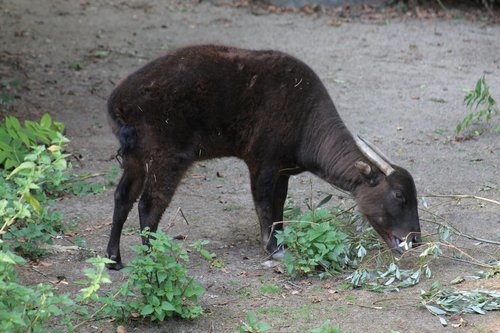
Dark brown to blackish coat with short, coarse hair; white markings often present on legs and face; small, backward-curving horns present in both sexes.
Size
Body length approximately 160-170 cm; shoulder height around 60-75 cm.
Weight
Typically weighs between 150-300 kg.
Distinctive features
Distinguished from the Mountain Anoa by its larger size, flatter horns, and different coat pattern; overall smaller and more solitary than other wild buffalo species.
Differences between males and females
Males are generally larger and have thicker, longer horns than females, though the difference is moderate.
Behaviour and diet of the Lowland Anoa
Mostly solitary or found in small family groups; not highly social, with limited interaction outside of breeding and maternal care.
When it is active
Primarily active during early morning and late afternoon (crepuscular), resting in dense cover during the heat of the day.
Diet
Herbivorous, feeding on grasses, leaves, fruits, and aquatic plants found in forest and wetland areas.
Communication
Communicates through vocal grunts, snorts, and body postures; scent marking may also play a role in territory and mate signaling.
Interactions with other species
Few natural predators remain due to loss of large carnivores in Sulawesi; humans are the primary threat through hunting and habitat destruction.
Role in its ecosystem
As a large herbivore, the Anoa plays a role in vegetation control and seed dispersal within Sulawesi's forest ecosystems.
Reproduction and lifecycle
Breeding can occur year-round with no strict seasonality; gestation lasts about 275-315 days, typically resulting in a single calf.
Raising the young
Calves are cared for exclusively by the mother, who nurses and protects them until weaning at several months of age.
Maturity and lifespan
Reaches sexual maturity around 2-3 years of age; lifespan can reach up to 20-30 years in captivity, shorter in the wild.
Taxonomy and naming of the Lowland Anoa
Classification
Mammalia > Artiodactyla > Bovidae > Bubalus > Bubalus depressicornis
Scientific synonyms
Anoa depressicornis; Bubalus (Anoa) depressicornis
What research says
Recent studies
Recent camera-trap surveys have provided updated population estimates and highlighted critical remaining habitat fragments requiring urgent protection.
Genome and DNA
Limited genetic studies exist; karyotype studies suggest close relation to other Bubalus species with distinct chromosomal differences from domestic buffalo.
Compared with similar species
Closely related to the Mountain Anoa (Bubalus quarlesi), but the Lowland Anoa is larger, inhabits lower elevations, and has slightly different horn shape and coat coloration.
The Lowland Anoa and people
The Lowland Anoa is sometimes called a 'dwarf buffalo' due to its small size; it is one of the few wild cattle species that willingly submerges itself in water and mud daily; despite being a bovid, its solitary nature is unusual among wild cattle.
Where and how to see it
Best observed in protected reserves like Bogani Nani Wartabone National Park during early morning hours; sightings are rare due to the species' shy and elusive nature.
Risks to humans
No notable risk to humans under normal circumstances, though wild individuals can act defensively if cornered.
Human uses
Historically hunted for meat and horns by local communities; now primarily of conservation and ecotourism interest rather than commercial use.
Myths and legends
In some local Sulawesi cultures, the Anoa is regarded as a symbol of the island's unique wilderness and is occasionally depicted in traditional art and folklore.
Countries where the Lowland Anoa is recorded
The 1 countries named in the range description of its IUCN Red List assessment.
Questions about the Lowland Anoa
Where does the Lowland Anoa live?
The Lowland Anoa is recorded in Indonesia across Asia. These countries come from the range description of its IUCN Red List assessment, and they are what place the species on the interactive map.
Is the Lowland Anoa endangered?
Yes. The IUCN Red List assesses the Lowland Anoa as Endangered, one of the three threatened categories. The species faces a very high risk of extinction in the wild — a step below Critically Endangered, but still on a trajectory that ends badly without intervention.
How many are left in the wild?
Population estimated at a few thousand individuals, with a continuing declining trend. This figure comes from the species assessment on the IUCN Red List; population estimates for wild mammals are ranges, not counts, and are revised at each assessment.
What habitat does the Lowland Anoa live in?
Lowland tropical rainforest, swampy forest, and dense vegetation near water sources; prefers undisturbed primary forest with thick understory for cover.
What is the scientific name of the Lowland Anoa?
The Lowland Anoa is Bubalus depressicornis, in the family Bovidae, order Artiodactyla.
Other species in the genus Bubalus
Other species in the family Bovidae
Species that share its range
Sources
Conservation status, range description and population estimate come from the IUCN Red List assessment for Bubalus depressicornis. Countries are derived from that range description, not from a mapped country list. Last refreshed on .
The distribution map is drawn from the IUCN Red List spatial data compiled in 2016. IUCN (International Union for Conservation of Nature)