
Markhor
Capra falconeri
Red List assessment
Near Threatenedon the IUCN Red List
- EXExtinct
- EWExtinct in the Wild
- CRCritically Endangered
- ENEndangered
- VUVulnerable
- NTNear Threatened
- LCLeast Concern
The Markhor is recorded in 5 countries across Asia. The IUCN Red List assesses the Markhor as Near Threatened. Approximately 5,700-6,000 mature individuals globally, with an increasing population trend attributed to effective conservation programs in Pakistan and Tajikistan.
- Family
- Bovidae
- Order
- Artiodactyla
- Genus
- Capra
- Countries recorded
- 5
- Continents
- Asia
- Red List category
- Near Threatened
- Data updated
- August 9, 2026
What is the Markhor?
The markhor is a large wild goat renowned for its spectacular spiraling horns, found in the rugged mountains of Central and South Asia. It is the national animal of Pakistan and a symbol of successful conservation through trophy hunting programs. Highly adapted to steep, rocky terrain, it is one of the most striking members of the goat family. Once critically endangered, its population has rebounded significantly in recent decades.
Where does the Markhor live?
Central Asia and the Himalayas, primarily Pakistan, Afghanistan, Tajikistan, and Uzbekistan, with small populations in India
Found across the Hindu Kush, Karakoram, and western Himalayan mountain ranges, spanning northern Pakistan, Afghanistan, Tajikistan, southern Uzbekistan, and small border areas of India (Jammu and Kashmir).
Altitude and depth
600-3600 meters, with seasonal vertical migration between lower winter ranges and higher summer pastures
Seasonal movements
Markhor undertake altitudinal migrations, moving to lower elevations in winter to avoid deep snow and returning to higher pastures in summer for grazing.
Habitat of the Markhor
Markhor inhabit rugged mountainous terrain including open woodlands, scrubby hillsides, and steep rocky slopes, often near cliffs that provide escape from predators. They favor areas with juniper, oak, and pine forests interspersed with grassy patches.
Adaptations to its environment
Markhor have strong, agile legs and specialized hooves for gripping steep rocky terrain, enabling them to navigate cliffs to escape predators. Their thick winter coats insulate against cold mountain temperatures, and their coloration provides camouflage against rocky backgrounds.
Conservation status and numbers
Near Threatened (NT) according to IUCN, an improvement from previously Endangered status, due to successful community-based conservation and trophy hunting programs that have driven population recovery over the past two decades.
Estimated population
Approximately 5,700-6,000 mature individuals globally, with an increasing population trend attributed to effective conservation programs in Pakistan and Tajikistan.
What threatens the Markhor?
Illegal poaching for meat and horns, habitat loss from livestock grazing competition and human encroachment, and historical overhunting remain concerns, though these have diminished with conservation efforts.
Diseases and parasites
Susceptible to diseases transmitted from domestic livestock including foot-and-mouth disease and various parasitic infections such as gastrointestinal helminths and external parasites like ticks.
What is being done to protect it?
Community-based trophy hunting programs in Pakistan generate revenue for local conservation, protected areas like Chitral Gol National Park and Torghar Conservation Project have been established, and CITES Appendix I listing restricts international trade.
Recommended actions
Continued support for community-based conservation incentive programs, stricter anti-poaching enforcement, habitat corridor protection to prevent population fragmentation, and cross-border cooperation between range states.
What the Markhor looks like
Markhor have a shaggy coat that varies from reddish-grey in summer to a longer greyish-white coat in winter, with males developing a distinctive long beard and mane on the throat and chest. Their most notable feature is the massive corkscrew-shaped horns.
Size
Shoulder height 65-115 cm depending on subspecies and sex; body length 132-186 cm
Weight
Males 80-110 kg; females 32-50 kg, showing significant size dimorphism
Distinctive features
The dramatically spiraled, corkscrew-twisted horns distinguish markhor from all other wild goats, with horn shape varying by subspecies (tightly spiraled in Bukharan markhor versus more open, flaring spirals in Astor markhor).
Differences between males and females
Males are substantially larger than females, possess much longer and more elaborately spiraled horns (up to 160 cm versus 25-32 cm in females), and develop a prominent beard and neck mane that females lack.
Behaviour and diet of the Markhor
Markhor form small herds typically of 3-9 individuals, usually segregated by sex outside the breeding season, with adult males often solitary or in small bachelor groups except during the rut.
When it is active
Primarily diurnal, with peak activity during early morning and late afternoon, resting in shaded or sheltered areas during the heat of midday.
Diet
Herbivorous, grazing on grasses and herbaceous plants in summer and browsing on shrubs, leaves, and twigs in winter, including oak and pine foliage when other food is scarce.
Communication
Markhor communicate through visual displays including horn presentations and body posturing during dominance contests, along with scent marking and occasional vocalizations such as alarm snorts and bleats.
Interactions with other species
Natural predators include snow leopards, wolves, and lynx, which primarily target young or vulnerable individuals; markhor share habitat and sometimes compete for forage with domestic livestock and other wild ungulates like ibex.
Role in its ecosystem
As herbivorous grazers and browsers, markhor play a role in shaping mountain vegetation structure and serve as an important prey species supporting predator populations like the snow leopard in their ecosystem.
Reproduction and lifecycle
Breeding (rutting) season occurs from October to January, with males competing for access to females through horn-clashing displays. Gestation lasts about 135-170 days, typically resulting in one or two kids born in spring (April-June).
Raising the young
Females provide sole parental care, nursing and protecting kids for several months; kids are able to follow their mothers within days of birth and are weaned by around 5-6 months of age.
Maturity and lifespan
Sexual maturity is reached at 18 months to 2.5 years; lifespan in the wild is typically 10-13 years, while captive individuals can live up to 15 years or more.
Taxonomy and naming of the Markhor
Classification
Class Mammalia > Order Artiodactyla > Family Bovidae > Genus Capra > Species Capra falconeri
Subspecies
Several subspecies are recognized including C. f. falconeri (Astor markhor, northern Pakistan/India), C. f. cashmiriensis (Kashmir markhor, Pakistan/India), C. f. megaceros (Kabul markhor, Afghanistan/Pakistan), and C. f. heptneri (Bukharan markhor, Tajikistan/Uzbekistan/Turkmenistan).
Scientific synonyms
Capra megaceros; Aegoceros falconeri (historical usage)
What research says
Recent studies
Recent research has focused on genetic diversity assessments among fragmented subspecies populations and the effectiveness of community-based conservation hunting programs in driving population recovery in Pakistan.
Genome and DNA
Markhor have a diploid chromosome number of 2n=60, consistent with other Capra species, and genetic studies have been used to clarify subspecies boundaries and inform conservation management units.
Compared with similar species
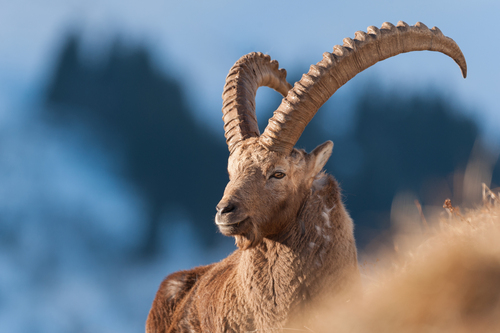
Unlike the Alpine ibex or Siberian ibex, which have backward-curving ridged horns, the markhor's horns twist in a distinctive open or tight corkscrew spiral; it is also generally larger and more robustly built than most other wild Capra species.
The Markhor and people
The markhor's name derives from Persian/Pashto words meaning 'snake-eater,' though it is not known to actually eat snakes. It is the national animal of Pakistan and features on national currency and emblems. Its horns can grow to over 1.6 meters in length, among the longest of any wild goat species.
Where and how to see it
Best observed in Pakistan's Chitral Gol National Park, Torghar Hills, or Kargah Wildlife Sanctuary during early morning or late afternoon in autumn through spring when they descend to lower elevations and are more visible.
Risks to humans
No notable risk to humans; markhor are shy, wary animals that avoid human contact and pose no direct threat.
Human uses
Markhor are hunted legally under regulated trophy hunting programs that generate significant revenue for local communities and conservation funding; historically also hunted for meat and their horns used in traditional decorative or ceremonial contexts.
Myths and legends
In local folklore across Central Asia, the markhor is sometimes believed to hunt and kill snakes, then produce a foam from its mouth that solidifies and can be used to extract snake venom from bite wounds, giving rise to its name.
Countries where the Markhor is recorded
The 5 countries named in the range description of its IUCN Red List assessment.
Questions about the Markhor
Where does the Markhor live?
The Markhor is recorded in Afghanistan, India, Pakistan, Tajikistan and Uzbekistan across Asia. These countries come from the range description of its IUCN Red List assessment, and they are what place the species on the interactive map.
Is the Markhor endangered?
The IUCN Red List assesses the Markhor as Near Threatened. The species does not qualify as threatened today, but it is close to the thresholds and likely to cross them soon. It is the category that most often changes at the next assessment.
How many are left in the wild?
Approximately 5,700-6,000 mature individuals globally, with an increasing population trend attributed to effective conservation programs in Pakistan and Tajikistan. This figure comes from the species assessment on the IUCN Red List; population estimates for wild mammals are ranges, not counts, and are revised at each assessment.
What habitat does the Markhor live in?
Markhor inhabit rugged mountainous terrain including open woodlands, scrubby hillsides, and steep rocky slopes, often near cliffs that provide escape from predators.
What is the scientific name of the Markhor?
The Markhor is Capra falconeri, in the family Bovidae, order Artiodactyla.
Other species in the genus Capra
Other species in the family Bovidae
Sources
Conservation status, range description and population estimate come from the IUCN Red List assessment for Capra falconeri. Countries are derived from that range description, not from a mapped country list. Last refreshed on .
The distribution map is drawn from the IUCN Red List spatial data compiled in 2015. IUCN (International Union for Conservation of Nature)