
Malayan Water Shrew
Chimarrogale hantu
Red List assessment
Near Threatenedon the IUCN Red List
- EXExtinct
- EWExtinct in the Wild
- CRCritically Endangered
- ENEndangered
- VUVulnerable
- NTNear Threatened
- LCLeast Concern
The Malayan Water Shrew is recorded in one country, Malaysia across Asia. The IUCN Red List assesses the Malayan Water Shrew as Near Threatened. No precise population estimate exists, but the species is considered uncommon and patchily distributed; the population trend is believed to be declining due to ongoing habitat loss in its limited range.
- Family
- Soricidae
- Order
- Eulipotyphla
- Genus
- Chimarrogale
- Countries recorded
- 1
- Continents
- Asia
- Red List category
- Near Threatened
- Data updated
- August 9, 2026
What is the Malayan Water Shrew?
The Malayan Water Shrew is a small, semi-aquatic insectivore endemic to the montane streams of Peninsular Malaysia. It is remarkable for its specialized adaptations to a freshwater lifestyle, a rarity among shrews, including dense water-repellent fur and fringed feet for swimming. This elusive species is rarely observed due to its nocturnal habits and restricted highland range. It plays an important role as a predator of aquatic invertebrates in pristine mountain stream ecosystems.
Where does the Malayan Water Shrew live?
Peninsular Malaysia, particularly the montane forest regions of the Titiwangsa Range including Cameron Highlands, Fraser's Hill, and Genting Highlands.
Endemic to Peninsular Malaysia, with records concentrated in the central mountain range (Titiwangsa Range) including Cameron Highlands, Fraser's Hill, and nearby highland forests. Its range is highly localized and fragmented compared to other Chimarrogale species found across Southeast Asia.
Altitude and depth
Typically found at elevations between 900 and 1800 meters above sea level, closely tied to montane stream systems.
Seasonal movements
No evidence of migration or hibernation; the species maintains year-round activity due to the relatively stable tropical highland climate, though breeding may peak during wetter monsoon periods.
Habitat of the Malayan Water Shrew
Found along clear, fast-flowing rocky streams within primary and secondary montane tropical rainforest. Prefers well-oxygenated, cool water bodies with abundant leaf litter and rocky substrate for foraging and shelter.
Adaptations to its environment
Possesses dense, water-repellent fur that traps air for insulation and buoyancy while swimming. Its feet have stiff fringes of hair that increase surface area for efficient paddling, and its small eyes and sensitive whiskers aid navigation in fast-flowing, often turbid water.
Conservation status and numbers
Classified as Near Threatened (NT) by the IUCN due to its restricted range and reliance on pristine montane stream habitats that are increasingly threatened by deforestation and agricultural encroachment in the Cameron Highlands region.
Estimated population
No precise population estimate exists, but the species is considered uncommon and patchily distributed; the population trend is believed to be declining due to ongoing habitat loss in its limited range.
What threatens the Malayan Water Shrew?
Habitat degradation from deforestation, agricultural expansion (particularly vegetable and tea plantations), stream pollution from pesticide runoff, and increased sedimentation affecting stream water quality are the primary threats.
What is being done to protect it?
Some populations occur within protected areas such as forest reserves in the Cameron Highlands, but targeted conservation programs specifically for this species are lacking. General forest protection laws in Malaysia offer indirect habitat safeguarding.
Recommended actions
Priority actions include stream habitat surveys to better delineate distribution, stricter enforcement of riparian buffer zones around agricultural areas, water quality monitoring, and inclusion of key stream habitats within formally protected reserves.
What the Malayan Water Shrew looks like
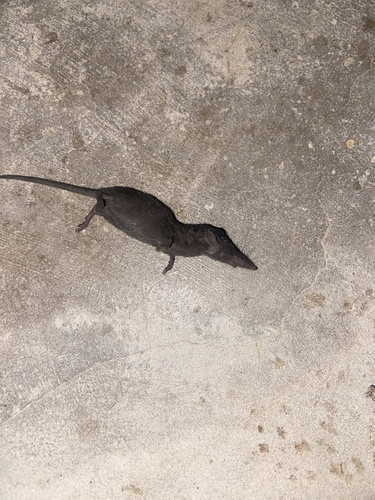
The fur is dense, soft, and dark grey to blackish-brown dorsally, with a paler, silvery-grey venter. The elongated, flexible snout is used for probing crevices, and the tail is well-furred, aiding in swimming stability.
Size
Head-body length approximately 70-90 mm, with a tail of similar or slightly greater length (70-100 mm), giving a total length of roughly 140-190 mm.
Weight
Estimated body weight ranges from 10 to 20 grams, consistent with other Chimarrogale species; no significant sexual size difference has been documented.
Distinctive features
Distinguished from other Chimarrogale species by subtle differences in skull morphology, dental characteristics, and fur coloration; genetic and morphometric analysis is often required for definitive identification in the field.
Behaviour and diet of the Malayan Water Shrew
Believed to be solitary and territorial, as is typical for most shrew species, with individuals occupying and defending stretches of stream habitat.
When it is active
Primarily nocturnal and crepuscular, foraging actively in and around streams during low-light hours to avoid predators and take advantage of aquatic invertebrate activity.
Diet
Carnivorous, feeding mainly on aquatic and semi-aquatic invertebrates such as insect larvae, small crustaceans, and worms found in and along stream beds.
How it feeds and hunts
Forages by diving and swimming along stream bottoms, using its sensitive whiskers and snout to detect prey hidden under rocks and in sediment, then capturing prey with quick bites.
Communication
Likely relies on high-frequency vocalizations, scent marking via specialized glands, and tactile whisker contact for navigation and possible mate or territory signaling, though specific studies are lacking.
Interactions with other species
Potential predators include larger carnivorous mammals, birds of prey, and snakes; competes with other small insectivorous mammals for stream-associated invertebrate prey.
Role in its ecosystem
Functions as a mid-level predator within montane stream ecosystems, helping regulate aquatic invertebrate populations and serving as an indicator species for stream water quality and forest health.
Reproduction and lifecycle
Reproductive biology is poorly documented, but likely follows the general shrew pattern with short gestation periods (around 3-4 weeks) and small litters of 2-4 young, possibly with multiple breeding events per year.
Raising the young
Presumed that females provide sole parental care, nursing and protecting young in a nest near the stream until weaning, based on patterns observed in related shrew species.
Maturity and lifespan
Specific data is lacking, but based on related shrew species, sexual maturity is likely reached within a few months, with a wild lifespan estimated at 1-2 years.
Taxonomy and naming of the Malayan Water Shrew
Classification
Class Mammalia > Order Eulipotyphla > Family Soricidae > Genus Chimarrogale > Species Chimarrogale hantu
Scientific synonyms
Previously considered a subspecies or synonym of Chimarrogale hantu Robinson & Kloss, 1911; some older literature grouped it under the broader Chimarrogale platycephala complex.
What research says
Recent studies
Recent taxonomic revisions using molecular phylogenetics have helped clarify the distinct species status of Chimarrogale hantu relative to other Southeast Asian water shrews, though field studies on ecology and behavior remain limited.
Compared with similar species
Closely related to other Chimarrogale species such as Chimarrogale phaeura and Chimarrogale sumatrana, but distinguished by geographic isolation in Peninsular Malaysia and subtle cranial differences; overall body plan and semi-aquatic adaptations are shared across the genus.
The Malayan Water Shrew and people
This shrew is one of the very few semi-aquatic mammals in Southeast Asia, essentially the ecological equivalent of otters in miniature. Its fur traps a layer of air underwater, giving it a silvery sheen when submerged, and it can navigate turbulent mountain streams entirely by touch using its whiskers.
Where and how to see it
Best observed at dusk or during night hours along clear, undisturbed mountain streams in the Cameron Highlands; patience and quiet stream-side observation with a red-filtered flashlight increase chances of a sighting, though encounters remain rare.
Risks to humans
No notable risk to humans; the species is shy, nocturnal, and avoids human contact.
Countries where the Malayan Water Shrew is recorded
The 1 countries named in the range description of its IUCN Red List assessment.
Questions about the Malayan Water Shrew
Where does the Malayan Water Shrew live?
The Malayan Water Shrew is recorded in Malaysia across Asia. These countries come from the range description of its IUCN Red List assessment, and they are what place the species on the interactive map.
Is the Malayan Water Shrew endangered?
The IUCN Red List assesses the Malayan Water Shrew as Near Threatened. The species does not qualify as threatened today, but it is close to the thresholds and likely to cross them soon. It is the category that most often changes at the next assessment.
How many are left in the wild?
No precise population estimate exists, but the species is considered uncommon and patchily distributed; the population trend is believed to be declining due to ongoing habitat loss in its limited range. This figure comes from the species assessment on the IUCN Red List; population estimates for wild mammals are ranges, not counts, and are revised at each assessment.
What habitat does the Malayan Water Shrew live in?
Found along clear, fast-flowing rocky streams within primary and secondary montane tropical rainforest.
What is the scientific name of the Malayan Water Shrew?
The Malayan Water Shrew is Chimarrogale hantu, in the family Soricidae, order Eulipotyphla.
Other species in the genus Chimarrogale


Other species in the family Soricidae



Species that share its range
Sources
Conservation status, range description and population estimate come from the IUCN Red List assessment for Chimarrogale hantu. Countries are derived from that range description, not from a mapped country list. Last refreshed on .
The distribution map is drawn from the IUCN Red List spatial data compiled in 2017. IUCN SSC Small Mammal Specialist Group