
Bornean Water Shrew
Chimarrogale phaeura
Red List assessment
Endangeredon the IUCN Red List
- EXExtinct
- EWExtinct in the Wild
- CRCritically Endangered
- ENEndangered
- VUVulnerable
- NTNear Threatened
- LCLeast Concern
The Bornean Water Shrew is recorded in 3 countries across Asia. The IUCN Red List assesses the Bornean Water Shrew as Endangered. No precise population estimate exists, but the population is considered small, fragmented, and declining due to continued habitat loss across its Bornean range.
- Family
- Soricidae
- Order
- Eulipotyphla
- Genus
- Chimarrogale
- Countries recorded
- 3
- Continents
- Asia
- Red List category
- Endangered
- Data updated
- August 9, 2026
What is the Bornean Water Shrew?
Chimarrogale phaeura, the Bornean Water Shrew, is a small semi-aquatic shrew endemic to the island of Borneo. It inhabits clear, fast-flowing montane and hill streams within primary tropical rainforest. Its remarkable adaptation to an aquatic lifestyle among shrews makes it a rare and specialized insectivore. As an endemic and habitat-restricted species, it is a useful indicator of freshwater ecosystem health in Bornean forests.
Where does the Bornean Water Shrew live?
Borneo (Malaysia, Indonesia, Brunei)
Endemic to the island of Borneo, with records from Sabah and Sarawak (Malaysia), Kalimantan (Indonesia), and possibly Brunei; distribution is patchy and tied to suitable forested stream habitats.
Altitude and depth
Approximately 300–1800 meters above sea level, mainly in hill and lower montane forest zones.
Habitat of the Bornean Water Shrew
Found along clear, fast-flowing rocky streams and rivers within lowland to montane tropical rainforest; requires well-oxygenated, unpolluted water and dense riparian vegetation cover.
Adaptations to its environment
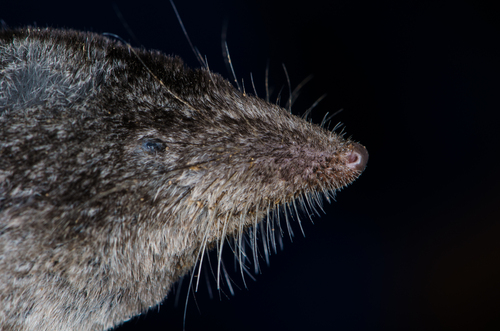
Possesses dense, water-repellent fur that traps air for insulation and buoyancy, along with fringed feet and tail that aid swimming and diving. Its small eyes and sensitive whiskers (vibrissae) help it navigate and locate prey in fast-moving, turbid water.
Conservation status and numbers
Classified as Endangered (EN) by the IUCN due to its restricted range, habitat specificity, and ongoing decline in suitable stream habitat quality caused by deforestation and water pollution.
Estimated population
No precise population estimate exists, but the population is considered small, fragmented, and declining due to continued habitat loss across its Bornean range.
What threatens the Bornean Water Shrew?
Primary threats include deforestation and logging (legal and illegal), oil palm plantation expansion, stream siltation, and water pollution from agricultural runoff and mining activities.
What is being done to protect it?
Some populations occur within protected areas such as national parks and forest reserves in Sabah and Sarawak; broader Bornean rainforest conservation initiatives indirectly benefit this species.
Recommended actions
Recommended actions include protecting riparian forest buffers, expanding protected stream habitats, monitoring water quality, and conducting further surveys to clarify distribution and population status.
What the Bornean Water Shrew looks like
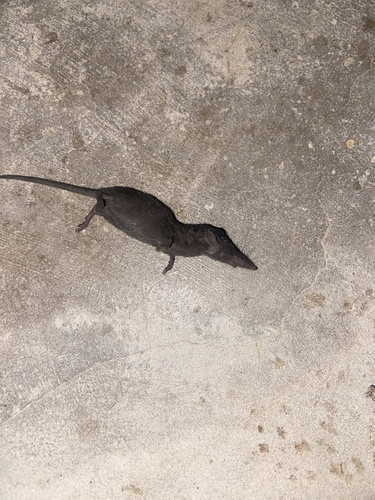
The fur is dense, soft, and dark brownish-grey to almost black (‘phaeura’ meaning dusky), with a slightly paler underside. The tail and hind feet bear stiff fringing hairs that assist in swimming.
Size
Head-body length approximately 70–90 mm, with a tail of similar or slightly shorter length (about 60–80 mm).
Weight
Estimated body weight around 15–35 grams, though precise data are limited.
Distinctive features
Distinguished from other Chimarrogale species by its darker, more uniformly blackish-brown pelage and specific skull and dental characteristics; endemic to Borneo unlike more widespread congeners.
Behaviour and diet of the Bornean Water Shrew
Believed to be solitary and territorial, as is typical for most shrews, with limited direct social interaction outside of mating encounters.
When it is active
Primarily nocturnal and crepuscular, foraging along stream banks and in the water during low-light hours to avoid predators and reduce competition.
Diet
Carnivorous insectivore feeding mainly on aquatic invertebrates such as insect larvae, crustaceans, and small fish or amphibians found in and near streams.
How it feeds and hunts
Hunts by diving and swimming in fast-flowing streams, using tactile whiskers and possibly echolocation-like water pressure sensing to detect prey among rocks and debris.
Communication
Likely relies on scent marking and ultrasonic or high-pitched vocalizations typical of shrews, alongside tactile communication via whiskers in aquatic environments.
Interactions with other species
Potential predators include larger carnivorous mammals, snakes, and birds of prey; may compete with other small aquatic insectivores for stream invertebrate resources.
Role in its ecosystem
Plays a role as a specialized predator of aquatic invertebrates, helping regulate stream insect populations and serving as an indicator species for clean, undisturbed forest streams.
Reproduction and lifecycle
Details of reproduction are poorly documented, but likely resembles other Chimarrogale species with multiple litters per year, short gestation periods, and small litter sizes typical of soricid shrews.
Raising the young
Presumed maternal care only, with females raising altricial young in a nest near the stream until weaning, though specific data for this species are lacking.
Maturity and lifespan
Specific data are lacking, but based on related shrews, sexual maturity is likely reached within a few months, with a wild lifespan of around 1–2 years.
Taxonomy and naming of the Bornean Water Shrew
Classification
Class Mammalia > Order Eulipotyphla > Family Soricidae > Genus Chimarrogale > Species Chimarrogale phaeura
Scientific synonyms
Crossogale phaeura; sometimes previously grouped under Chimarrogale platycephala
What research says
Recent studies
Recent taxonomic reviews of Bornean Chimarrogale species have refined species boundaries using morphological and limited molecular data, though comprehensive genetic studies remain scarce.
Compared with similar species
Similar to other Southeast Asian water shrews like Chimarrogale platycephala and Chimarrogale hantu, but distinguished by darker fur coloration and Bornean endemism.
The Bornean Water Shrew and people
This shrew is one of the very few semi-aquatic mammals adapted to fast mountain streams in Borneo; its water-repellent fur allows it to dive and swim almost like a miniature otter, and it is so rarely observed that much of its biology remains a mystery to science.
Where and how to see it
Best observed at dusk or night along clear, undisturbed forest streams in Sabah's highland reserves such as Crocker Range or Kinabalu Park, requiring patience and quiet observation near rocky stream banks.
Risks to humans
No notable risk to humans.
Countries where the Bornean Water Shrew is recorded
The 3 countries named in the range description of its IUCN Red List assessment.
Questions about the Bornean Water Shrew
Where does the Bornean Water Shrew live?
The Bornean Water Shrew is recorded in Brunei, Indonesia and Malaysia across Asia. These countries come from the range description of its IUCN Red List assessment, and they are what place the species on the interactive map.
Is the Bornean Water Shrew endangered?
Yes. The IUCN Red List assesses the Bornean Water Shrew as Endangered, one of the three threatened categories. The species faces a very high risk of extinction in the wild — a step below Critically Endangered, but still on a trajectory that ends badly without intervention.
How many are left in the wild?
No precise population estimate exists, but the population is considered small, fragmented, and declining due to continued habitat loss across its Bornean range. This figure comes from the species assessment on the IUCN Red List; population estimates for wild mammals are ranges, not counts, and are revised at each assessment.
What habitat does the Bornean Water Shrew live in?
Found along clear, fast-flowing rocky streams and rivers within lowland to montane tropical rainforest; requires well-oxygenated, unpolluted water and dense riparian vegetation cover.
What is the scientific name of the Bornean Water Shrew?
The Bornean Water Shrew is Chimarrogale phaeura, in the family Soricidae, order Eulipotyphla.
Other species in the genus Chimarrogale


Other species in the family Soricidae



Species that share its range
Sources
Conservation status, range description and population estimate come from the IUCN Red List assessment for Chimarrogale phaeura. Countries are derived from that range description, not from a mapped country list. Last refreshed on .
The distribution map is drawn from the IUCN Red List spatial data compiled in 2008. IUCN (International Union for Conservation of Nature)