
Sumatran Water Shrew
Chimarrogale sumatrana
Red List assessment
Data Deficienton the IUCN Red List
- EXExtinct
- EWExtinct in the Wild
- CRCritically Endangered
- ENEndangered
- VUVulnerable
- NTNear Threatened
- LCLeast Concern
Data Deficient has no position on the scale above — it records the absence of an assessment, not a degree of risk.
The Sumatran Water Shrew is recorded in one country, Indonesia across Asia. The IUCN Red List records the Sumatran Water Shrew as Data Deficient. No reliable population estimate exists; the species is presumed rare based on scarcity of records, with an unknown but likely declining trend due to ongoing habitat loss in Sumatra.
- Family
- Soricidae
- Order
- Eulipotyphla
- Genus
- Chimarrogale
- Countries recorded
- 1
- Continents
- Asia
- Red List category
- Data Deficient
- Data updated
- August 9, 2026
What is the Sumatran Water Shrew?
The Sumatran Water Shrew is a small, semi-aquatic insectivore endemic to the mountainous streams of Sumatra, Indonesia. It belongs to the genus Chimarrogale, a group of specialized shrews adapted to fast-flowing freshwater habitats. Very little is known about its biology due to its rarity and the difficulty of studying it in remote montane forest streams. It is remarkable for being one of the few truly aquatic shrews in Southeast Asia.
Where does the Sumatran Water Shrew live?
Indonesia (Sumatra)
Endemic to the island of Sumatra, Indonesia, with records concentrated in the Barisan mountain range. Known localities are scattered and few, reflecting both its rarity and under-sampling. No populations are confirmed outside Sumatra.
Altitude and depth
Approximately 800-2000 meters above sea level, in upland stream habitats.
Habitat of the Sumatran Water Shrew
Found along clear, fast-flowing mountain streams and rivers within tropical montane rainforest. Requires well-oxygenated, cool water with rocky substrates for foraging and shelter. Dense riparian vegetation and undisturbed forest cover are essential for its survival.
Adaptations to its environment
Possesses dense, water-repellent fur and fringed feet/toes that aid in swimming and diving in swift currents. Its elongated, sensitive snout helps detect aquatic invertebrate prey by touch in turbid or fast water. A streamlined body shape reduces drag while foraging underwater.
Conservation status and numbers
Classified as Data Deficient (DD) by the IUCN due to extremely limited information on its population size, distribution, and ecological requirements. Its restricted range and habitat specialization suggest it could be vulnerable, but insufficient data prevents a more precise assessment.
Estimated population
No reliable population estimate exists; the species is presumed rare based on scarcity of records, with an unknown but likely declining trend due to ongoing habitat loss in Sumatra.
What threatens the Sumatran Water Shrew?
Deforestation and land conversion for agriculture and plantations (palm oil, coffee) degrade riparian habitats. Water pollution and sedimentation from logging and mining reduce stream water quality essential for its prey base. Habitat fragmentation isolates populations along mountain streams.
What is being done to protect it?
No species-specific conservation programs are known to exist. Some individuals may occur within protected areas such as Kerinci Seblat and Gunung Leuser National Parks, which offer indirect habitat protection.
Recommended actions
Conduct systematic surveys to clarify distribution, population status, and habitat requirements. Protect and restore riparian forest corridors in the Barisan mountains, and monitor water quality in streams within its known range.
What the Sumatran Water Shrew looks like
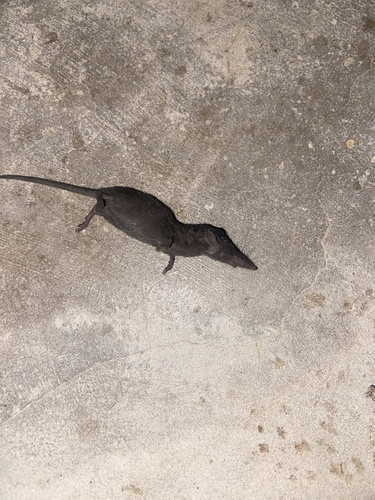
Dense, soft, dark brown to blackish dorsal fur with a paler, silvery-grey underside, typical of water shrews. Small eyes and ears are partially concealed within the fur, and the tail is thick and well-furred to aid swimming.
Size
Head-body length approximately 7-9 cm, with a tail of similar or slightly shorter length (6-8 cm).
Weight
Estimated 20-35 grams, based on related Chimarrogale species.
Distinctive features
Distinguished from other Chimarrogale species by subtle differences in skull morphology, dentition, and fur coloration, though field identification is difficult due to similarity with congeners like C. himalayica. Its restriction to Sumatra is a key distinguishing ecological trait.
Behaviour and diet of the Sumatran Water Shrew
Presumed solitary, as is typical for most shrew species, with individuals occupying and defending stretches of stream habitat. Direct behavioral observations are lacking.
When it is active
Likely primarily nocturnal or crepuscular, consistent with related water shrew species, though exact activity patterns for this species remain undocumented.
Diet
Carnivorous, feeding mainly on aquatic invertebrates such as insect larvae, small crustaceans, and worms found in stream sediments and under rocks. May also opportunistically take small fish or amphibian larvae.
How it feeds and hunts
Forages by diving and swimming in fast-flowing water, using its sensitive whiskers and snout to detect prey by touch among rocks and gravel. Hunting likely occurs mainly at night to avoid predators and reduce competition.
Communication
Likely relies on scent marking via specialized glands and tactile/vibrissal sensing, as vocal communication in shrews is generally limited to high-pitched squeaks for short-range interaction or distress.
Interactions with other species
Potential predators include owls, snakes, and carnivorous mammals inhabiting montane forests; may compete with other small insectivores and semi-aquatic species for stream invertebrate prey. Ecological interactions remain largely unstudied.
Role in its ecosystem
Functions as a specialized predator of aquatic invertebrates, helping regulate stream macroinvertebrate populations and serving as an indicator species for freshwater ecosystem health in montane Sumatran forests.
Reproduction and lifecycle
Breeding biology is poorly documented; related Chimarrogale species are thought to breed seasonally with litters of 2-4 young after a short gestation typical of small soricids (around 20-30 days).
Raising the young
Presumed maternal care only, as in other shrews, with the mother nursing and protecting the altricial young in a nest near the stream until weaning.
Maturity and lifespan
Unknown precisely, but likely reaches sexual maturity within a few months as in related shrews; lifespan in the wild is probably short, around 1-2 years, typical for small soricids.
Taxonomy and naming of the Sumatran Water Shrew
Classification
Mammalia > Eulipotyphla > Soricidae > Chimarrogale > Chimarrogale sumatrana
Scientific synonyms
Crossopus sumatranus; formerly sometimes considered a subspecies of Chimarrogale himalayica
What research says
Recent studies
Very few recent studies exist specifically on this species; most knowledge is extrapolated from broader taxonomic reviews of the genus Chimarrogale and regional biodiversity surveys in Sumatra.
Compared with similar species
Closely resembles the Himalayan water shrew (Chimarrogale himalayica) in general morphology and ecology but is geographically isolated on Sumatra and considered a distinct species based on morphological differences. It is generally smaller and more habitat-restricted than some mainland Asian congeners.
The Sumatran Water Shrew and people
It is one of the few truly semi-aquatic shrews in the world, adapted to hunting underwater in swift mountain streams. Despite being a mammal, it can dive and swim skillfully, an unusual trait among insectivores. Its extreme rarity means it has been recorded only a handful of times since its description.
Where and how to see it
Best observed, if at all, at night near clear, fast-flowing montane streams within Sumatra's Barisan range, such as in Kerinci Seblat National Park. Patience and specialized fieldwork techniques (live-trapping near streambanks) are required due to its elusive and rare nature.
Risks to humans
No notable risk to humans.
Countries where the Sumatran Water Shrew is recorded
The 1 countries named in the range description of its IUCN Red List assessment.
Questions about the Sumatran Water Shrew
Where does the Sumatran Water Shrew live?
The Sumatran Water Shrew is recorded in Indonesia across Asia. These countries come from the range description of its IUCN Red List assessment, and they are what place the species on the interactive map.
Is the Sumatran Water Shrew endangered?
The IUCN Red List assesses the Sumatran Water Shrew as Data Deficient. There is not enough information to judge the risk of extinction, usually because the species is rarely seen or has never been surveyed. It is not a reassuring category: several species were Data Deficient right up to the point they were found to be Critically Endangered.
How many are left in the wild?
No reliable population estimate exists; the species is presumed rare based on scarcity of records, with an unknown but likely declining trend due to ongoing habitat loss in Sumatra. This figure comes from the species assessment on the IUCN Red List; population estimates for wild mammals are ranges, not counts, and are revised at each assessment.
What habitat does the Sumatran Water Shrew live in?
Found along clear, fast-flowing mountain streams and rivers within tropical montane rainforest.
What is the scientific name of the Sumatran Water Shrew?
The Sumatran Water Shrew is Chimarrogale sumatrana, in the family Soricidae, order Eulipotyphla.
Other species in the genus Chimarrogale

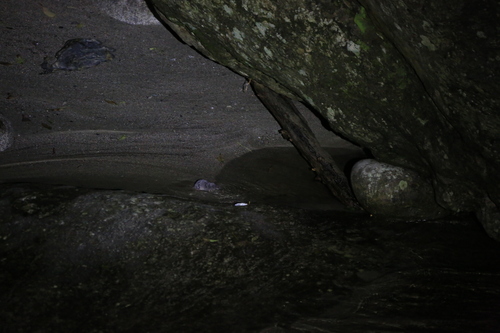
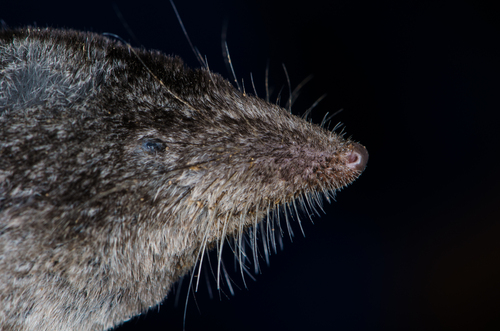
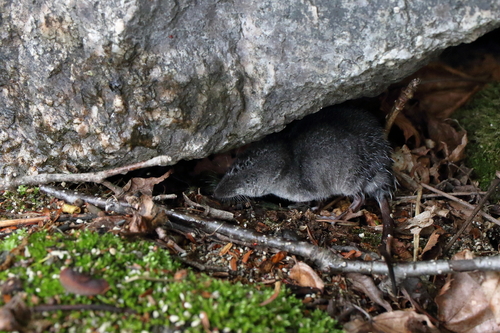

Other species in the family Soricidae
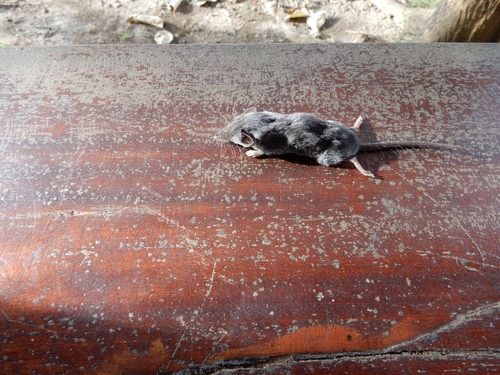



Species that share its range
Sources
Conservation status, range description and population estimate come from the IUCN Red List assessment for Chimarrogale sumatrana. Countries are derived from that range description, not from a mapped country list. Last refreshed on .
The distribution map is drawn from the IUCN Red List spatial data compiled in 2008. IUCN (International Union for Conservation of Nature)