
Louise's Spiny Mouse
Acomys louisae
Red List assessment
Least Concernon the IUCN Red List
- EXExtinct
- EWExtinct in the Wild
- CRCritically Endangered
- ENEndangered
- VUVulnerable
- NTNear Threatened
- LCLeast Concern
The Louise's Spiny Mouse is recorded in 3 countries across Africa. The IUCN Red List assesses the Louise's Spiny Mouse as Least Concern. No reliable global population estimate exists.
- Family
- Muridae
- Order
- Rodentia
- Genus
- Acomys
- Countries recorded
- 3
- Continents
- Africa
- Red List category
- Least Concern
- Data updated
- August 9, 2026
What is the Louise's Spiny Mouse?
Louise's Spiny Mouse is a small, arid-adapted rodent endemic to the Horn of Africa, particularly northern Somalia. Like all members of the genus Acomys, it is characterized by stiff, spine-like guard hairs on its dorsum, large eyes, and prominent ears suited to a nocturnal lifestyle. It inhabits rocky, semi-desert scrubland and is considered a remarkable member of a genus noted for unusual biological traits including exceptional skin regeneration. Its restricted range in a politically unstable region makes it one of the less-studied African spiny mice.
Where does the Louise's Spiny Mouse live?
Primarily found in northern Somalia (Somaliland region), with possible range extensions into adjacent areas of Djibouti and the Ogaden region of eastern Ethiopia.
The species is primarily known from northern Somalia (the Somaliland and Puntland regions), with records suggesting it may extend marginally into adjacent Djibouti and the Ogaden plateau of eastern Ethiopia. It is considered endemic to the Horn of Africa subregion.
Altitude and depth
Typically found from near sea level up to approximately 1500 m, often in rocky escarpments and upland semi-desert plateaus of northern Somalia.
Seasonal movements
No confirmed seasonal migration or hibernation is documented. Activity patterns may shift slightly with the bimodal rainfall seasons (Jilaal and Hagaa) of the Somali climate, potentially affecting food availability and reproductive timing.
Habitat of the Louise's Spiny Mouse
Arid and semi-arid rocky terrain, thorn scrub, and dry savanna with rocky outcrops. It is typically associated with stony hillsides, dry riverbeds (wadis), and acacia-dominated scrubland typical of the Somali-Masai arid zone.
Adaptations to its environment
Possesses stiff, spine-like dorsal hairs that may deter some predators. Large eyes and ears enhance nocturnal sensory perception. Like other Acomys species, it is physiologically adapted to minimize water loss in arid conditions, and the genus is noted for the ability to regenerate full-thickness skin wounds, a trait rare among mammals.
Conservation status and numbers
Least Concern (LC) on the IUCN Red List. The species is not considered to face immediate risk of extinction; its population is presumed relatively stable across its Somali range, though data are limited due to the difficulty of conducting surveys in the region.
Estimated population
No reliable global population estimate exists. The population trend is assumed stable or only slightly declining based on general habitat conditions across northern Somalia, but robust data are lacking.
What threatens the Louise's Spiny Mouse?
Habitat degradation through overgrazing by livestock, charcoal production causing woody scrub loss, and desertification driven by climate change are the principal threats. Political instability in Somalia limits conservation monitoring and enforcement.
Diseases and parasites
As with other Acomys species, it is susceptible to ectoparasites (fleas, ticks, mites) and endoparasites (helminths). Some Acomys species are known reservoirs for Leishmania and other zoonotic pathogens, though specific data for A. louisae are unavailable.
What is being done to protect it?
No species-specific conservation programs are known to target Acomys louisae. General protected areas in the Horn of Africa region, such as parts of the Lag Badana National Park in Somalia, may incidentally protect some habitat. It benefits nominally from CITES and national wildlife legislation.
Recommended actions
Priority actions include systematic field surveys to clarify the species' distribution and population status, habitat protection measures in northern Somalia, integration into national biodiversity action plans, and support for in-country research capacity in Somalia and Djibouti.
What the Louise's Spiny Mouse looks like
Dorsal fur is grayish-brown to sandy-brown with a distinctly spiny or bristly texture due to stiff, flattened guard hairs. The underparts are whitish to pale buff. It has a relatively long, scaly tail, large dark eyes, and large, naked-appearing rounded ears.
Size
Body length approximately 70–110 mm; tail length approximately 60–100 mm. A small, compact rodent typical of the genus Acomys.
Weight
Estimated body mass of approximately 20–50 g, consistent with other small Acomys species; sex-specific weight data for this species are not available.
Distinctive features
Distinguished from sympatric Acomys species (such as A. wilsoni or A. dimidiatus) by its specific combination of cranial measurements, fur coloration, and geographic range. Molecular and morphological analysis is often required for definitive identification.
Differences between males and females
Sexual dimorphism is minimal as in most Acomys species; males and females are similar in size and coloration. Females have multiple pairs of mammae for nursing litters.
Behaviour and diet of the Louise's Spiny Mouse
Likely semi-colonial or loosely social, consistent with other Acomys species that form small family groups or tolerate conspecifics in shared refugia such as rock crevices. Dominance hierarchies within small groups are probable.
When it is active
Primarily nocturnal, emerging after dusk to forage. During the hottest parts of the day, individuals shelter in rocky crevices, under boulders, or in burrows to avoid thermal stress.
Diet
Omnivorous, consuming seeds, dry plant material, insects, and other invertebrates. In arid environments, it also exploits succulent plant tissues as a water source, and will opportunistically take small invertebrates for protein.
How it feeds and hunts
Uses keen olfaction and large eyes to locate invertebrate prey and scattered seeds at night. Foraging is active and exploratory across rocky terrain, with food sometimes cached in sheltered refugia.
Communication
Uses ultrasonic and audible vocalizations for social interaction and alarm calls. Scent marking via urine and facial glands is used for territory and mate signaling. Tactile communication plays a role in social bonding within groups.
Interactions with other species
Predators likely include owls (e.g., Bubo species), small carnivores such as genets, and snakes. It may compete with other small granivorous rodents for seeds. As a seed consumer, it may play a minor role in seed dispersal in its arid ecosystem.
Role in its ecosystem
Functions as a small omnivore in the arid scrub food web, contributing to invertebrate population control and minor seed dispersal. It is prey for several nocturnal predators, making it a link between producer and predator trophic levels.
Reproduction and lifecycle
Breeding appears to occur year-round with peaks possibly linked to rainfall and food availability. Gestation is approximately 38–42 days (as in related species), with litters of 2–5 precocial young that are born relatively well-developed.
Raising the young
Young are born with eyes open or opening very shortly after birth, and are weaned within 3–4 weeks. Maternal care is the primary form of parental investment; communal nursing among related females may occur as in other Acomys species.
Maturity and lifespan
Sexual maturity is likely reached at 6–10 weeks of age, consistent with related Acomys species. Wild lifespan is probably 1–3 years; captive individuals of the genus can live up to 5–7 years.
Taxonomy and naming of the Louise's Spiny Mouse
Classification
Mammalia > Rodentia > Muridae (subfamily Deomyinae) > Acomys > Acomys louisae
Scientific synonyms
Described by Oldfield Thomas in 1896; no widely recognized senior synonyms are recorded, though historical literature sometimes placed it within broader Acomys groupings of East African spiny mice.
What research says
Recent studies
No recent high-profile studies specifically targeting Acomys louisae are known. General research on Acomys regeneration biology (particularly A. cahirinus and A. kempi) has renewed interest in the genus, but A. louisae remains poorly studied.
Genome and DNA
Chromosome number is not confirmed specifically for A. louisae; related Acomys species have karyotypes ranging from 2n=36 to 2n=68. No specific genomic studies have been published for this species.
Compared with similar species
Most closely related to other East African and Horn of Africa spiny mice such as Acomys wilsoni and Acomys percivali. It differs from the widespread A. cahirinus by its restricted Horn of Africa range and morphological features. All share the characteristic spiny dorsal pelage and arid-zone adaptations.
The Louise's Spiny Mouse and people
1) Members of the Acomys genus possess one of the most extraordinary regenerative abilities known in mammals — they can fully regenerate large patches of skin, including hair follicles, sweat glands, and cartilage, without scarring. 2) The 'spines' of spiny mice are not true quills but flattened, ribbed guard hairs that give the back a rigid, bristly texture. 3) Acomys young are among the most precocious of any murid rodent, born fully furred and mobile — a dramatic contrast to the blind, hairless young of most mice.
Where and how to see it
Best observed at night in rocky hillside habitats of northern Somalia (Somaliland), particularly around Hargeisa, Berbera, and the Golis Mountains. Use of red-light torches near rock outcrops and dry wadis after sunset offers the best chance of sighting. Access is currently challenging due to security conditions in the region.
Risks to humans
No notable risk. Like all wild rodents, it can bite if handled and may carry ectoparasites or zoonotic pathogens, but it poses no significant direct threat to humans.
Countries where the Louise's Spiny Mouse is recorded
The 3 countries named in the range description of its IUCN Red List assessment.
Questions about the Louise's Spiny Mouse
Where does the Louise's Spiny Mouse live?
The Louise's Spiny Mouse is recorded in Djibouti, Ethiopia and Somalia across Africa. These countries come from the range description of its IUCN Red List assessment, and they are what place the species on the interactive map.
Is the Louise's Spiny Mouse endangered?
The IUCN Red List assesses the Louise's Spiny Mouse as Least Concern. The species is widespread and abundant enough not to qualify for any threatened category. It does not mean the species is safe forever, only that nothing in the current data raises an alarm.
How many are left in the wild?
No reliable global population estimate exists. This figure comes from the species assessment on the IUCN Red List; population estimates for wild mammals are ranges, not counts, and are revised at each assessment.
What habitat does the Louise's Spiny Mouse live in?
Arid and semi-arid rocky terrain, thorn scrub, and dry savanna with rocky outcrops.
What is the scientific name of the Louise's Spiny Mouse?
The Louise's Spiny Mouse is Acomys louisae, in the family Muridae, order Rodentia.
Other species in the genus Acomys
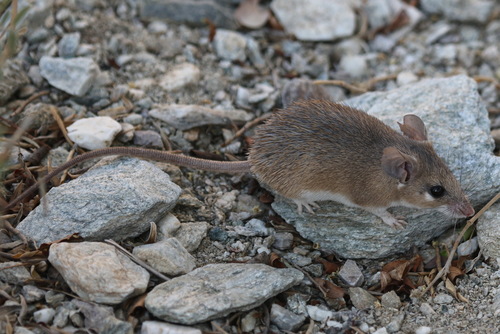
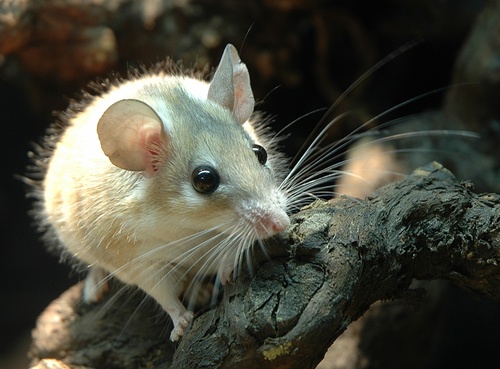
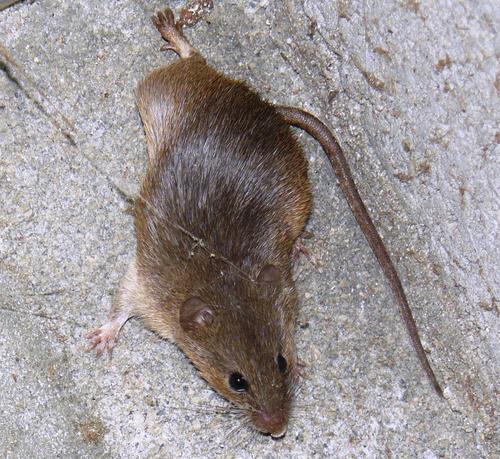
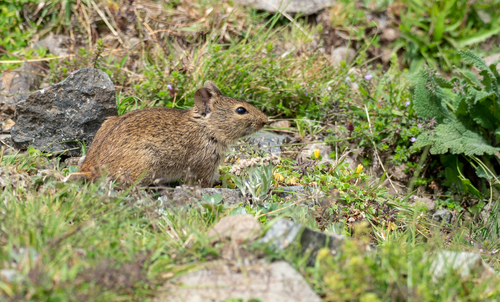
Other species in the family Muridae
Sources
Conservation status, range description and population estimate come from the IUCN Red List assessment for Acomys louisae. Countries are derived from that range description, not from a mapped country list. Last refreshed on .
The distribution map is drawn from the IUCN Red List spatial data compiled in 2008. IUCN (International Union for Conservation of Nature)