
Korean Field Mouse
Apodemus peninsulae
Red List assessment
Least Concernon the IUCN Red List
- EXExtinct
- EWExtinct in the Wild
- CRCritically Endangered
- ENEndangered
- VUVulnerable
- NTNear Threatened
- LCLeast Concern
The Korean Field Mouse is recorded in 5 countries across Asia and Europe. The IUCN Red List assesses the Korean Field Mouse as Least Concern. No precise global population estimate is available.
- Family
- Muridae
- Order
- Rodentia
- Genus
- Apodemus
- Countries recorded
- 5
- Continents
- Asia and Europe
- Red List category
- Least Concern
- Data updated
- August 9, 2026
What is the Korean Field Mouse?
The Korean Field Mouse (Apodemus peninsulae) is a medium-sized murid rodent first described by Oldfield Thomas in 1906 from specimens collected on the Korean Peninsula, hence its specific epithet. It is one of the most widespread and abundant small mammals across Siberia, the Russian Far East, Manchuria, and the Korean Peninsula, occupying a broad range of temperate and boreal habitats. It plays a critical ecological role as a seed disperser and prey species, forming a foundational link in northeastern Asian forest food webs. It is also of epidemiological significance as a documented reservoir host for hantaviruses in parts of its range.
Where does the Korean Field Mouse live?
Northeastern Asia, including Russia (Siberia, Russian Far East, Sakhalin Island), Mongolia, northeastern and northern China (Manchuria, Inner Mongolia), North and South Korea, and parts of Kazakhstan
Broadly distributed across northeastern Asia, from the eastern Ural Mountains through Siberia and the Russian Far East (including Primorsky Krai, Khabarovsk, and Sakhalin Island), across Mongolia, northeastern and northern China (Heilongjiang, Jilin, Liaoning, Inner Mongolia, Hebei), and throughout the Korean Peninsula (both North and South Korea). Marginal populations occur in eastern Kazakhstan.
Altitude and depth
Found from lowland plains and river valleys up to approximately 2500 m above sea level in mountainous regions of China and Korea. Most abundant between 200 and 1500 m elevation in forested zones.
Seasonal movements
Does not hibernate but significantly reduces surface activity during the coldest winter months. Breeding ceases in late autumn and resumes in early spring. Population density fluctuates markedly between years, often in synchrony with mast seeding events (acorn and pine cone crops), leading to pronounced boom-and-bust cycles.
Habitat of the Korean Field Mouse
Primarily inhabits mixed and deciduous forests, taiga, forest edges, shrubby areas, riverine woodlands, and montane meadows. Also found in agricultural borders, hedgerows, and woodland margins adjacent to human settlements. Prefers areas with dense ground cover and abundant mast-producing tree species such as oak, pine, and birch.
Adaptations to its environment
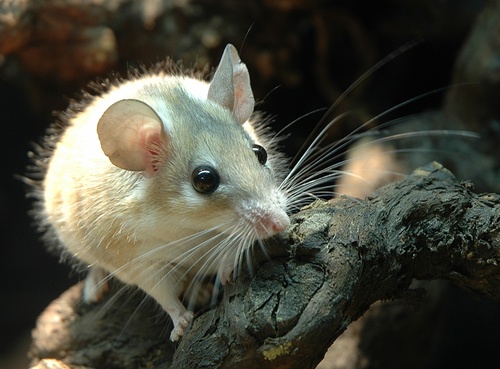
Large, highly mobile ears and prominent dark eyes are adapted for nocturnal predator detection and navigation. Food-caching behavior — storing seeds in underground burrows — enables survival through boreal winters with scarce surface resources. Its generalist diet and tolerance for disturbed habitats make it highly adaptable across a wide range of temperate and boreal environments.
Conservation status and numbers
Least Concern (LC) on the IUCN Red List. The species maintains a vast range across northeastern Asia with large, broadly stable populations and no documented range-wide decline. Local populations may fluctuate with habitat change, but no threshold for a threatened category has been reached.
Estimated population
No precise global population estimate is available. The species is considered abundant and widespread, with population densities varying considerably according to habitat quality and the annual seed crop. Overall trend is considered stable.
What threatens the Korean Field Mouse?
Deforestation and land conversion for agriculture, particularly in northeastern China and South Korea. Indiscriminate use of rodenticides in agricultural areas poses direct and indirect threats. Urbanization and fragmentation of forest habitats may reduce connectivity between local populations.
Diseases and parasites
Documented reservoir host for hantaviruses in northeastern Asia, including Amur virus (AMRV) and strains related to Hantaan virus, posing a zoonotic risk to humans. Carries ectoparasites including fleas (Siphonaptera), ixodid ticks (vectors of Borrelia, Rickettsia, and Anaplasma), and mites. Internal helminths (nematodes, cestodes) are commonly recorded. Also implicated as a host in the transmission cycle of tick-borne encephalitis virus.
What is being done to protect it?
Not specifically targeted by dedicated conservation programs due to its Least Concern status. Benefits indirectly from protected areas across its range, including Sikhote-Alin Biosphere Reserve and Kedrovaya Pad Nature Reserve (Russia), Changbaishan/Baekdu Mountain Nature Reserve (China/North Korea border), and several national parks in South Korea (e.g., Seoraksan, Jirisan).
Recommended actions
Implementation of long-term population monitoring to detect potential future declines. Reduction of indiscriminate rodenticide application in agricultural landscapes bordering forests. Maintenance and expansion of protected forest areas across Siberia, Manchuria, and the Korean Peninsula to preserve habitat connectivity.
What the Korean Field Mouse looks like
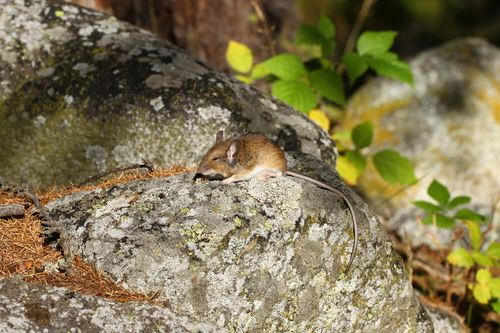
Dorsal fur is warm reddish-brown to yellowish-brown, sometimes with a faint buffy lateral line demarcating it from the pale underparts. Ventral fur is white to grayish-white. The tail is bicolored (brownish-grey above, paler below) and approximately equal to body length. Ears are large, prominent, and thinly haired; eyes are large and glossy black.
Size
Head-body length: 80–115 mm; tail length: 70–110 mm (approximately equal to or slightly shorter than body length); hind foot length: 18–23 mm; ear length: 14–18 mm.
Weight
Typically 15–35 grams. Adults average approximately 20–28 g; individuals may be heavier in autumn due to pre-winter fat accumulation.
Distinctive features
Lacks the bold dark dorsal stripe of the Striped Field Mouse (Apodemus agrarius), which is sympatric over much of its range. Larger and more robustly built than the Pygmy Field Mouse (Apodemus uralensis). The combination of reddish-brown dorsal coloration, lack of dorsal stripe, relatively large body size, and long bicolored tail distinguishes it from co-occurring Apodemus species.
Differences between males and females
Minimal. Males and females are very similar in size and coloration, though males may average marginally heavier. No significant secondary sexual characters are present.
Behaviour and diet of the Korean Field Mouse
Primarily solitary outside the breeding season. Home ranges overlap considerably, particularly at high population densities, but aggressive interactions between individuals are relatively infrequent. No fixed social hierarchy or permanent group structure has been documented.
When it is active
Predominantly nocturnal, with peak foraging activity occurring during the first several hours after dusk. Some crepuscular activity is observed. Remains active year-round but restricts surface movements during extreme cold or deep snow cover.
Diet
Omnivorous with a strong granivorous tendency. Primary diet consists of seeds from trees (oak acorns, pine seeds, birch seeds) and shrubs, supplemented by berries, fungi, green plant material, and invertebrates (insects, larvae, earthworms). Invertebrate consumption increases in spring when seeds are scarce. Caches large quantities of seeds underground for winter use.
How it feeds and hunts
Forages primarily on the ground and in low vegetation, relying heavily on olfaction to detect buried seeds, fungi, and invertebrates. Actively excavates soil and leaf litter with its forepaws. Vibrissae aid navigation and object detection in low-light conditions. Pursues and captures invertebrates opportunistically.
Communication
Uses ultrasonic vocalizations during mating interactions and mother–pup communication. Scent marking with urine and secretions from flank glands conveys information on individual identity, sex, and reproductive status. Body postures and tactile signals are used during close-range encounters.
Interactions with other species
Major prey item for numerous predators including Ural and Tawny owls (Strix uralensis, S. aluco), Long-eared and Short-eared owls, red fox (Vulpes vulpes), Siberian weasel (Mustela sibirica), sable (Martes zibellina), and various snake species. Competes for food and microhabitat with sympatric rodents including Apodemus agrarius, Myodes (Clethrionomys) voles, and Microtus species. Inadvertently promotes forest regeneration through seed dispersal when cached seeds are not recovered.
Role in its ecosystem
Forms a critical link in boreal and temperate forest food webs as an abundant primary consumer and prey species for a wide range of carnivores. Its seed-caching and forgetting behavior makes it an important secondary seed disperser for many mast-producing tree species. Burrowing activity contributes to soil aeration and nutrient cycling.
Reproduction and lifecycle
Breeding season extends from March–April through October–November, pausing during the coldest winter months. Females produce 2–4 litters per year under favorable conditions. Gestation lasts approximately 18–25 days. Litter size ranges from 3 to 8 young, averaging around 5.
Raising the young
Young are born altricial — naked, blind, and helpless — in a grass-lined nest constructed in a burrow, under logs, or among dense roots. The female provides all parental care, nursing young for approximately 3 weeks until weaning. Males do not participate in rearing offspring. Juveniles disperse shortly after weaning.
Maturity and lifespan
Sexual maturity is reached at approximately 2–3 months of age, allowing rapid population increase during favorable seasons. In the wild, lifespan rarely exceeds 12–18 months due to high predation and environmental mortality. In captivity, individuals may survive 2–3 years.
Taxonomy and naming of the Korean Field Mouse
Classification
Mammalia > Rodentia > Muridae > Apodemus > Apodemus peninsulae
Subspecies
Several subspecies are recognized: A. p. peninsulae (Thomas, 1906) – Korean Peninsula and Manchuria; A. p. giliacus (Thomas, 1907) – Sakhalin Island; A. p. praetor (Miller, 1914) – northeastern China and adjacent Russian Far East; A. p. sowerbyi (Thomas, 1908) – central and northern China. Taxonomy remains debated and additional forms may be recognized.
Scientific synonyms
Mus peninsulae Thomas, 1906 (original description); occasionally treated as a subspecies of Apodemus sylvaticus in older literature. Some synonymy exists with regional forms previously described under different names.
What research says
Recent studies
Recent molecular phylogenetic analyses have confirmed the status of A. peninsulae as a species distinct from the European Wood Mouse (A. sylvaticus) and clarified its relationships to other Asian Apodemus species. Population genetic studies in China and Russia have documented strong geographic structuring linked to past glacial refugia. Ongoing epidemiological research continues to characterize its role as a hantavirus and tick-borne pathogen reservoir in northeastern Asia.
Genome and DNA
Diploid chromosome number is 2n = 48. Phylogeographic genetic studies have revealed substantial population structure across the species' range, with distinct genetic lineages corresponding to Siberian, Manchurian, Korean, and Sakhalin geographic regions, suggesting complex Pleistocene refugial history.
Compared with similar species
Ecologically analogous to the European Wood Mouse (Apodemus sylvaticus) and Yellow-necked Mouse (A. flavicollis), occupying a similar niche in Asian boreal and temperate forests. Distinguished from the co-occurring Striped Field Mouse (A. agrarius) by the absence of a dorsal stripe and its more strictly forest-associated habitat use. Smaller and more slender than the Large Japanese Field Mouse (A. speciosus) of Japan. Larger and more reddish than the Pygmy Field Mouse (A. uralensis), with which it is broadly sympatric in western parts of its range.
The Korean Field Mouse and people
During peak autumn mast years, a single Korean Field Mouse may cache hundreds of seeds per night, inadvertently acting as a tree-planter across the forest floor when caches are forgotten. Its populations can increase tenfold within a single season during oak or pine mast years, triggering cascading population booms in its predators. Despite its small size, it can leap distances exceeding 30 cm in a single bound when evading a predator.
Where and how to see it
Best observed at dusk and during the night along forest edges and woodland trails in Siberia, northeastern China, or the Korean Peninsula during late summer and autumn when populations peak. Live-trapping with Sherman or Longworth traps baited with sunflower seeds or rolled oats is the standard scientific survey method. In protected areas such as Sikhote-Alin Biosphere Reserve (Russia) or Seoraksan National Park (South Korea), patient observation at forest edges after dark using a dim red-light headlamp may yield sightings.
Risks to humans
Potential carrier of hantaviruses (Amur virus and related strains), transmissible to humans through inhalation of aerosolized dried urine, droppings, or saliva — a notable public health concern in endemic regions of eastern Russia and northeastern China. May also carry tick-borne pathogens via its tick load. Bites are possible if the animal is handled but the species is not aggressive. Standard precautions (gloves, face mask) are recommended when working in areas with rodent activity.
Human uses
Not commercially exploited for food or trade. Widely used as a study organism in ecological, population dynamics, and zoonotic disease research across northeastern Asia. Occasionally subject to localized rodent control in agricultural settings where it may damage stored grain or field crops.
Myths and legends
No myths or legends are specifically associated with Apodemus peninsulae. However, mice and rats hold broad cultural significance across East Asian traditions; in the Chinese and Korean zodiac, the Rat (mouse) is the first of the twelve animals, symbolizing intelligence, cunning, adaptability, and prosperity.
Countries where the Korean Field Mouse is recorded
The 5 countries named in the range description of its IUCN Red List assessment.
Questions about the Korean Field Mouse
Where does the Korean Field Mouse live?
The Korean Field Mouse is recorded in China, Kazakhstan, Mongolia, Russia and South Korea across Asia and Europe. These countries come from the range description of its IUCN Red List assessment, and they are what place the species on the interactive map.
Is the Korean Field Mouse endangered?
The IUCN Red List assesses the Korean Field Mouse as Least Concern. The species is widespread and abundant enough not to qualify for any threatened category. It does not mean the species is safe forever, only that nothing in the current data raises an alarm.
How many are left in the wild?
No precise global population estimate is available. This figure comes from the species assessment on the IUCN Red List; population estimates for wild mammals are ranges, not counts, and are revised at each assessment.
What habitat does the Korean Field Mouse live in?
Primarily inhabits mixed and deciduous forests, taiga, forest edges, shrubby areas, riverine woodlands, and montane meadows.
What is the scientific name of the Korean Field Mouse?
The Korean Field Mouse is Apodemus peninsulae, in the family Muridae, order Rodentia.
Other species in the genus Apodemus
Other species in the family Muridae
Sources
Conservation status, range description and population estimate come from the IUCN Red List assessment for Apodemus peninsulae. Countries are derived from that range description, not from a mapped country list. Last refreshed on .
The distribution map is drawn from the IUCN Red List spatial data compiled in 2008. IUCN (International Union for Conservation of Nature)