
Chevrier's Field Mouse
Apodemus chevrieri
Red List assessment
Least Concernon the IUCN Red List
- EXExtinct
- EWExtinct in the Wild
- CRCritically Endangered
- ENEndangered
- VUVulnerable
- NTNear Threatened
- LCLeast Concern
The Chevrier's Field Mouse is recorded in 2 countries across Asia. The IUCN Red List assesses the Chevrier's Field Mouse as Least Concern. No precise global population estimate is available.
- Family
- Muridae
- Order
- Rodentia
- Genus
- Apodemus
- Countries recorded
- 2
- Continents
- Asia
- Red List category
- Least Concern
- Data updated
- August 9, 2026
What is the Chevrier's Field Mouse?
Chevrier's Field Mouse is a small murid rodent endemic to the montane regions of southwestern and central China. It belongs to the diverse genus Apodemus, often called Old World field mice or wood mice, which are widespread across Eurasia. The species occupies forested hillsides and rocky scrubland, typically at mid to high elevations, where it plays a key role in seed dispersal and invertebrate regulation. It is named in honor of a French naturalist and represents one of several Apodemus species unique to the Chinese highlands.
Where does the Chevrier's Field Mouse live?
Southwestern and central China, primarily in Yunnan, Sichuan, Guizhou, Hubei, Hunan, and possibly adjacent provinces; may extend marginally into northern Myanmar.
Endemic to China, with confirmed records from Yunnan, Sichuan, Guizhou, Hubei, and Hunan provinces. Its range broadly covers the southwestern Chinese highlands and the eastern fringes of the Tibetan Plateau foothills. Marginal populations may occur in adjacent northern Myanmar.
Altitude and depth
Typically found between 800 and 3,500 m above sea level, with peak abundance in montane forest zones between 1,500 and 2,800 m.
Seasonal movements
No true hibernation is recorded; activity continues year-round, though foraging intensity may decrease during the coldest winter months. Breeding activity peaks in spring and summer in correlation with increased food availability.
Habitat of the Chevrier's Field Mouse
Primary habitats include montane broadleaf and mixed conifer-broadleaf forests, scrubby hillsides, rocky outcrops, and forest edges. It is also found in agricultural margins bordering upland forests and along stream banks with dense riparian vegetation.
Adaptations to its environment
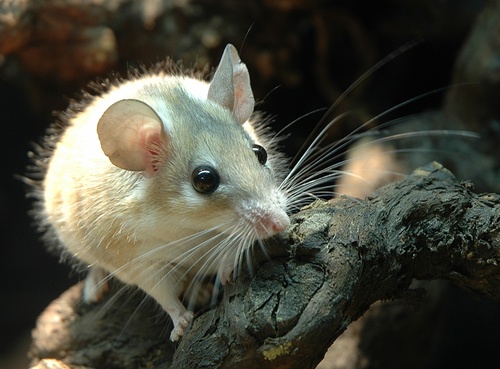
Large eyes and relatively large ears enhance sensitivity in low-light forest environments. Agile climbing ability allows exploitation of both ground-level and arboreal food resources. Dense fur provides insulation against cold montane temperatures, and food-caching behavior helps survive lean winter periods.
Conservation status and numbers
Least Concern (LC) on the IUCN Red List. The species has a relatively broad range within China, tolerates some habitat disturbance, and no major range-wide population decline has been documented that would warrant a more threatened category.
Estimated population
No precise global population estimate is available. The species is considered locally common within suitable habitat; population trend is assumed stable, though data are limited.
What threatens the Chevrier's Field Mouse?
Localized habitat loss due to agricultural expansion, logging, and conversion of montane forests at lower elevations. Intensification of land use in southwestern China may reduce connectivity between subpopulations. Rodenticide use in agricultural areas near forest edges poses a direct mortality risk.
Diseases and parasites
Like other Apodemus species, it likely serves as a host for ectoparasites (fleas, mites, ticks) and endoparasites (helminths, protozoa). Potential reservoir for hantaviruses and other rodent-borne pathogens, though specific disease data for this species are limited.
What is being done to protect it?
The species occurs within several protected areas in Yunnan and Sichuan, including nature reserves that protect montane forest ecosystems. China's broader biodiversity legislation and forest protection programs indirectly benefit the species. No targeted conservation program exists for this species specifically.
Recommended actions
Continued monitoring of population trends and distribution through standardized trapping surveys. Reduction of rodenticide use near forest-agricultural interfaces. Expansion and improved management of montane forest reserves in Yunnan and Sichuan.
What the Chevrier's Field Mouse looks like
Dorsal pelage is warm tawny-brown to reddish-brown, often with a slight ochre tint along the flanks. The ventral surface is pale grey-white to creamy white with a relatively distinct demarcation. The tail is bicolored (darker above, paler below), lightly haired, and scaly. Eyes are large and dark, and ears are moderately large and rounded.
Size
Head-body length approximately 80–110 mm; tail length approximately 85–115 mm (roughly equal to or slightly shorter than head-body length). Hind foot length around 20–24 mm.
Weight
Typically 15–30 g; sexual dimorphism in size is minimal, though males may average slightly heavier than females.
Distinctive features
Distinguished from the closely related Apodemus draco (South China Field Mouse) by a slightly more robust build, differences in molar morphology, and subtle differences in fur tone. Chromosome number and genetic markers provide the most reliable differentiation among sympatric Apodemus species in the region.
Differences between males and females
Sexual dimorphism is minimal. Males may be marginally larger and heavier on average, but the difference is not visually striking and there are no distinct color differences between sexes.
Behaviour and diet of the Chevrier's Field Mouse
Primarily solitary outside of the breeding season. Home ranges of individuals overlap modestly, and dominance hierarchies may develop among males competing for territories. Does not form stable social groups.
When it is active
Predominantly nocturnal, with peak activity shortly after dusk and before dawn. May occasionally be active during overcast days. Spends daylight hours in underground burrows or sheltered crevices among rocks and tree roots.
Diet
Omnivorous. Diet includes seeds, nuts, berries, fungi, roots, and a variety of invertebrates such as insects, earthworms, and insect larvae. Seed consumption increases in autumn when energy-rich resources are abundant, and the species engages in food caching to prepare for winter.
How it feeds and hunts
Forages opportunistically on the ground and in low vegetation, using whiskers and olfaction to locate food items under leaf litter. Invertebrates are detected by scent and sound and seized with the incisors. No complex predatory technique is employed.
Communication
Communicates via high-frequency ultrasonic vocalizations, particularly during social and mating interactions. Scent marking using urine and scent glands is critical for territory demarcation and mate attraction. Tactile signals and body postures are used during close-range interactions.
Interactions with other species
Predated upon by owls (e.g., Strix species), weasels, martens, foxes, and snakes. Competes for food resources with other sympatric small rodents such as Apodemus draco and various Myodes voles. Acts as an important seed disperser and prey item within montane food webs.
Role in its ecosystem
Functions as a primary consumer and an important link in montane food webs, channeling energy from plant matter and invertebrates to higher predators. Contributes to seed dispersal and possibly mycorrhizal fungal spore dispersal through consumption of hypogeous fungi.
Reproduction and lifecycle
Breeding occurs primarily from spring through early autumn (approximately March to October), with peak reproductive activity in spring and summer. Gestation lasts approximately 19–21 days. Litter size typically ranges from 3 to 7 pups, and females may produce multiple litters per year.
Raising the young
The female is the primary caregiver, nursing and protecting the altricial young in a grass-lined nest within a burrow or rock crevice. Pups are weaned at approximately 18–21 days. Males do not typically participate in direct parental care.
Maturity and lifespan
Sexual maturity is reached at approximately 6–8 weeks of age in females and slightly later in males. Wild lifespan is typically 12–18 months due to high predation pressure; captive individuals may live up to 3 years.
Taxonomy and naming of the Chevrier's Field Mouse
Classification
Mammalia > Rodentia > Muridae > Apodemus > Apodemus chevrieri. First described by Milne-Edwards in 1868.
Scientific synonyms
Mus chevrieri Milne-Edwards, 1868. Sometimes listed under older generic arrangements before the genus Apodemus was broadly applied to Asian species.
What research says
Recent studies
Molecular phylogenetic studies of Chinese Apodemus have helped clarify the distinctiveness of A. chevrieri from neighboring species. Recent biogeographic analyses suggest the southwestern Chinese highlands served as a refugium shaping diversification within the genus during Pleistocene climatic oscillations.
Genome and DNA
Chromosome number is not definitively published for this species specifically; related Apodemus species typically have diploid counts of 2n=48. Phylogenomic studies have been used to clarify relationships among Asian Apodemus species, placing chevrieri within the draco species group.
Compared with similar species
Closely related to Apodemus draco (South China Field Mouse) and Apodemus latronum (Large-eared Field Mouse), all occurring in southwestern China. Distinguished from the European A. sylvaticus by its more restricted montane range, slightly warmer dorsal coloration, and genetic divergence. Compared to A. draco, chevrieri tends to occupy somewhat higher altitudes and has subtle morphological differences in skull and molar structure.
The Chevrier's Field Mouse and people
Despite its small size, Chevrier's Field Mouse can cache thousands of seeds in scattered locations, inadvertently planting future trees and contributing to forest regeneration. Like many Apodemus species, it is capable of gnawing through surprisingly hard nut shells to extract energy-rich kernels. The genus Apodemus contains over 20 species across Eurasia, making it one of the most species-rich small mammal genera on the continent.
Where and how to see it
Best observed at dusk and nighttime in montane forest habitats of Yunnan and Sichuan provinces, China, using red-filtered headlamps to minimize disturbance. Live-trapping surveys along forest trails at elevations above 1,500 m during spring and autumn yield the highest encounter rates. Nature reserves such as those in the Hengduan Mountains region provide accessible habitat.
Risks to humans
No notable risk to humans under normal circumstances. As with any wild rodent, it may carry ectoparasites or zoonotic pathogens, so handling wild-caught individuals without proper protective equipment is inadvisable.
Countries where the Chevrier's Field Mouse is recorded
The 2 countries named in the range description of its IUCN Red List assessment.
Questions about the Chevrier's Field Mouse
Where does the Chevrier's Field Mouse live?
The Chevrier's Field Mouse is recorded in China and Myanmar across Asia. These countries come from the range description of its IUCN Red List assessment, and they are what place the species on the interactive map.
Is the Chevrier's Field Mouse endangered?
The IUCN Red List assesses the Chevrier's Field Mouse as Least Concern. The species is widespread and abundant enough not to qualify for any threatened category. It does not mean the species is safe forever, only that nothing in the current data raises an alarm.
How many are left in the wild?
No precise global population estimate is available. This figure comes from the species assessment on the IUCN Red List; population estimates for wild mammals are ranges, not counts, and are revised at each assessment.
What habitat does the Chevrier's Field Mouse live in?
Primary habitats include montane broadleaf and mixed conifer-broadleaf forests, scrubby hillsides, rocky outcrops, and forest edges.
What is the scientific name of the Chevrier's Field Mouse?
The Chevrier's Field Mouse is Apodemus chevrieri, in the family Muridae, order Rodentia.
Other species in the genus Apodemus
Other species in the family Muridae
Sources
Conservation status, range description and population estimate come from the IUCN Red List assessment for Apodemus chevrieri. Countries are derived from that range description, not from a mapped country list. Last refreshed on .
The distribution map is drawn from the IUCN Red List spatial data compiled in 2008. IUCN (International Union for Conservation of Nature)