
Koopman's Porcupine
Coendou nycthemera
Red List assessment
Data Deficienton the IUCN Red List
- EXExtinct
- EWExtinct in the Wild
- CRCritically Endangered
- ENEndangered
- VUVulnerable
- NTNear Threatened
- LCLeast Concern
Data Deficient has no position on the scale above — it records the absence of an assessment, not a degree of risk.
The Koopman's Porcupine is recorded in one country, Brazil across South America. The IUCN Red List records the Koopman's Porcupine as Data Deficient. No reliable population estimate exists; the species is rarely recorded and its population trend is unknown
- Family
- Erethizontidae
- Order
- Rodentia
- Genus
- Coendou
- Countries recorded
- 1
- Continents
- South America
- Red List category
- Data Deficient
- Data updated
- August 9, 2026
What is the Koopman's Porcupine?
Koopman's Porcupine is a little-known species of prehensile-tailed porcupine endemic to the eastern Amazon rainforest of Brazil. It is arboreal, nocturnal, and covered in sharp quills for defense, using its long prehensile tail to navigate the forest canopy. Very little field data exists on this species, making it one of the more mysterious Neotropical porcupines. Its rarity and limited range have earned it a Data Deficient status from the IUCN.
Where does the Koopman's Porcupine live?
Brazil, restricted to the eastern Amazon Basin, primarily in the state of Pará
Endemic to a limited area of eastern Amazonia in Brazil, mainly within the state of Pará, with its range potentially extending into neighboring Maranhão.
Altitude and depth
Lowland tropical forest, typically below 500 meters elevation
Habitat of the Koopman's Porcupine
Primarily found in lowland tropical rainforest and humid forest habitats within the Amazon basin, favoring dense canopy cover for arboreal movement.
Adaptations to its environment
Possesses a prehensile tail and specialized grasping feet for climbing through dense forest canopy, along with sharp quills covering its body as a defense mechanism against predators. Nocturnal habits help it avoid daytime predators and extreme heat.
Conservation status and numbers
Listed as Data Deficient (DD) by the IUCN due to insufficient information on population size, distribution, and threats to accurately assess its conservation status.
Estimated population
No reliable population estimate exists; the species is rarely recorded and its population trend is unknown
What threatens the Koopman's Porcupine?
Habitat loss from deforestation for agriculture, cattle ranching, and logging in the Amazon basin is the primary suspected threat, though specific impacts on this species remain poorly documented.
What is being done to protect it?
No species-specific conservation programs are known to exist; general protection may occur incidentally through Brazilian Amazon protected areas and reserves within its range.
Recommended actions
Increased field surveys and taxonomic research to clarify distribution and population status, along with habitat protection measures within the Amazon basin to prevent further deforestation.
What the Koopman's Porcupine looks like
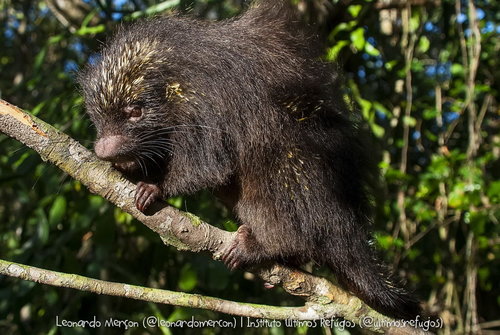
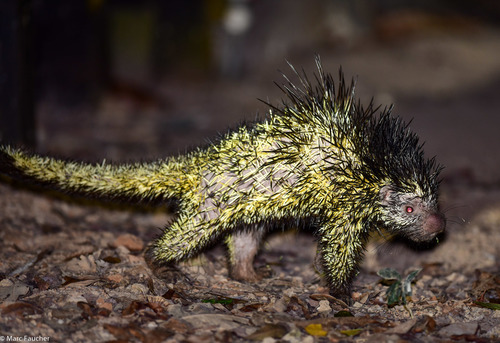
Covered in dense, sharp quills that are typically pale or yellowish with dark tips, giving a speckled appearance. The body is compact and rounded, with a long, scaly, prehensile tail lacking quills near the tip for better grip.
Size
Body length approximately 30-45 cm, with a prehensile tail of similar or greater length
Weight
Estimated at 1-3 kg, based on related Coendou species
Distinctive features
Distinguished from closely related Coendou species primarily through subtle differences in quill coloration patterns and skull morphology identified through taxonomic studies.
Behaviour and diet of the Koopman's Porcupine
Believed to be largely solitary, as is typical for most prehensile-tailed porcupines, though details specific to this species are lacking.
When it is active
Nocturnal, active during the night and resting in tree cavities or dense foliage during the day
Diet
Herbivorous, likely feeding on leaves, fruits, bark, and buds found in the forest canopy, similar to related porcupine species
Communication
Likely uses vocalizations, scent marking, and quill rattling for communication and defense, similar to related porcupine species, though specific studies are lacking.
Interactions with other species
Potential predators include large raptors, felids such as jaguars and ocelots, and snakes, though quills provide significant defense against most threats.
Role in its ecosystem
Plays a role in seed dispersal and forest regeneration through its herbivorous diet, contributing to the ecological dynamics of the Amazon rainforest canopy.
Reproduction and lifecycle
Reproductive details are not well documented, but likely similar to related Coendou species with single offspring births after a gestation period of several months
Raising the young
Presumed to involve maternal care typical of porcupines, with the mother carrying and nursing a single offspring for an extended period before independence.
Maturity and lifespan
Specific data unavailable, but related Coendou species typically reach maturity within 1-2 years and can live up to 10-15 years in the wild
Taxonomy and naming of the Koopman's Porcupine
Classification
Mammalia > Rodentia > Erethizontidae > Coendou > Coendou nycthemera
Scientific synonyms
Previously classified under Coendou prehensilis or as a synonym within the Coendou vestitus complex before being recognized as a distinct species
What research says
Recent studies
Recent taxonomic revisions of the genus Coendou have helped clarify the species status of Coendou nycthemera, distinguishing it from morphologically similar relatives, though field studies remain scarce.
Compared with similar species
Closely resembles other Amazonian Coendou species such as Coendou prehensilis, but differs in quill coloration and certain cranial features identified through genetic and morphological analysis.
The Koopman's Porcupine and people
This species is so rarely observed that much of its biology remains a mystery to science. It belongs to a unique group of New World porcupines that, unlike Old World porcupines, are excellent climbers with grasping tails rather than ground-dwelling quill-rollers.
Where and how to see it
Due to its rarity and nocturnal, arboreal habits, observation opportunities are extremely limited; dedicated wildlife researchers in remote areas of Pará, Brazil, offer the best chance, though sightings are exceptionally uncommon.
Risks to humans
No notable risk to humans, though like other porcupines, its quills can cause injury if handled carelessly
Countries where the Koopman's Porcupine is recorded
The 1 countries named in the range description of its IUCN Red List assessment.
Questions about the Koopman's Porcupine
Where does the Koopman's Porcupine live?
The Koopman's Porcupine is recorded in Brazil across South America. These countries come from the range description of its IUCN Red List assessment, and they are what place the species on the interactive map.
Is the Koopman's Porcupine endangered?
The IUCN Red List assesses the Koopman's Porcupine as Data Deficient. There is not enough information to judge the risk of extinction, usually because the species is rarely seen or has never been surveyed. It is not a reassuring category: several species were Data Deficient right up to the point they were found to be Critically Endangered.
How many are left in the wild?
No reliable population estimate exists; the species is rarely recorded and its population trend is unknown This figure comes from the species assessment on the IUCN Red List; population estimates for wild mammals are ranges, not counts, and are revised at each assessment.
What habitat does the Koopman's Porcupine live in?
Primarily found in lowland tropical rainforest and humid forest habitats within the Amazon basin, favoring dense canopy cover for arboreal movement.
What is the scientific name of the Koopman's Porcupine?
The Koopman's Porcupine is Coendou nycthemera, in the family Erethizontidae, order Rodentia.
Other species in the genus Coendou
Other species in the family Erethizontidae
Species that share its range
Sources
Conservation status, range description and population estimate come from the IUCN Red List assessment for Coendou nycthemera. Countries are derived from that range description, not from a mapped country list. Last refreshed on .
The distribution map is drawn from the IUCN Red List spatial data compiled in 2008. IUCN (International Union for Conservation of Nature)