
Kashmir Field Mouse
Apodemus rusiges
Red List assessment
Least Concernon the IUCN Red List
- EXExtinct
- EWExtinct in the Wild
- CRCritically Endangered
- ENEndangered
- VUVulnerable
- NTNear Threatened
- LCLeast Concern
The Kashmir Field Mouse is recorded in 2 countries across Asia. The IUCN Red List assesses the Kashmir Field Mouse as Least Concern. No precise global population estimate is available.
- Family
- Muridae
- Order
- Rodentia
- Genus
- Apodemus
- Countries recorded
- 2
- Continents
- Asia
- Red List category
- Least Concern
- Data updated
- August 9, 2026
What is the Kashmir Field Mouse?
The Kashmir Field Mouse (Apodemus rusiges) is a small murid rodent endemic to the high-altitude Himalayan and Karakoram landscapes of the Kashmir region. Like other members of the genus Apodemus, it is a nimble, terrestrial field mouse occupying rocky and scrubby mountain habitats. It represents one of the few Apodemus species adapted to the extreme conditions of the western Himalayas. Its restricted range and specialized habitat make it a notable component of high-altitude South Asian small mammal communities.
Where does the Kashmir Field Mouse live?
Indian subcontinent, primarily the Kashmir Valley and Ladakh region of northern India, with possible presence in adjacent areas of Pakistan-administered Kashmir.
Primarily distributed across the Kashmir Valley and Ladakh in the Union Territory of Jammu & Kashmir and Ladakh, India. Its range may extend into adjacent high-altitude zones of Pakistan (Azad Kashmir, Gilgit-Baltistan), though precise boundary data are limited.
Altitude and depth
Typically found between approximately 1,500 m and 4,000 m above sea level, with peak occurrence in subalpine and alpine zones of the western Himalayas.
Seasonal movements
Likely does not undergo true hibernation but may show reduced surface activity during the harshest winter months. Breeding activity is expected to peak in spring and summer when food resources are most abundant.
Habitat of the Kashmir Field Mouse
Rocky montane scrubland, alpine meadows, shrubby hillsides, and the margins of cultivated land at high altitudes. It is often associated with boulder fields, stone walls, and areas with dense ground cover that provide shelter from predators and harsh weather.
Adaptations to its environment
Compact, robust body form typical of high-altitude small mammals helps minimize heat loss. Dense, insulating fur provides protection against cold temperatures. Its generalist omnivorous diet allows exploitation of seasonally variable food sources in mountain environments.
Conservation status and numbers
Least Concern (LC) on the IUCN Red List. The species is not considered threatened at present due to a presumably adequate and stable population within its native range, absence of major documented population declines, and continued presence in suitable habitat.
Estimated population
No precise global population estimate is available. The population trend is presumed stable based on current IUCN assessment, though detailed surveys are lacking.
What threatens the Kashmir Field Mouse?
Habitat degradation through overgrazing by livestock, agricultural expansion, and potential impacts of climate change causing shifts in alpine vegetation zones. Human disturbance near settlements may locally reduce populations.
Diseases and parasites
Like other Apodemus species, likely hosts ectoparasites (fleas, mites, ticks) and endoparasites (helminths, protozoans). May serve as a reservoir for tick-borne diseases, though specific studies on A. rusiges are lacking.
What is being done to protect it?
The species benefits indirectly from protected areas within its range, such as Hemis National Park and Dachigam National Park in Ladakh and Kashmir. No species-specific conservation programs are known to exist.
Recommended actions
Comprehensive field surveys to refine distribution and population data; monitoring of habitat quality in key alpine zones; assessment of climate change impacts on high-altitude small mammal communities; inclusion in regional biodiversity monitoring programs.
What the Kashmir Field Mouse looks like
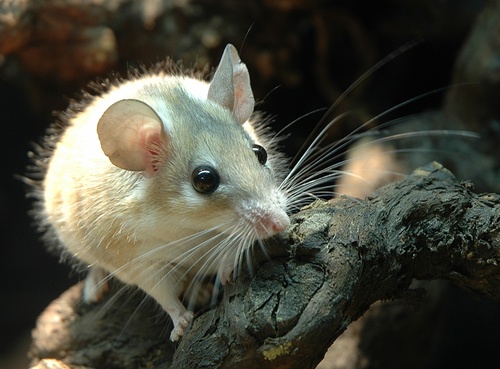
Dorsal pelage is typically warm brown to sandy-brown with a slightly darker mid-dorsal stripe; ventral surface is paler, often whitish or cream. Large, rounded ears, prominent dark eyes, and a relatively long, sparsely haired, bicolored tail are characteristic.
Size
Body length approximately 80–110 mm; tail length approximately 70–100 mm, typically slightly shorter than or equal to body length.
Weight
Estimated body mass between 15 and 35 g, consistent with other Apodemus species of similar size; no significant documented sexual size dimorphism in weight.
Distinctive features
Distinguished from other regional Apodemus species (such as A. pallipes or A. gurkha) by its specific combination of body proportions, fur coloration, and cranial morphology. Precise field identification often requires skull or genetic analysis.
Differences between males and females
Minimal sexual dimorphism; males and females are similar in size and coloration, as is typical for the genus Apodemus.
Behaviour and diet of the Kashmir Field Mouse
Presumed to be largely solitary outside of the breeding season, as is typical for most Apodemus field mice. Individuals may share overlapping home ranges but are generally not gregarious.
When it is active
Primarily nocturnal and crepuscular, with most foraging activity occurring after dusk. Like other Apodemus, it may occasionally be active during daylight hours, especially in summer.
Diet
Omnivorous; diet likely includes seeds, grain, plant material (roots, stems, berries), invertebrates (insects, larvae, worms), and possibly small amounts of fungal material. Diet composition shifts seasonally with resource availability.
How it feeds and hunts
Forages opportunistically on the ground and among rocks, using its sensitive whiskers and keen olfaction to locate food items. May cache seeds and other food for use during periods of scarcity.
Communication
Uses ultrasonic vocalizations for intraspecific communication, especially during mating and mother-pup interactions. Scent marking with urine and glandular secretions is used to delineate home ranges and convey reproductive status.
Interactions with other species
Prey for a variety of avian (owls, raptors) and mammalian (weasels, foxes, small carnivores) predators. May compete with other small rodent species such as Mus and Rattus for food resources near human settlements. Potentially a seed disperser for local plant species.
Role in its ecosystem
Functions as a mid-level consumer in high-altitude ecosystems, cycling nutrients and potentially dispersing seeds. It is an important prey base for predators in Kashmir and Ladakh mountain communities.
Reproduction and lifecycle
Breeding season likely spans spring through late summer (approximately April to September), coinciding with warmer temperatures and peak food availability. Gestation period estimated at around 21–25 days, consistent with other Apodemus species.
Raising the young
Altricial young are born in a grass-lined nest concealed under rocks or in burrows. The female provides primary parental care, nursing and protecting the pups until weaning at approximately 3–4 weeks of age.
Maturity and lifespan
Sexual maturity is likely reached at 6–10 weeks of age, consistent with congeners. Wild lifespan is estimated at 1–2 years; captive individuals of related species can live up to 3–4 years.
Taxonomy and naming of the Kashmir Field Mouse
Classification
Mammalia > Rodentia > Muridae > Apodemus > Apodemus rusiges (Thomas, 1914)
Scientific synonyms
Described by Oldfield Thomas in 1914; sometimes historically treated as a subspecies or close relative of Apodemus pallipes. No widely accepted synonyms are currently in use.
What research says
Recent studies
No prominent recent genetic or ecological studies specifically focused on Apodemus rusiges are known; the species remains understudied relative to European Apodemus congeners.
Genome and DNA
No specific chromosome count or genomic studies are documented for A. rusiges. Related Apodemus species typically have a diploid number of 2n=48, but this has not been confirmed for this species.
Compared with similar species
Most closely related to other central and western Himalayan Apodemus species such as A. pallipes and A. gurkha. It shares general body plan and ecological niche with the well-studied European wood mouse (A. sylvaticus) but is adapted to significantly higher altitudes and harsher climates.
The Kashmir Field Mouse and people
Apodemus rusiges lives at altitudes where few other mouse species can survive, making it one of the highest-dwelling field mice in the western Himalayas. Like many Apodemus, it is capable of brief periods of torpor to conserve energy during cold spells. Its large eyes are an adaptation for excellent night vision, helping it navigate rocky terrain in near-darkness.
Where and how to see it
Best observed at dusk or after dark in rocky alpine meadows and scrubland of Ladakh and the Kashmir Valley, particularly around stone walls and boulder fields near streams. Areas within Hemis National Park or the Zanskar Valley offer suitable habitat. Use of live traps baited with seeds is the standard method for scientific surveys.
Risks to humans
No notable risk to humans. Like all wild rodents, it may carry ectoparasites that could theoretically transmit pathogens, so handling should be avoided without appropriate protective equipment.
Countries where the Kashmir Field Mouse is recorded
The 2 countries named in the range description of its IUCN Red List assessment.
Questions about the Kashmir Field Mouse
Where does the Kashmir Field Mouse live?
The Kashmir Field Mouse is recorded in India and Pakistan across Asia. These countries come from the range description of its IUCN Red List assessment, and they are what place the species on the interactive map.
Is the Kashmir Field Mouse endangered?
The IUCN Red List assesses the Kashmir Field Mouse as Least Concern. The species is widespread and abundant enough not to qualify for any threatened category. It does not mean the species is safe forever, only that nothing in the current data raises an alarm.
How many are left in the wild?
No precise global population estimate is available. This figure comes from the species assessment on the IUCN Red List; population estimates for wild mammals are ranges, not counts, and are revised at each assessment.
What habitat does the Kashmir Field Mouse live in?
Rocky montane scrubland, alpine meadows, shrubby hillsides, and the margins of cultivated land at high altitudes.
What is the scientific name of the Kashmir Field Mouse?
The Kashmir Field Mouse is Apodemus rusiges, in the family Muridae, order Rodentia.
Other species in the genus Apodemus
Other species in the family Muridae
Sources
Conservation status, range description and population estimate come from the IUCN Red List assessment for Apodemus rusiges. Countries are derived from that range description, not from a mapped country list. Last refreshed on .
The distribution map is drawn from the IUCN Red List spatial data compiled in 2008. IUCN (International Union for Conservation of Nature)