
Hotson's Brush-tailed Mouse
Calomyscus hotsoni
Red List assessment
Least Concernon the IUCN Red List
- EXExtinct
- EWExtinct in the Wild
- CRCritically Endangered
- ENEndangered
- VUVulnerable
- NTNear Threatened
- LCLeast Concern
The Hotson's Brush-tailed Mouse is recorded in 2 countries across Asia. The IUCN Red List assesses the Hotson's Brush-tailed Mouse as Least Concern. No precise population estimate exists; the species is considered locally common within suitable rocky habitat patches, with a presumed stable trend.
- Family
- Calomyscidae
- Order
- Rodentia
- Genus
- Calomyscus
- Countries recorded
- 2
- Continents
- Asia
- Red List category
- Least Concern
- Data updated
- August 9, 2026
What is the Hotson's Brush-tailed Mouse?
Hotson's Brush-tailed Mouse is a small, mouse-like hamster endemic to the arid mountainous regions of Balochistan, Pakistan. It belongs to the ancient and taxonomically distinct family Calomyscidae, sometimes called 'mouse-like hamsters' due to their hamster-like cheek pouches combined with a mouse-like body shape. The species is remarkable for its long, brush-tipped tail used for balance on rocky terrain, and for being one of the least-studied rodents in South Asia. It thrives in harsh, rocky desert habitats where few other small mammals can survive.
Where does the Hotson's Brush-tailed Mouse live?
Southwestern Pakistan (Balochistan province), with possible range extension into adjacent areas of southeastern Iran.
Endemic to the Balochistan region of southwestern Pakistan, with records concentrated in the Kalat and Chagai districts; some taxonomists suggest a possible range extension into bordering areas of Iran, though this remains unconfirmed.
Altitude and depth
Typically found at elevations between 1000 and 2500 meters in mountainous and hilly terrain.
Seasonal movements
No long-distance migration; the species likely reduces surface activity during the coldest winter months and driest peak summer periods, retreating to burrows and rock crevices for thermal buffering.
Habitat of the Hotson's Brush-tailed Mouse
Found in arid and semi-arid rocky habitats, including stony deserts, rocky outcrops, cliff bases, and sparsely vegetated hillsides with crevices for shelter. It avoids sandy or loose-soil areas, preferring hard substrates that provide stable burrow sites and protection from predators.
Adaptations to its environment
Possesses efficient kidneys for water conservation, allowing survival with minimal free water intake typical of arid-zone rodents. Its long tail aids balance while climbing rocky surfaces, and its cryptic sandy-brown coloration provides camouflage against the rocky desert substrate.
Conservation status and numbers
Listed as Least Concern (LC) by the IUCN, reflecting a presumably stable population within its restricted but suitable rocky habitat, though data remain sparse due to limited field surveys.
Estimated population
No precise population estimate exists; the species is considered locally common within suitable rocky habitat patches, with a presumed stable trend.
What threatens the Hotson's Brush-tailed Mouse?
Potential threats include habitat degradation from overgrazing by livestock, mining activities in Balochistan, and general aridification linked to climate change, though no major population declines have been documented.
What is being done to protect it?
No species-specific conservation programs are known; general habitat protections may occur incidentally through broader Balochistan wildlife reserves and protected areas, though few are specifically managed for small mammals.
Recommended actions
Recommended actions include conducting systematic population surveys across its known range, assessing habitat quality trends, and evaluating impacts of mining and grazing to ensure the species does not require future uplisting.
What the Hotson's Brush-tailed Mouse looks like
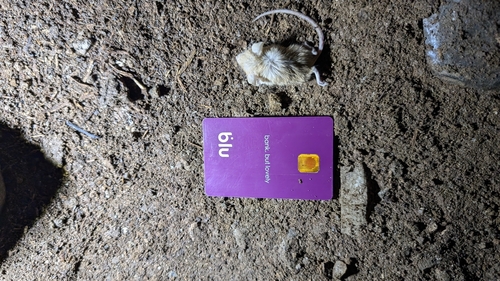
Soft, sandy-brown to grayish-brown dorsal fur contrasts with a whitish or pale gray underside. The tail is long, thin, and ends in a distinctive tuft of longer hairs, giving rise to the common name 'brush-tailed mouse'. Large eyes and prominent ears reflect its nocturnal lifestyle.
Size
Body length approximately 7-9 cm, with a tail of similar or slightly greater length (8-10 cm), giving a total length of roughly 15-19 cm.
Weight
Estimated body weight between 15 and 25 grams, typical for small calomyscid rodents.
Distinctive features
Distinguished from other Calomyscus species primarily through subtle cranial and dental morphology, as well as slight differences in pelage tone and tail proportions, features that historically caused it to be classified as a subspecies of C. bailwardi.
Differences between males and females
Minimal sexual dimorphism has been reported; males and females are similar in size and coloration, with only slight average size differences.
Behaviour and diet of the Hotson's Brush-tailed Mouse
Believed to be largely solitary or living in loose, low-density populations, consistent with other desert-adapted Calomyscus species that maintain individual burrow systems.
When it is active
Primarily nocturnal, emerging after dusk to forage and avoid the extreme daytime heat and visual predators of its open rocky habitat.
Diet
Omnivorous, feeding mainly on seeds, plant matter, and likely small invertebrates when available, typical of desert-dwelling calomyscid rodents.
Communication
Likely relies on scent marking and simple vocalizations for intraspecific communication, along with tactile and olfactory cues typical of small nocturnal rodents, though specific studies are lacking.
Interactions with other species
Preyed upon by nocturnal predators such as owls, foxes, and snakes native to the Balochistan region; may compete for resources with other small desert rodents sharing similar rocky habitats.
Role in its ecosystem
Plays a role in local desert ecosystems as a seed disperser and consumer of plant material, while also serving as prey supporting the local food web of nocturnal predators.
Reproduction and lifecycle
Details specific to this species are poorly documented, but related Calomyscus species typically breed during warmer months, with females producing small litters of 2-5 young after a gestation period of around 25-30 days.
Raising the young
Presumed maternal care similar to related rodents, with females nursing and sheltering young within burrows until weaning, after which juveniles disperse to establish their own territories.
Maturity and lifespan
Sexual maturity is likely reached within a few months, consistent with small desert rodents; lifespan in the wild is estimated at 1-3 years, potentially longer in captivity, though specific data are unavailable.
Taxonomy and naming of the Hotson's Brush-tailed Mouse
Classification
Class Mammalia > Order Rodentia > Family Calomyscidae > Genus Calomyscus > Species Calomyscus hotsoni
Scientific synonyms
Calomyscus bailwardi hotsoni (originally described as a subspecies of Calomyscus bailwardi before being elevated to full species status)
What research says
Recent studies
Recent taxonomic revisions using molecular data have refined the classification of the Calomyscus genus, supporting the recognition of C. hotsoni as a valid species distinct from its former parent taxon C. bailwardi.
Genome and DNA
Limited genetic studies exist; molecular phylogenetic work has helped clarify its status as a distinct species within Calomyscus, separate from C. bailwardi, based on mitochondrial DNA analysis.
Compared with similar species
Closely resembles other Calomyscus species such as C. bailwardi and C. baluchi, differing mainly in subtle skull morphology, dental characteristics, and pelage coloration rather than obvious external traits.
The Hotson's Brush-tailed Mouse and people
Despite being called a 'mouse', it is more closely related to hamsters than true mice. Its brush-tipped tail acts like a natural balancing pole, allowing it to navigate steep rocky slopes with remarkable agility.
Where and how to see it
Best observed at night using red-filtered flashlights in rocky hillside habitats of Balochistan's Kalat region during warmer, drier months when rodent activity peaks; patience and quiet movement are essential given its shy, nocturnal nature.
Risks to humans
No notable risk to humans; it is a small, harmless rodent with no significant history of disease transmission or aggressive behavior.
Countries where the Hotson's Brush-tailed Mouse is recorded
The 2 countries named in the range description of its IUCN Red List assessment.
Questions about the Hotson's Brush-tailed Mouse
Where does the Hotson's Brush-tailed Mouse live?
The Hotson's Brush-tailed Mouse is recorded in Iran and Pakistan across Asia. These countries come from the range description of its IUCN Red List assessment, and they are what place the species on the interactive map.
Is the Hotson's Brush-tailed Mouse endangered?
The IUCN Red List assesses the Hotson's Brush-tailed Mouse as Least Concern. The species is widespread and abundant enough not to qualify for any threatened category. It does not mean the species is safe forever, only that nothing in the current data raises an alarm.
How many are left in the wild?
No precise population estimate exists; the species is considered locally common within suitable rocky habitat patches, with a presumed stable trend. This figure comes from the species assessment on the IUCN Red List; population estimates for wild mammals are ranges, not counts, and are revised at each assessment.
What habitat does the Hotson's Brush-tailed Mouse live in?
Found in arid and semi-arid rocky habitats, including stony deserts, rocky outcrops, cliff bases, and sparsely vegetated hillsides with crevices for shelter.
What is the scientific name of the Hotson's Brush-tailed Mouse?
The Hotson's Brush-tailed Mouse is Calomyscus hotsoni, in the family Calomyscidae, order Rodentia.
Other species in the genus Calomyscus
Other species in the family Calomyscidae

Species that share its range
Sources
Conservation status, range description and population estimate come from the IUCN Red List assessment for Calomyscus hotsoni. Countries are derived from that range description, not from a mapped country list. Last refreshed on .
The distribution map is drawn from the IUCN Red List spatial data compiled in 2008. IUCN (International Union for Conservation of Nature)