
Baluchi Brush-tailed Mouse
Calomyscus baluchi
Red List assessment
Least Concernon the IUCN Red List
- EXExtinct
- EWExtinct in the Wild
- CRCritically Endangered
- ENEndangered
- VUVulnerable
- NTNear Threatened
- LCLeast Concern
The Baluchi Brush-tailed Mouse is recorded in 2 countries across Asia. The IUCN Red List assesses the Baluchi Brush-tailed Mouse as Least Concern. Population size unknown but presumed stable; no comprehensive population surveys have been conducted across its range
- Family
- Calomyscidae
- Order
- Rodentia
- Genus
- Calomyscus
- Countries recorded
- 2
- Continents
- Asia
- Red List category
- Least Concern
- Data updated
- August 9, 2026
What is the Baluchi Brush-tailed Mouse?
Calomyscus baluchi is a small nocturnal rodent belonging to the mouse-like hamster family Calomyscidae, endemic to the arid mountainous regions of Baluchistan spanning Iran and Pakistan. It is notable for its long, brush-tipped tail resembling that of a small squirrel, an unusual feature among rodents of its size. This species is adapted to rocky desert and semi-arid habitats and remains relatively understudied due to its remote range.
Where does the Baluchi Brush-tailed Mouse live?
Southeastern Iran and southwestern Pakistan, particularly the Baluchistan region
Found in southeastern Iran (Sistan and Baluchestan province) and southwestern Pakistan (Balochistan province), inhabiting the arid highlands and rocky terrain of this transboundary region.
Altitude and depth
Approximately 500-2000 meters above sea level
Seasonal movements
Likely reduces activity during the coldest winter months and hottest summer periods, though detailed seasonal behavioral data is limited for this species
Habitat of the Baluchi Brush-tailed Mouse
Rocky arid and semi-arid habitats, including stony deserts, rocky outcrops, cliffs, and scrubland with sparse vegetation. Often found in areas with crevices and boulder fields that provide shelter.
Adaptations to its environment
Possesses large eyes and ears adapted for nocturnal activity in low light, and a prehensile-like brush-tipped tail that aids balance when climbing rocky terrain. Efficient kidney function allows it to survive with minimal water intake, typical of desert-adapted rodents.
Conservation status and numbers
Listed as Least Concern by IUCN due to its relatively wide distribution across suitable rocky habitats in the region and no evidence of significant population decline, though data remains limited.
Estimated population
Population size unknown but presumed stable; no comprehensive population surveys have been conducted across its range
What threatens the Baluchi Brush-tailed Mouse?
Potential habitat degradation from overgrazing by livestock, mining activities, and human settlement expansion in parts of its range. Climate change affecting arid ecosystem dynamics could pose a longer-term concern.
What is being done to protect it?
No specific conservation programs target this species; it may receive incidental protection within any protected areas overlapping its range in Iran or Pakistan
Recommended actions
Conduct baseline population surveys and habitat assessments, monitor for range fragmentation due to mining or development, and include the species in regional biodiversity monitoring programs.
What the Baluchi Brush-tailed Mouse looks like
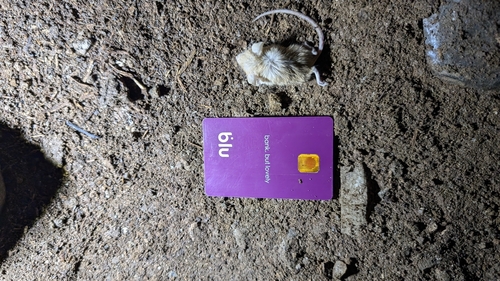
Soft grayish to sandy-brown fur on the dorsal side with a paler, whitish underside, typical of desert-dwelling rodents for camouflage. The tail is notably long with a distinctive tuft of longer hairs at the tip, giving it a brush-like appearance.
Size
Body length approximately 7-9 cm, with a tail length roughly equal to or slightly longer than the body, around 8-11 cm
Weight
Approximately 15-25 grams
Distinctive features
Distinguished from related Calomyscus species primarily through cranial and dental morphology as well as genetic markers, since external appearance is highly similar across the genus. The brush-tipped tail is a key generic feature shared with other Calomyscus species but the specific proportions and coloration help differentiate this species.
Differences between males and females
Minimal sexual dimorphism reported; males and females are similar in size and coloration
Behaviour and diet of the Baluchi Brush-tailed Mouse
Generally solitary, coming together only for mating; individuals maintain separate burrows or rock crevice shelters
When it is active
Strictly nocturnal, emerging after dusk to forage and returning to rocky shelters before dawn to avoid predators and daytime heat
Diet
Omnivorous, feeding primarily on seeds, plant matter, and likely supplementing with insects when available, consistent with other Calomyscus species
Communication
Likely uses ultrasonic vocalizations and scent marking for communication, as documented in related rodent species, though specific studies on this species are lacking
Interactions with other species
Preyed upon by nocturnal predators such as owls, foxes, and snakes native to the arid Baluchistan region; may compete with other small rodents for food resources
Role in its ecosystem
Plays a role in seed dispersal and serves as a prey base for small predators within its arid ecosystem, contributing to local food web dynamics
Reproduction and lifecycle
Breeding likely occurs in warmer months with litters of 2-5 young after a gestation period estimated around 25-30 days, based on data from related Calomyscus species
Raising the young
Females are presumed to be the primary caregivers, nursing and protecting young in a nest within rock crevices until weaning, typical of small rodent parental patterns
Maturity and lifespan
Sexual maturity likely reached within a few months, with a wild lifespan estimated at 2-3 years based on similar-sized rodents
Taxonomy and naming of the Baluchi Brush-tailed Mouse
Classification
Class Mammalia > Order Rodentia > Family Calomyscidae > Genus Calomyscus > Species Calomyscus baluchi
Scientific synonyms
Previously considered part of the Calomyscus bailwardi or Calomyscus mystax complex before taxonomic revision separated Baluchistan populations as a distinct species
What research says
Recent studies
Molecular phylogenetic studies in the early 2000s helped clarify species boundaries within the Calomyscus genus, leading to the recognition of C. baluchi as a distinct species separate from C. bailwardi and C. mystax
Compared with similar species
Closely resembles other Calomyscus species such as Calomyscus bailwardi and Calomyscus mystax in general appearance, with differentiation relying on molecular genetics and subtle cranial measurements rather than obvious external traits
The Baluchi Brush-tailed Mouse and people
Despite its mouse-like body, its brush-tipped tail gives it a superficial resemblance to a tiny squirrel. The genus name Calomyscus derives from Greek meaning beautiful mouse, referencing its delicate appearance.
Where and how to see it
Best observed at night using red-filtered flashlights in rocky desert terrain of Baluchistan, particularly in undisturbed rocky outcrops during cooler months when activity may be higher; patience and knowledge of local rock crevice habitats are essential.
Risks to humans
No notable risk
Countries where the Baluchi Brush-tailed Mouse is recorded
The 2 countries named in the range description of its IUCN Red List assessment.
Questions about the Baluchi Brush-tailed Mouse
Where does the Baluchi Brush-tailed Mouse live?
The Baluchi Brush-tailed Mouse is recorded in Iran and Pakistan across Asia. These countries come from the range description of its IUCN Red List assessment, and they are what place the species on the interactive map.
Is the Baluchi Brush-tailed Mouse endangered?
The IUCN Red List assesses the Baluchi Brush-tailed Mouse as Least Concern. The species is widespread and abundant enough not to qualify for any threatened category. It does not mean the species is safe forever, only that nothing in the current data raises an alarm.
How many are left in the wild?
Population size unknown but presumed stable; no comprehensive population surveys have been conducted across its range This figure comes from the species assessment on the IUCN Red List; population estimates for wild mammals are ranges, not counts, and are revised at each assessment.
What habitat does the Baluchi Brush-tailed Mouse live in?
Rocky arid and semi-arid habitats, including stony deserts, rocky outcrops, cliffs, and scrubland with sparse vegetation.
What is the scientific name of the Baluchi Brush-tailed Mouse?
The Baluchi Brush-tailed Mouse is Calomyscus baluchi, in the family Calomyscidae, order Rodentia.
Other species in the genus Calomyscus
Other species in the family Calomyscidae

Species that share its range
Sources
Conservation status, range description and population estimate come from the IUCN Red List assessment for Calomyscus baluchi. Countries are derived from that range description, not from a mapped country list. Last refreshed on .
The distribution map is drawn from the IUCN Red List spatial data compiled in 2008. IUCN (International Union for Conservation of Nature)