
Hyrcanian Field Mouse
Apodemus hyrcanicus
Red List assessment
Near Threatenedon the IUCN Red List
- EXExtinct
- EWExtinct in the Wild
- CRCritically Endangered
- ENEndangered
- VUVulnerable
- NTNear Threatened
- LCLeast Concern
The Hyrcanian Field Mouse is recorded in 2 countries across Asia. The IUCN Red List assesses the Hyrcanian Field Mouse as Near Threatened. No precise global population estimate is available.
- Family
- Muridae
- Order
- Rodentia
- Genus
- Apodemus
- Countries recorded
- 2
- Continents
- Asia
- Red List category
- Near Threatened
- Data updated
- August 9, 2026
What is the Hyrcanian Field Mouse?
The Hyrcanian Field Mouse is a small, semi-cryptic murid rodent endemic to the ancient Hyrcanian temperate forests fringing the southern Caspian Sea. It was formally recognized as a distinct species through karyotypic and molecular studies, distinguishing it from the closely related Ural Field Mouse (A. uralensis). It inhabits one of the world's most biodiverse and relict temperate forest ecosystems, a UNESCO World Heritage site. Its restricted range and dependence on intact forest cover make it a sentinel species for the health of Hyrcanian woodlands.
Where does the Hyrcanian Field Mouse live?
Northern Iran (Gilan, Mazandaran, and Golestan provinces) and possibly adjacent southeastern Azerbaijan, within the Hyrcanian biogeographic zone along the southern Caspian Sea coast.
Endemic to the Hyrcanian region: the narrow forested belt along the southern and southwestern Caspian coast, primarily in the Iranian provinces of Gilan, Mazandaran, and Golestan. Possibly extends into the Talysh Mountains of southeastern Azerbaijan. Its range is highly fragmented due to agricultural and urban encroachment.
Altitude and depth
Typically found from near sea level (~0 m) up to approximately 2,000 m in the Alborz foothills bordering the Caspian lowlands, following the altitudinal distribution of Hyrcanian forest cover.
Seasonal movements
No long-distance migrations documented. Activity likely decreases during cold winter months, with possible periods of reduced activity or torpor during the coldest periods, though true hibernation has not been confirmed. Breeding peaks in spring and early summer when food resources are most abundant.
Habitat of the Hyrcanian Field Mouse
Primarily dense Hyrcanian temperate deciduous and mixed forests dominated by oak (Quercus), hornbeam (Carpinus), beech (Fagus), and alder (Alnus). Also uses forest edges, shrubby undergrowth, and riparian gallery forests. It favors areas with abundant leaf litter, woody debris, and dense understory vegetation that provide cover and foraging substrate.
Adaptations to its environment
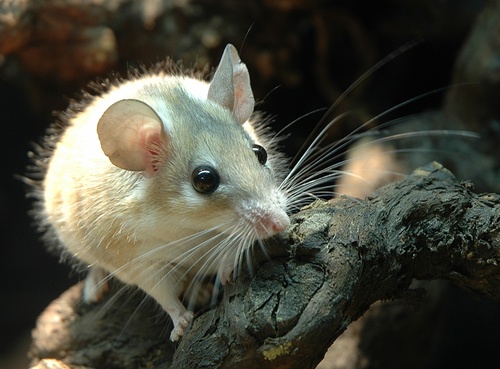
Well-adapted to the humid, densely forested Hyrcanian environment with large, prominent eyes suited for low-light conditions under the forest canopy. Its relatively large ears enhance auditory detection of predators among dense leaf litter. Strong hind limbs enable agile movement through complex forest floor microhabitats. Its omnivorous diet allows flexibility when seasonal food resources shift.
Conservation status and numbers
Near Threatened (NT) on the IUCN Red List. The species qualifies for NT due to its restricted range, dependence on an increasingly threatened forest ecosystem, and ongoing habitat loss. It does not yet meet the thresholds for Vulnerable status but warrants close monitoring given accelerating deforestation in the Hyrcanian region.
Estimated population
No precise global population estimate is available. The population trend is considered declining, correlating with the ongoing loss and degradation of Hyrcanian forest habitat, which has been reduced by an estimated 30–50% over recent decades.
What threatens the Hyrcanian Field Mouse?
The primary threat is habitat loss and fragmentation resulting from agricultural expansion, urban development, logging, and road construction within the Hyrcanian forests. Overgrazing by livestock degrades the forest understory. Climate change is altering precipitation patterns and forest composition in the Caspian lowlands, potentially reducing suitable habitat. Invasive species and rodenticide use in agricultural border zones also pose localized threats.
Diseases and parasites
Like other Apodemus species, likely hosts ectoparasites (fleas, ticks, mites) and endoparasites (helminths, protozoans). May serve as a reservoir for tick-borne pathogens and hantaviruses, as documented in related congeners, though species-specific studies are limited for A. hyrcanicus.
What is being done to protect it?
Parts of the species' range fall within protected areas including Golestan National Park, Miankaleh Wildlife Refuge, and several Iranian forest reserves. The Hyrcanian forests were inscribed as a UNESCO World Heritage Site in 2019, providing increased international attention to habitat conservation. Iranian national legislation offers general protections for biodiversity in forested reserves.
Recommended actions
Priority actions include expansion and improved management of protected areas within Hyrcanian forests, enforcement of logging restrictions, long-term population monitoring and distribution surveys, genetic diversity assessments to identify conservation units, and control of agricultural encroachment at forest margins. Community-based conservation initiatives engaging local populations are also recommended.
What the Hyrcanian Field Mouse looks like
Dorsal fur is medium brown to tawny-brown, often with a slightly reddish or yellowish hue, becoming paler and greyish-white on the ventral surface. The boundary between dorsal and ventral coloration is relatively distinct. The tail is bicolored (darker above, paler below), sparsely haired, and approximately as long as the body. Eyes are large and black; ears are relatively large and rounded.
Size
Body length approximately 75–105 mm; tail length approximately 70–100 mm (roughly equal to or slightly shorter than head-body length); hind foot length approximately 17–22 mm.
Weight
Typically 15–30 g; slight individual variation exists but pronounced sexual size dimorphism is not well documented in this species.
Distinctive features
Distinguished from the similar Apodemus uralensis by karyotypic differences (chromosome number and morphology) and molecular markers. Compared to A. flavicollis (Yellow-necked Mouse), it lacks the distinctive yellow chest patch. It is generally smaller than A. mystacinus (Rock Mouse). In the field, reliable identification from sympatric Apodemus species requires skull morphometrics or genetic analysis.
Differences between males and females
Sexual dimorphism is minimal in this species; males and females are similar in size and coloration, as is typical for most Apodemus species.
Behaviour and diet of the Hyrcanian Field Mouse
Largely solitary outside the breeding season, as typical of most Apodemus field mice. Brief social associations occur during mating. Males may have overlapping home ranges with females, while male territories are more exclusive. No complex social hierarchy is documented.
When it is active
Primarily nocturnal and crepuscular. Activity peaks in the hours following dusk and before dawn, with most foraging occurring during darkness to reduce predation risk from diurnal raptors.
Diet
Omnivorous; diet includes seeds (particularly of forest trees such as beech mast, acorns, and hornbeam), berries, fungi, green plant material, invertebrates (insects, worms, larvae), and occasionally small vertebrates. Diet composition shifts seasonally with resource availability.
How it feeds and hunts
Forages actively on the forest floor and in low vegetation, using its vibrissae and olfaction to detect food items under leaf litter and in soil crevices. Caches seeds in underground stores or concealed surface sites for use during winter. Opportunistically exploits invertebrates encountered during foraging movements.
Communication
Communicates via ultrasonic vocalizations during social interactions and mating, as well as audible squeaks when alarmed or handled. Scent marking with urine and secretions from specialized glands plays a key role in territory demarcation and mate attraction. Tactile signals are used during close-range interactions.
Interactions with other species
Predated upon by owls (especially Barn Owl Tyto alba and Tawny Owl Strix aluco), small mustelids (weasels, stone martens), foxes, and snakes within the Hyrcanian ecosystem. Competes with other small rodents (e.g., Myodes glareolus, other Apodemus species) for food and microhabitat. As a seed cacher, it may act as a dispersal agent for forest tree seeds, contributing to forest regeneration.
Role in its ecosystem
Functions as an important seed disperser and consumer in the Hyrcanian forest ecosystem, particularly for mast-producing trees. Serves as a key prey item for a range of mesopredators and raptors, linking primary production to higher trophic levels. Its burrowing activity contributes to soil aeration and nutrient cycling.
Reproduction and lifecycle
Breeding season is primarily spring through early autumn (approximately April–September), with peak reproduction in spring and early summer. Gestation lasts approximately 19–21 days. Litter size is typically 3–7 young. Multiple litters per year are possible under favorable conditions.
Raising the young
Altricial young are born hairless and blind in a nest of grass, moss, and plant fibers constructed in a burrow or under woody debris. The female provides primary parental care, nursing the young for approximately 3 weeks until weaning. Males do not typically participate in direct care of offspring.
Maturity and lifespan
Sexual maturity is typically reached at 6–8 weeks of age, as in related Apodemus species. Wild lifespan is generally less than 18 months due to high predation and environmental mortality. Captive individuals of related species can live up to 3 years.
Taxonomy and naming of the Hyrcanian Field Mouse
Classification
Mammalia > Rodentia > Muridae > Apodemus > Apodemus hyrcanicus
Scientific synonyms
Formerly considered conspecific with or closely related to Apodemus uralensis (Ural Field Mouse); some historical specimens were assigned to Apodemus sylvaticus or Apodemus flavicollis before genetic analyses confirmed hyrcanicus as a distinct species.
What research says
Recent studies
Phylogeographic studies of Apodemus in the Caucasus and Iran have helped clarify the evolutionary distinctiveness of A. hyrcanicus and its relationships to other members of the A. uralensis species complex. The inscription of Hyrcanian forests as a UNESCO World Heritage Site (2019) has stimulated renewed biodiversity surveys that include small mammal documentation. Molecular clock analyses suggest the Hyrcanian lineage diverged relatively recently during Pleistocene climatic oscillations.
Genome and DNA
The species was distinguished in part through karyotypic analysis; chromosome number is reported as 2n=48, similar to other Apodemus species in the uralensis group. Molecular phylogenetic studies using mitochondrial and nuclear markers have confirmed its status as a distinct species within the subgenus Sylvaemus. Detailed genomic data remain limited.
Compared with similar species
Most similar to Apodemus uralensis (Ural Field Mouse), from which it is distinguished primarily by chromosomal and molecular characters. Both are smaller and less colorful than A. flavicollis (Yellow-necked Mouse), which shares parts of the Hyrcanian range and is distinguished by its yellow neck patch. A. hyrcanicus occupies a more restricted, humid forest habitat compared to the broader ecological tolerance of A. sylvaticus (Wood Mouse).
The Hyrcanian Field Mouse and people
The Hyrcanian forests where this mouse lives are among the oldest temperate forests on Earth, persisting largely unchanged for over 25–50 million years, making A. hyrcanicus a resident of a true living fossil ecosystem. Like other Apodemus, it can scatter-hoard hundreds of seeds in separate caches across its territory, inadvertently planting future trees. Despite its small size, it is capable of climbing into low shrubs and tree roots to access food, demonstrating impressive agility for an animal weighing less than 30 g.
Where and how to see it
Best observed in the dense temperate forests of northern Iran, particularly in and around Golestan National Park or the forested slopes of the Alborz Mountains in Gilan and Mazandaran provinces. Nighttime spotlighting or live-trap surveys along forest edges and riparian corridors during spring and autumn offer the best chances of detection. Patience near fallen logs and areas of abundant leaf litter at dusk is advisable.
Risks to humans
No notable risk to humans under normal circumstances. As with all wild rodents, handling carries a theoretical risk of bites and potential exposure to tick-borne or rodent-borne pathogens; standard precautions apply during field handling.
Countries where the Hyrcanian Field Mouse is recorded
The 2 countries named in the range description of its IUCN Red List assessment.
Questions about the Hyrcanian Field Mouse
Where does the Hyrcanian Field Mouse live?
The Hyrcanian Field Mouse is recorded in Azerbaijan and Iran across Asia. These countries come from the range description of its IUCN Red List assessment, and they are what place the species on the interactive map.
Is the Hyrcanian Field Mouse endangered?
The IUCN Red List assesses the Hyrcanian Field Mouse as Near Threatened. The species does not qualify as threatened today, but it is close to the thresholds and likely to cross them soon. It is the category that most often changes at the next assessment.
How many are left in the wild?
No precise global population estimate is available. This figure comes from the species assessment on the IUCN Red List; population estimates for wild mammals are ranges, not counts, and are revised at each assessment.
What habitat does the Hyrcanian Field Mouse live in?
Primarily dense Hyrcanian temperate deciduous and mixed forests dominated by oak (Quercus), hornbeam (Carpinus), beech (Fagus), and alder (Alnus).
What is the scientific name of the Hyrcanian Field Mouse?
The Hyrcanian Field Mouse is Apodemus hyrcanicus, in the family Muridae, order Rodentia.
Other species in the genus Apodemus
Other species in the family Muridae
Sources
Conservation status, range description and population estimate come from the IUCN Red List assessment for Apodemus hyrcanicus. Countries are derived from that range description, not from a mapped country list. Last refreshed on .
The distribution map is drawn from the IUCN Red List spatial data compiled in 2008. IUCN (International Union for Conservation of Nature)