
Greater Kudu
Tragelaphus strepsiceros
Red List assessment
Least Concernon the IUCN Red List
- EXExtinct
- EWExtinct in the Wild
- CRCritically Endangered
- ENEndangered
- VUVulnerable
- NTNear Threatened
- LCLeast Concern
The Greater Kudu is recorded in 11 countries across Africa. The IUCN Red List assesses the Greater Kudu as Least Concern. Estimated at over 480,000 individuals across its range, with populations generally stable or increasing in well-managed protected areas and game ranches, though declining in areas with heavy poaching pressure.
- Family
- Bovidae
- Order
- Artiodactyla
- Genus
- Tragelaphus
- Countries recorded
- 11
- Continents
- Africa
- Red List category
- Least Concern
- Data updated
- August 9, 2026
What is the Greater Kudu?
The Greater Kudu is one of the largest antelope species, renowned for the male's spectacular spiraling horns that can reach nearly 2 meters along the curve. It inhabits woodland and bushveld areas across southern and eastern Africa, relying on dense cover for protection from predators. Known for its striking appearance with vertical white stripes and large ears, it is a favorite subject for wildlife photography and safari tourism. Despite its size, the kudu is remarkably agile and can leap fences up to 2.5 meters high.
Where does the Greater Kudu live?
Southern and Eastern Africa, primarily in Namibia, Botswana, Zimbabwe, South Africa, Zambia, Tanzania, Kenya, and Ethiopia
Widely distributed across eastern and southern Africa from Chad and Sudan through East Africa (Ethiopia, Kenya, Tanzania) down to southern Africa (Namibia, Botswana, Zimbabwe, South Africa, Mozambique). Population is fragmented due to habitat loss.
Altitude and depth
Typically found from sea level up to 2500 meters, with some populations in mountainous regions of Ethiopia reaching higher elevations.
Seasonal movements
No long-distance migration, but movements may occur seasonally in response to water and forage availability, particularly during dry seasons when kudus concentrate near permanent water sources.
Habitat of the Greater Kudu
Prefers mixed woodland, bushveld, and savanna with dense shrub cover for concealment and browsing. Also found in rocky hills, riverine forests, and semi-arid scrubland. Avoids open grasslands and dense closed-canopy forests.
Adaptations to its environment
Large mobile ears provide excellent hearing to detect predators in dense vegetation. Their coloration and stripe pattern offer effective camouflage in dappled woodland light. Kudus can survive extended periods with minimal water by obtaining moisture from browse, an adaptation to semi-arid environments.
Conservation status and numbers
Listed as Least Concern by IUCN due to a large range and relatively stable overall population, though some regional populations face significant declines from habitat loss and poaching. The species benefits from occurring in numerous protected areas and private game reserves.
Estimated population
Estimated at over 480,000 individuals across its range, with populations generally stable or increasing in well-managed protected areas and game ranches, though declining in areas with heavy poaching pressure.
What threatens the Greater Kudu?
Habitat loss due to agricultural expansion and human settlement, poaching for meat and horns, and periodic disease outbreaks such as rabies and anthrax. Fencing of land also fragments populations and restricts movement.
Diseases and parasites
Susceptible to anthrax, rabies, and bovine tuberculosis, with anthrax outbreaks historically causing significant local population declines. Also hosts various tick species and internal parasites common to African ungulates.
What is being done to protect it?
Protected within numerous national parks and game reserves including Kruger National Park, Etosha National Park, and Hwange National Park. Extensive private game ranching in southern Africa also contributes significantly to population stability through sustainable use programs.
Recommended actions
Strengthen anti-poaching enforcement, maintain habitat connectivity through wildlife corridors, and support community-based conservation programs that provide economic incentives for protecting kudu habitat. Continued monitoring of disease outbreaks is also recommended.
What the Greater Kudu looks like
Grey-brown to reddish-brown coat with 4-12 vertical white stripes along the torso. Large rounded ears and a distinctive white chevron marking between the eyes are characteristic features.
Size
Shoulder height ranges from 100-150 cm; body length is approximately 190-245 cm. Males are notably larger than females.
Weight
Males typically weigh 190-315 kg, while females are smaller at 120-215 kg.
Distinctive features
Males possess magnificent long, spiraled horns with 2-3 twists, among the most impressive of all antelope species. The combination of large ears, vertical stripes, and horn shape distinguishes it from the closely related Lesser Kudu.
Differences between males and females
Males are significantly larger and heavier than females and possess the iconic spiral horns, which females completely lack. Males also often have a mane of long hair along the throat and neck.
Behaviour and diet of the Greater Kudu
Females and young form small herds of 6-10 individuals, while adult males are often solitary or form small bachelor groups outside of breeding season. Social bonds among females are generally loose and non-territorial.
When it is active
Primarily crepuscular and nocturnal, resting in shade during the hottest part of the day and becoming most active at dawn, dusk, and during the night.
Diet
Browser that feeds primarily on leaves, shoots, and forbs from a wide variety of shrubs and trees, showing preference for succulent plants during dry seasons. Occasionally consumes fruits, flowers, tubers, and forbs.
Communication
Communicates through a low-pitched bark used as an alarm call, along with body postures and scent marking via preorbital glands. Males may also grunt and clash horns during dominance displays.
Interactions with other species
Primary predators include lions, leopards, African wild dogs, and spotted hyenas, with young calves particularly vulnerable. Kudus often share habitat with other browsers like impala and giraffe, and their alarm calls can benefit other species by alerting them to predator presence.
Role in its ecosystem
As a browser, the Greater Kudu plays a role in shaping woodland vegetation structure and can influence shrub density in its habitat. It also serves as an important prey species supporting populations of large carnivores.
Reproduction and lifecycle
Breeding typically peaks at the end of the rainy season, with gestation lasting about 240 days (roughly 8 months). Females usually give birth to a single calf, which is hidden in dense vegetation for the first few weeks of life.
Raising the young
Calves are hidden by their mothers in thick cover for the first 4-5 weeks, with the mother returning periodically to nurse. Weaning occurs at around 6 months, though calves may remain with their mothers for up to 2 years.
Maturity and lifespan
Females reach sexual maturity around 1-2 years, while males mature later at about 4-5 years due to social hierarchy constraints. Lifespan in the wild is typically 7-8 years, while individuals in captivity can live up to 20 years.
Taxonomy and naming of the Greater Kudu
Classification
Mammalia > Artiodactyla > Bovidae > Tragelaphus > T. strepsiceros
Subspecies
Several subspecies recognized including T. s. strepsiceros (southern Africa), T. s. chora (Ethiopia and Somalia), T. s. cottoni (Sudan, Chad), and T. s. burlacei (Sudan region), though taxonomy is debated.
Scientific synonyms
Strepsiceros strepsiceros; Strepsiceros kudu
What research says
Recent studies
Recent genetic research has focused on population structure and connectivity across fragmented ranges in southern Africa. Studies have also examined anthrax epidemiology in kudu populations, given their notable susceptibility compared to other African ungulates.
Genome and DNA
Diploid chromosome number is 2n=31 in males and 2n=32 in females due to a Y-autosome translocation, a notable feature within the Tragelaphus genus. Genetic studies have helped clarify subspecies boundaries and phylogenetic relationships within spiral-horned antelopes.
Compared with similar species
Distinguished from the Lesser Kudu by its larger size, more numerous horn spirals, and less prominent white stripes. Compared to the Bongo, another spiral-horned antelope, the Greater Kudu inhabits drier, more open woodland rather than dense rainforest.
The Greater Kudu and people
Male Greater Kudus have horns that can grow up to 1.8 meters long when measured along the spiral curve, among the longest of any antelope. Despite weighing over 250 kg, kudus are capable of jumping fences up to 2.5 meters high with ease. Their spiral horns were historically used by various African cultures to craft musical instruments and ceremonial objects.
Where and how to see it
Best observed at dawn or dusk in woodland areas of parks such as Kruger National Park, Etosha National Park, or Hwange National Park, where they emerge to browse near cover. Patience and quiet movement are key, as kudus are shy and quick to flee into thick brush when disturbed.
Risks to humans
No notable risk to humans under normal circumstances, though males can become dangerous if cornered or during the rut, using their horns defensively. Vehicle collisions with kudu are a notable road hazard in parts of their range.
Human uses
Widely hunted for trophy hunting and bushmeat, and it is an important species in the game ranching industry across southern Africa. Kudu horns are also used traditionally in craft-making and ceremonial instruments in some African cultures.
Myths and legends
In several southern African cultures, kudu horns have traditional significance and are used to make the ceremonial horn instrument known as the 'shofar-like' kudu horn trumpet used in some rituals. The animal features prominently in African folklore as a symbol of grace and agility.
Countries where the Greater Kudu is recorded
The 11 countries named in the range description of its IUCN Red List assessment.
Questions about the Greater Kudu
Where does the Greater Kudu live?
The Greater Kudu is recorded in Botswana, Chad, Ethiopia, Kenya and Mozambique, among 11 countries in total across Africa. These countries come from the range description of its IUCN Red List assessment, and they are what place the species on the interactive map.
Is the Greater Kudu endangered?
The IUCN Red List assesses the Greater Kudu as Least Concern. The species is widespread and abundant enough not to qualify for any threatened category. It does not mean the species is safe forever, only that nothing in the current data raises an alarm.
How many are left in the wild?
Estimated at over 480,000 individuals across its range, with populations generally stable or increasing in well-managed protected areas and game ranches, though declining in areas with heavy poaching pressure. This figure comes from the species assessment on the IUCN Red List; population estimates for wild mammals are ranges, not counts, and are revised at each assessment.
What habitat does the Greater Kudu live in?
Prefers mixed woodland, bushveld, and savanna with dense shrub cover for concealment and browsing.
What is the scientific name of the Greater Kudu?
The Greater Kudu is Tragelaphus strepsiceros, in the family Bovidae, order Artiodactyla.
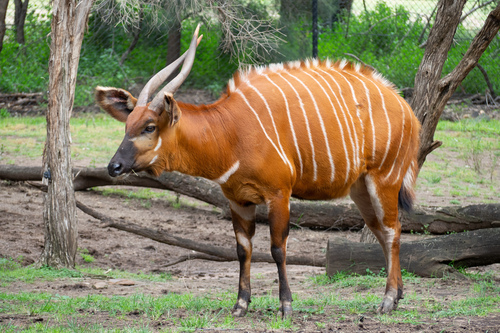
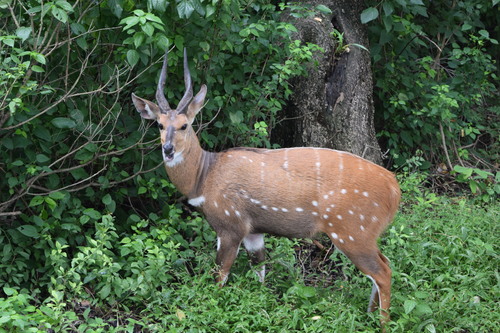
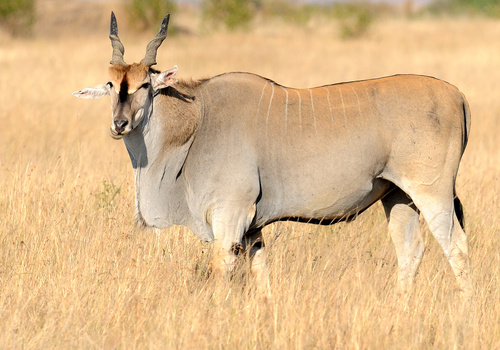
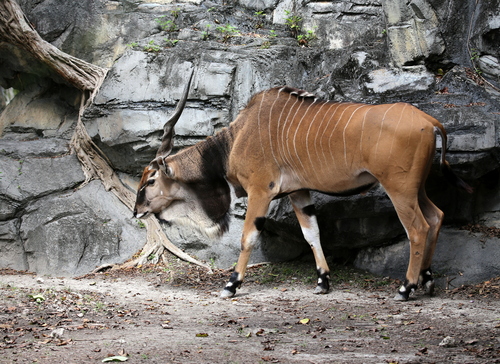
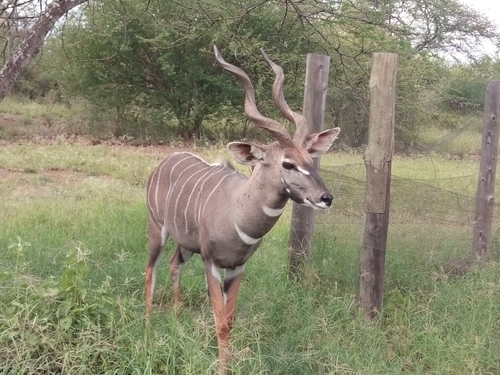
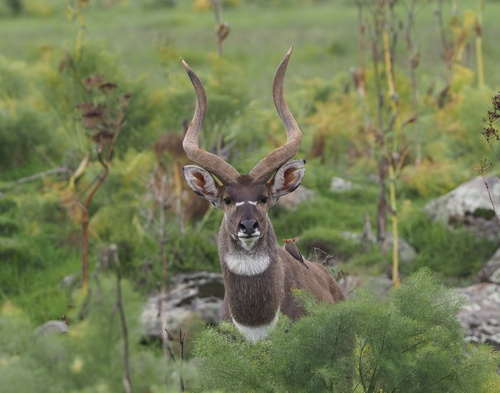
Other species in the genus Tragelaphus
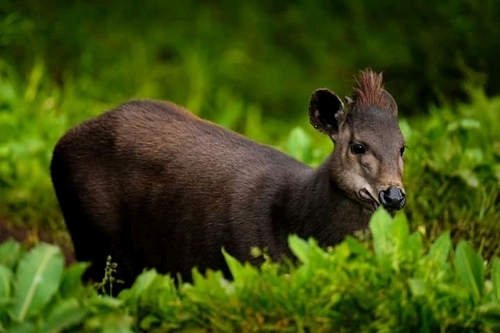
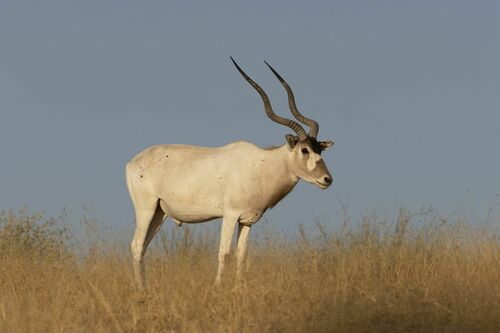
Other species in the family Bovidae
Sources
Conservation status, range description and population estimate come from the IUCN Red List assessment for Tragelaphus strepsiceros. Countries are derived from that range description, not from a mapped country list. Last refreshed on .
The distribution map is drawn from the IUCN Red List spatial data compiled in 2016. IUCN (International Union for Conservation of Nature)